Showing posts with label Wrath of the Righteous. Show all posts

Tuesday, April 11, 2017

Experiments in RPG: Wrath of the Righteous 4E?


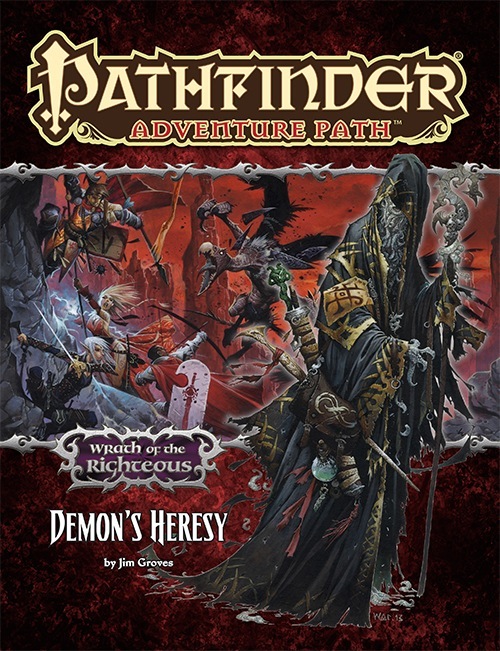
It's been a few months since We called the Wrath of the Righteous campaign. Some of it was the system as Maximum Pathfinder is something I find myself a little less interested in these days. A lot of it was the campaign itself as it really gets tangled up in itself in the latter half of the campaign. I think it's a downside to having multiple authors writing each of the six adventures as they get locked in on something they think is cool even when it doesn't really fit with the rest of the campaign. The single biggest example of this problem is that at a certain point the party pretty much has to work out a deal with one demon lord to help them against another demon lord and I mean it is assumed for the rest of the path that this is how things are. To me this is a ridiculous assumption for a few reasons:
  • Chaotic Evil - They're demons! You can't trust them to keep their word by their very nature as the embodiment of chaotic evil in D&D (and Pathfinder)! Devils, sure, that's one of their signature things, that you can make a deal with them because they are Lawful Evil. This assumes/requires that the players are stupid or it assumes demons have a different nature than I see them having based on every prior portrayal of them in D&D.
  • The Prior Campaign - It's all about killing demons! Not negotiating, not making accommodations, not mutual neutrality, but raising an army and destroying their major foothold on the world! Now suddenly we're going to the Abyss and making deals with them?
  • Lawful Good - This whole adventure path was touted as the one for the paladins and clerics and anyone else that wanted to be on the side of Right. It was an AP that would let your LG's unleash their full potential. Paladins don't make deals with demons in my eyes. Neither does a cleric of the lawful good fighting god. Making that a key point in the AP means that either someone didn't get the memo and the editors didn't catch the lapse or that everyone thought it was a good idea - it was not. 
That said I hate leaving a campaign unfinished. I have done some work re-figuring how the campaign ought to go to be more to my liking. Then I had an idea - if I am going to have to rework the whole thing anyway before I would even consider finishing it, why not fix the mechanical issues to? This kind of epic level play is exactly what 4th Edition D&D was made for! I looked at some potential encounters and how it might work and it looked completely do-able.

So I asked my players how they felt about it and they were not instantly opposed to it. We talked through some points and I'd say there is a chance this will actually happen some day. I'm not stopping my Deadlands game or my M&M game for it, but it may find a home on the schedule down the road. The characters translate fairly well and would be about 11 - 13th level. The one glaring issue is the Cavalier as there is not really a class in 4E that is all about mounted combat. That's the one part that does not yet have an easy answer but I suspect we could find something he would be happy playing that's still a big tough guy in heavy armor. 

So that's how that's going. More when it actually becomes a game. 


Monday, January 23, 2017

Something New for Monday: The End of the Wrath of the Righteous Campaign


So Saturday was supposed to be the 2017 kickoff and re-launch of the Pathfinder campaign, Wrath of the Righteous. I was thinking this new once-a-month plan would help keep things on track. I've spent the last week reviewing my notes and re-reading the remaining books in the adventure path. By Friday I was ... not excited about starting things back up. I thought about it a lot. Saturday morning I was trying to make some notes to prepare for that night's session and ... I just couldn't. I am burned out on the whole thing. After spending a lot of time Saturday morning pondering this state of affairs I can break it down to roughly 5 things:

  • Priority - We have really spun our wheels on this campaign. Sessions have become increasingly infrequent, dropping into the single digits in 2015 and 2016. Everyone says they like it but it's just not coming together regularly. It does not seem to be the priority for everyone that it started out as. 
  • Rules - I like Pathfinder but 10th-level PF core + Mythic + Mass Combat + Downtime is a ton of crunch. Playing infrequently and playing multiple characters means combat slows to a crawl and it's typically an hour, minimum, for any fight, even one that just lasts a few rounds. Some monster stat blocks are half of a full page long - later ones are a full page! The drawn-out combats are one of the reasons we set 4E aside. Now I have the same problem with a different set of rules. There are other sub-systems at play too, like item creation. Book #4 has a sub-system for gaining the attention of a demon lord in order to get an audience with her - it's not a skill challenge, it's not a specific adventure, it's a set of tasks to generate a number of points that indicates you have achieved sufficient notoriety to get a moment of her time. It's the last thing this campaign needed.
  • Remaining adventures - the latter half of the AP is increasingly distant from traditional D&D. 
    • Most of it happens on other planes  - the Abyss - and involves a ton of weird demonic monsters that you're not going to find looking through old monster manuals. I'd expect some weirdness, but it's some pretty exotic stuff and some of the stat blocks get to be ridiculously long. It's tough as a DM to figure out how to run these more complex creatures effectively when they have this many details to juggle, especially considering most of them are only going to be around for one fight.
    • It's very heavily plotted with dependencies on meeting/impressing/defeating specific NPC's to advance the storyline.  At one point the assumption is that the party will negotiate a deal with one demon lord in order to take down another demon lord. I know my players and one of them in particular is not going to just go along with that - especially not as a lawful good paladin! This is supposed to be the bigtime demon-bashing campaign made specifically for lawful good duty-bound paladin and cleric types and yet for some reason they felt the need to include a plot point like this  that is going to be a non-starter for hardcore holy avenger types. There's also a sub plot about a demon turning to good which may be interesting for some people but my crew is "demon = evil" and should be destroyed. They're not usually looking to talk with a demon because that's not why they're there: they are stopping an invasion, not negotiating. 
    • The DM advice at the front of the modules says that XP is going to be difficult to track so you should just level the party up at appropriate times. This is a tremendous failure in my eyes. "Balanced encounters" are a central concept to the game. The XP and level system is tied to that concept. Many pages in many books are spent on it and many discussions online revolve around getting this right. To recommend throwing it out and winging it partway through an AP means either your system doesn't work or that you're not trying hard enough to make it work. It's disappointing.
  • Time  - We've been playing this AP since 2013. I've been looking at these same adventure books for over 3 years. I've been looking at the same notes, the same NPC's, the same maps, for over 3 years and honestly I'm tired of doing that. There are six books in the AP and we're now averaging a year per book. I don't want to be running this same campaign in 2019!
  • Approach - I realized I am tired of running not just someone else's setting - I like Golarion and a lot of my games are set in published campaign worlds - but I am tired of running an entire campaign designed by someone else. It is full of NPCs pushed into way too prominent roles, monsters I don't care that much about, background information the players will never discover, and way too many assumptions about how the plot must proceed - assumptions my players are not likely to automatically jump to. 
Now there are some very cool things in this AP, which is why I wanted to run it in the first place. You will rescue helpless civilians, liberate a city, forge a bastion of good in a hostile land, journey to the Abyss, have the opportunity to slay multiple dragons, major demons, and demon lords, and pretty much ascend to demi-godhood yourselves along the way! 

The problem is that is just so much work to get there!


So I decided to tell my players after they arrived. I had no particular game I wanted to play, I just knew I did not want to keep playing this one. So after we all gathered around the table I talked through a lot of the points above.

They didn't scorch me. They completely understood. I admit it's a little weird to be burned out on a game you only ran 5 times last year but that's the best way to describe it. I haven;t deliberately ended 

I've talked about zero-prep campaigns here a fair amount and they do have some good points. Without Combat Manager I wouldn't have gotten as far as I did. Even with it though there's still a lot of overhead during the game. Honestly, I was spoiled by 4E's monster statblocks and how easy they were to run. I also think if you want to run demigod level characters that's a much better system for it than Pathfinder. I have evolved my thinking on this whole concept a bit: 
  • A pre-made adventure is a handy thing as they tend to be a chunk of something you can fit in to a campaign. 
  • A pre-made campaign is a mixed blessing, probably too much of a good thing. I'm running someone else's plot and characters and setting for years, potentially, and that's likely to exceed my own threshold for pre-made stuff. 
If nothing else this has helped me figure out the limits of my tolerance for longer packaged campaigns and what I do and don't like about them and that's good to know. Part of why I run games is to exercise my own creative impulses and having everything done for me removes that part of the fun. Taking one of the old AD&D adventures and fitting it into a new setting can be a creative challenge and a lot of fun, plus it's still my framework. This AP got to where it felt like I was running someone else's script and not doing a lot of the things I enjoy. So we're going to fix that - with a new game.


DM Notes:
If I was revamping the whole thing ...
  • Skip Mythic. It is really cool, but it adds a ton of overhead to both leveling up, and to actions in play. I think the optional hero point system gives you plenty of flexibility, especially when you consider the inherent powers of a fully kitted out high level Pathfiner character anyway. It's also a ton of work for the DM to manage Mythic monsters and that whole extra layer of capabilities for a creature that will typically be making one appearance only.
  • Fewer NPCs. My players are capable of talking to each other in-character. They are capable of motivating each other. For a very long time my philosophy has been that the "important" NPC's develop in play, whether it's the High King of Men or the local blacksmith that the fighter deals with after every adventure. I do not like being presented with the "lynchpin NPC" who drives the plot forward - the PC's should be doing that.
  • A different kind of Redemption: One of the main themes of the PA is "redemption" - there are various sub plots involving some NPC's in the party, a fallen paladin, a succubus, and more. I don't mind some of this but making the reformation of a demon - the supernatural personification of chaotic evil in the game! - such a major point is problematic. I would rather have seen more emphasis on saving mortal souls than those of evil outsiders who, largely being made up of deceased mortals, presumably had their chance and chose their side.
  • Additional Theme: Good is not monolithic. I would have loved to have seen more disagreement between the leaders of "good" and suggestions of alternate approaches on how to tackle the scenarios in the campaign. This would give a source of conflict within the campaign - besides the obvious one - AND it would have opened things up more to let the party have some choice in their actions. The plot of the reformed succubus is a great example as there is no mention of what other people think when the party shows up with a rescued/captured demon girl. How about those other NPC's you've been toting around for months? How about that band of 100 paladins that's the cornerstone of your army?! I can picture a great scene happening in the city square - "You brought a what back to our camp? A demon of seduction? To a camp full of men on campaign? This seemed like a good idea to you?" - that kind of thing. I could probably work it in but there's nothing along those lines in the adventure and in fact it assumes that she's a helpful and trustworthy source of information on the Abyss for the rest of the campaign!
  • Less Abyss - it's an unpleasant place. It imposes negative modifiers. It should be the target of a commando raid, not an extended visit in my opinion, yet a whole bunch of books 4 & 5 and some of 6 all take place here. Book 2 & 3 together are all about capturing, garrisoning, and rebuilding the city of Drezen in the Worldwound, then exploring the area around it. It's a really interesting part of the campaign  with mass combat, hex crawling, and dungeon bashing all mixed together. It's very old school D&D in a lot of ways. Then we leave the city and do very little with it for the next 2 books. It comes up again somewhat in Book 6 but it just doesn't flow together very well. This may be where having different authors for every volume of an AP shows.
The concept is cool and there are a lot of memorable parts, but the way it is stitched together is just not working for me any more. 

Thursday, December 8, 2016

New Ideas for 2017: Changing up the Schedule


The Pathfinder game has really hit a wall this year. By holding fast to the idea that I must have all 3 players present to run I thought I was ensuring the best game. What I ensured instead was less game - a lot less. We're in the single digits for the year for sessions played.  It's not any one persons fault either as the schedule issues have been pretty evenly spread between us. That doesn't make it better though and it's embarrassing to write it here.

I keep calling it the "main" game yet we've spent more sessions playing other games than we have my "main" game.  I've run more sessions of Star Wars  than I have my Pathfinder game in 2016. That's with two different systems but still ...

The once-a-month-game that I play in has had more sessions this year than my planned-as-twice-a-month-campaign! After talking through December schedules with my players, we won't get a chance to play again the rest of this year. We may play other stuff with a different mix of players but this particular trio is done until January.


So I have to change some things up. The plan is not working. I'm seriously thinking about cutting it back to once a month, setting a fixed weekend for it, starting earlier, and setting the player minimum to "two" instead of "three'. I spent 2016 being flexible, planning on the fly for the next game (or trying to anyway) and instead of making it easier to fit in I flexed myself right out of a campaign.

I'm looking at something like this right now:

  • 1st weekend: The Freedom City campaign. Whoever is interested and can make it can play, no player continuity required. 
  • 3rd weekend: Wrath of the Righteous

2nd and 4th weekends would be other non-gaming stuff, the once a month Kingmaker game I am playing in, and the occasional "other" game depending on which set of apprentices and friends is available and interested. Heck, I'm toying with the idea of a weeknight game again - I just have to ask each of the players if that's even an option instead of jumping on WoW or SWTOR. With one more kid graduating high school next spring it may not even be realistic but I'm still thinking about it.

If I can't run the Righteous with a two-player minimum  (They run 2 characters each. Two Mythic characters) then at some point I'm going to have to shelve it and see what else I can do. I'd hate to do it but it feels a little like I'm swimming upstream here. It's also a disappointing thought because I have other PF AP's I'd like to run. It's taken us 3 years to get to the halfway point of this one and that's with only 4 schedules to consider! 

I'm a little pessimistic now that this long term campaign format will work for us. I think a more flexible set of smaller adventures like I used to run may be the way forward - regardless of the game - instead of the sprawling epic that takes years to complete. If most of my group can really only have one regular main game - and even that is a debatable point right now - then I don't want to spend six years on one set of adventures.  I'd rather cover more ground as I have a lot of other awesome games that we could do in that time. I'd rather do six games for a year each in six years than six volumes of an AP with the same characters in that time. 

I know Savage Worlds, I know - you give a decent amount of crunch and still play way faster than Pathfinder for us.
I'd like to do something that plays a little faster too. We still spend a fair amount of time bogged down in mechanics because we don't play as often as we had planned so we don't get that sustained learning curve. It's also worse than a regular PF game as 1) They play two characters each which doubles the workload in mechanics-heavy situations like combat and 2) Mythic - it adds a whole new layer of special abilities that key off of or enable other special abilities and keeping track of those connections and abilities in play is a challenge, even  running PF Combat Manager on my side and  HeroLab for iPad on their side.  

So I don't have a great answer yet but I'm working on it. Feel free to make suggestions if you have any ideas. 

Tuesday, April 26, 2016

Pathfinder Wrath of the Righteous Campaign Update


I realized recently that I haven't spent much time talking about D&D/Pathfinder. This is a little strange because that's both where I started in RPGs and the one I am playing and running more than any other right now. Some of that is because I gave up trying to post session recaps of the campaign I am running and I decided not to talk too much about the campaign I am playing. That seems like a huge miss for my own blog. I'm still not sure I'm going to say much about the Kingmaker campaign and I'm not sure how soon the recapping will re-start, but I can at least talk about where things stand in the Worldwound.


Wrath of the Righteous just finished session #35. I would say we are about halfway done with book 3 out of 6 - it's a Pathfinder Adventure Path and that's how they come. We started in late 2013 and have had numerous interruptions that make our original plan for twice a month work out to more like once a month on average. Considering I stopped recapping with session #6 I have a lot of write-ups in the backlog. I know some people like reading them and I do like having a record of the game available on line so I will see what I can do about attacking that. In the meantime I can talk about the game system in general and this AP in particular.


The party is up to 9th level and 3rd tier Mythic. Most of the published adventure paths peter out about level 15 but Wrath of the Righteous was designed and sold as the "Maximum" campaign - characters will hit 20th level and 10th tier Mythic before the end. This is Pathfinder set on 11 and I am already feeling the effects. "Normal" Pathfinder starts to get crazy in the teens according to what other people have reported. Mythic lets people break the standard assumptions of Pathfinder in many ways and 3rd tier is where this really starts to show.  In fact, this book is where a lot of WOTR campaigns break and are ended by frustrated DM's, at least according to what I am seeing on the Paizo boards and in other places. I'm determined not to let that happen but I can certainly see why.


A big chunk of this adventure is wilderness exploration. Anyone who's run that kind of game in 3E, 4E, or PF knows what that means: novas. A lot of wilderness exploration ends up running about one encounter per day, and one encounter per day means a player can unleash his character's most powerful abilities without the controlling factor of "but I might need them later", and Mythic power only exacerbates this problem. With a Mythic boost the ranger can fire off a ridiculous number of arrows in one round, the wizard can recall and recast almost any spell when needed, and the cleric is extremely unlikely to run out of healing. Going through a smaller-scale encounter area like a dungeon or hostile city puts at least some consideration for what might be next in their heads. Losing that removes most of the constraints so that foes of what would be an appropriate level in a normal PF game melt in a round or less. One guideline I've seen is that a CR equivalent to level + mythic tier makes for a better encounter but I'm not sure about that either.


I made this problem worse on my own by allowing each of my three players to run two characters. In general I trust them to do this right and the reasoning was that 3 characters was pretty limiting, especially if someone didn't show up. The base assumption for Pathfinder adventures is that they are aimed at a party of four. For a long time I only had 2 players so dual characters was a necessity but then when my third became a regular attendee it was a little awkward to keep him at 1 pc while the others had 2. By itself I could easily manage a larger party but adding the complications of Mythic characters on top of the 50% larger party  ... it's tricky. Max enemy hit points is an easy bump. Adding more foes to each encounter does help but it also increases the complexity of the fight and that has some problems of its own. Adding Mythic levels to the opposition does make a difference but everything can't be Mythic, nor should it be. Even with Mythic, I'm pretty sure my party could take on the most powerful villains in the current book right now, several levels below where they are supposed to be.

Oh Templars of the Ivory labyrinth, how many suits of full plate will my party loot from you before we are done?
The other issue that does reduce the fun to some degree (which makes it a significant problem) is combat. At low levels PF combat was fast - especially compared to 4th edition which was our previous game. Five rounds was a long combat and even then it only took a few minutes to slice through it most of the time. As the levels go up though, characters have more and more options. Mythic increases those options. On top of that my players have two characters each to run so it's difficult to determine your plan and stick to it through a fight as you have to split your focus during each round. This also means they are not as good at knowing what their character can and should do in any given situation because there are so many options floating out there.  This means combat can take a long time sometimes. Not because it's grindy and there are more hit points to chew through, but because there are so many different ways they could go in a fight. A fight might still only last five rounds, but those five rounds might take us an hour now, instead of the ten minutes they took at level 3. We are easily back up to the same rough time as a 4E combat or a Champions combat so "speed of play" is not really the solid feature that it was early on.


I knew from the beginning that it would happen at some point and we are now at that transition: I am effectively running a superhero game. They don't really fly yet but they can make full moves and do full attacks and that's before they are blessed, stoneskinned, and hasted and those are the lower-level powers at their disposal.  Sudden Block is one of those irritating powers that the paladin uses regularly: I manage to score a hit, he uses sudden block, which means I need to re-roll at a penalty, take the lower of the two, then if I miss he gets to make an attack of his own in response on my bad guys turn! Oh - and he can do this to protect someone else to! This kind of option was common in 4E but it was less painful because everybody had interesting moves or tricks in that game - in PF that is not the case. That's just one example.  So while we're not quite halfway through the game is already shifting from a typical D&D style game. I'm not sure how I'm going to manage it but I am going to try. I don't want to cut them back down to one character each because that changes the dynamic of the party considerably. I don't want to just remove Mythic as that dramatically changes each character and I'd like to see just how ridiculous it can get. If you're a fellow DM looking for a "how?", well, I don't know yet. I've run plenty of superhero games before, just not with this set of rules. If I can make the shift in mindset then I think the mechanics will follow.


So what would I do if I was starting the AP over again? As much as I like the idea, I would probably skip Mythic Power for the PC's and use the Hero Point system from the Advanced Player's Guide. I think it gives players enough extra oomph to feel extra heroic without breaking the game the way Mythic does. I think that version of the campaign would still be a step up to "Mighty" without going all the way to "Deity".


That's where the campaign stands right now. There are definitely challenges but they are largely system challenges. My players are having a good time, I am having a good time, the story/plot/setting/background of the campaign are epic and cool and exactly what my guys have wanted to do for a long time. If I can figure out the mechanics to a satisfying degree then this will be a campaign they will remember for a long time.


Tuesday, December 1, 2015

A Week of Finishing


I took a week off last week - from work, from the blog, from as much as possible. We had all of the kids(they were all out of school), so I didn't get to stop being a grown up, but they are old enough now to make being off even more fun.

It's amazing how much you can get done when you have a nice block of mostly unscheduled time, some goals, and some determination.


  • In a manner of speaking we "finished off" my own personal miniatures and boardgame drought that's been on for a few months by playing a couple of rounds of King of Tokyo, getting in our first game of Relic (40K Talisman), and starting and finishing a game of 40K. We also worked in a session of Marvel Heroic Roleplaying for the first time in two years, breaking that drought as well! Its a lot easier to justify the shelf space these things take up when we're actually playing them and doing that made me pretty damn happy.


  • Early in the week we finished up the Hunger Games movies. Since this was the last one, I took a crash course in the story by watching the first 3 movies with Apprentice Twilight over the last couple of weeks and then the whole family went and saw the finale together. Nice. I feel that much more informed on a pop culture thing and something all of my kids have enjoyed. This month ... it's my turn (cue John  Williams theme).


  • Later I managed to finish reading the Star Trek Vanguard series. It took my quite a while as I worked in a few other books (and a lot of other rule books) in between. I really liked it, and it's by far the best set of Trek books I've read in maybe ... ever. I like the setting, I like many of the characters, I like the plot, and I like the authors (there are several) approach to the whole thing. I read a lot of trek books in the 80's and then got out of it for a long time. I tried getting back in a few years ago with some of the better-regarded book series but none of them grabbed me. This one did and I was very happy to discover there is a sort of sequel series set in the same area with some of the same characters - that's next year's read. 
Still an awesome episode
  • I have been watching Battlestar Galactica (the newer series) with Apprentice Blaster for much of this year and we were down to the "final season" of about 10 episodes at the beginning of the break and I asked him if he wanted to try and finish it up while we were off - "sure!"- so off we went with most days ending late at night with an episode or two knocked out. We finally finished up the finale about 2am one night and then talked about it for another hour. It was a lot of fun and we're already talking about what show to do next - Deep Space Nine has been mentioned.
    As far as BSG ... after watching it a second time much closer together than the 5 or 6 years it took to watch it live, I still like it a lot and hate the finale less - though it is still terribly flawed. It's easier to see the groundwork for some of the mystical stuff being laid if you know to look for it. Of course it's also easier to see the jump the shark moment which for me is when a certain Viper explodes somewhat unexpectedly. Those last few episodes are still really good though and the first half of the finale is just awesome. It does say something about the type of show it is when Gaius Baltar finally gets the girl he's been after since the very first episode while loyal Lee Adama ends up abandoned by his dad, his wife, and the girl he's loved all along. For all of its flaws I still really like the show. Now to convince Lady Blacksteel to give it a try ...

  • After 31 sessions, 18 of them in this book alone, we have finally finished The Sword of Valor, adventure #2 of Wrath of the Righteous! The campaign started in September of 2013 and we started Book 2 in June 2014. We had a lot of gaps, sometimes for months as life intervened, and it has taken way longer than it should have considering we aim for 2 sessions a month. We should be hitting session 50 or so, instead we just hit the 30's - but I can't complain too much. Having 3 consistent players running two mythic characters each (and with occasional guest appearances by other players) it's already pretty ridiculous when it comes to their ability to break the game - but we're all having a blast with it, so we will continue. I hope to achieve a more consistent pattern of playing next year and maybe we can crack 50 by this time next year, because at a year per book it's going to take 4 more years to finish this one up and Apprentice Blaster will be close to finishing college ...


  • Finally, the biggest wrap-up was Apprentice Twilight, my daughter, turning 18. The kid that originally moved me to "Dad" status is now a legal adult, is about to graduate and is headed off to college in less than a year. My kid can vote in that election next year. Time is a funny thing - some days I think about it and I can feel every single day since the day she arrived. Other days it feels like it has been a blur and I wonder when she stopped liking Barbies and where all of this, uh, "silver" hair came from. She had a happy birthday with the whole family around, and the rest of us were pretty happy too.
It was a very good week! More to come!


Bonus Finish: I also managed to finish up Season One of Agents of Shield last week and I finally like that show again. On to Season Two!


Thursday, August 6, 2015

RPGaDay - Day 6 - Most Recent RPG Played


Errr ... well that would also be Pathfinder. I ran session 28 of Wrath of the Righteous just this past Saturday for 4 players with what ended up being 7 characters, as Apprentice Red rejoined us for one session. Wow ... I have only written up 6 of those? I have a lot of homework to do there. We shook off the cobwebs and should be back on track for next time later this month. I have no idea how long this AP will need up taking us to play through in real time but as long as everyone is having fun who cares?

Thursday, January 15, 2015

Wrath of the Righteous - Session 6a: Into the Ruins


Our Heroes (Level 2):
  • Relyn Steelguard, Paladin of Iomedae
  • Graidin Cratchet, Wizard
  • Arken Surien, Cavalier of the Order of the Lion, in service to Queen Galfrey of Mendev
  • Jaren, Dragon Sorcerer 
  • Phalcon, Cleric of Erastil
  • (+Delanour, Ranger)
  • (+Arken's Horse, animal companion)
Moving into what's left of Kenabres the group discusses priorities:
  • Anevia (ranger, still limping) says "I must find my wife! I hope she's safe!"
  • Aravashnial (wizard, still blinded) says "Take me to the library, we will find aid there!"
  • Horgus (merchant, still annoying) says "Take me to my manor house - I will pay you well"
The heroes, having only recently arrived in the city, have no particular attachment to any person or place though there is discussion about heading for a temple or one of the guard stations. They reach no consensus but decide to seek better shelter in the city and scout things out. 

Other eyes are watching - as the group moves along an open stretch of road, a flock of fiendish vultures descends and attacks! In the fight Arken's warhorse trots up, seemingly in fine shape - what a stroke of luck! The vultures are dispatched, and the group decides to look for citizens to find out what has happened in the past few days since they fell into the undercity. 

Pressing on, they soon see a small tailor's shop that looks largely intact though there is the sound of smashing coming from inside the wide-open front door. Investigating, the team sees a man-sized ratlike demon tearing the place up. Relyn and Arken are having none of that so they charge in and take out some anger on the creature, avoiding it's nasty claws and slaying it with no mercy.

From a back room come the shopkeepers, a married couple named Belthis and Neera. They are extremely grateful for the party's rescue and offer to share food and news if the group will spend the night. This seems like a great idea to our heroes and they pass their first night on the surface catching up on recent events.  

During the night they learn much - the Kenabres wardstone has been destroyed, the Kite, the fortress that held it, has also been destroyed, cultists came out of the woodwork, some of the crusaders have gone mad, there are demonic bugs all over the city, many people have been possessed, and the water may have been poisoned. The one hopeful bit of rumor is that Queen Galfrey is on the way at the head of an army but no one knows when they will arrive.

The next morning the heroes decide to head for the Blackwing Librarium. Aravashnial describes it as a center of arcane learning for demon hunters and the others back him up. It's probably the closest of the several potential destinations so they might as well head there first. 

Belthis and Neera have also come the realization that they cannot stay in the shop any longer so they gather up their things and prepare to leave with the party. 

Leading this rag-tag fugitive band of refugees, the group comes across a group of Baphomet cultists - a familiar sight from below -  about to sacrifice a man in broad daylight. Without hesitation the heroes attack. Graiden uses sleep magic on three of them, Relyn engages another, and Arken finally gets to unleash a mounted charge on another, killing him in a single sweep. The victim turns out to be a ranger from Mendev, scouting through the ruins to try and determine who is left. Reclaiming his gear from nearby, he joins the group figuring that Blackwing is as likely a place as any to have survived.

Pressing on, the party makes its way to what was once the famous Blackwing Librarium. It now lies in ruins. From the open front door a voice bellows loudly "... stack the damn books higher!" It does not look good ...

DM Notes: With a small group of players, any absence is felt keenly. Dave and Red both had upcoming (and past) schedule conflicts so Blaster made a second character, a ranger. This also seemed like a good opportunity to work in the cavalier's horse, so both showed up this session.

This was the beginning of an especially fun part of the campaign as the ruined city is pretty much a sandbox - the party can go wherever they wish. The NPC's each have an agenda but the players don't have to accommodate it. It's a refreshing change after the relatively limited set of choices in escaping from below. A city just destroyed by demons is a pretty interesting type of post-apocalyptic setting and I hope they enjoyed it as much as I did.

A word on structure: normally I try to write one recap per session but a lot went on in sessions 5-6-7 so I'm splitting some of them up into multiple entries. More to come!

Wednesday, January 14, 2015

Wrath of the Righteous - Session 5: Out of the Darkness


Our Heroes (Level 2):
  • Relyn Steelguard, Paladin of Iomedae
  • Graidin Cratchet, Wizard
  • Arken Surien, Cavalier of the Order of the Lion, in service to Queen Galfrey of Mendev
  • Jaren, Dragon Sorcerer 
  • Phalcon, Cleric of Erastil

Checking one last door in the upper level the party finds a sort of open well leading to an underground river. Figuring there might be something interesting, they decide to climb down. Poking around down there they discover a secret door that leads to a hidden room off the river. Webs? No problem! Dust? No problem! Old wooden chest against one wall? No problem! Hidden spiked pit trap? Problem! Well, not so much as the clumsy cavalier only takes a few scratches, then it's time to escape with the loot. We'll call that time "fun with climb checks" as armor and the loot combined to make for some entertaining moments in what seemed like a pretty easy task initially. 

The pair of cultists that almost laid the cavalier low back in Session #3 were actually guarding a door in the ceiling. Last time The cleric and the NPC's (the blind, the gimpy, and the greedy) had stayed back to watch it while the rest of the party explored the rest of the rooms on their level. Now, it was time to climb the iron ladder on the wall and see what was up there.

First up was a rats' nest inhabited by a trio of giant rats which were dispatched with very little effort.


Next was another guard post in front of a rusted iron door guarded by the two biggest mongrelmen they had yet encountered, looking even more mutated than the others. Alerted by the final squeaks of the rats, they were ready for the heroes. The paladin and cavalier worked well as a team, moving up together and attacking the same target. The sorcerer and the wizard did likewise. The cleric was still finding his feet and when he tried to maneuver around one of the mutants and paid for it when the beast clocked him and dropped him in one solid hit. He survived, but he wasn't happy about the skirmish. Examining the area, the party realizes it's set up more to defend against something coming through the door rather than something coming at the door from this side. Unsure of what lies beyond but undeterred regardless, they open it.

With a shriek of rusted hinges the portal opens and beyond it the heroes see a large worked stone chamber, arches soaring overhead at the edges of the torchlight. This may be part of the foundations of the city - progress! There is also newer, cruder work in the center of the room, limiting access. It might have started out as a defensive wall but is now the outside of a maze, presumably constructed by the mutants as a defense against intruders. They move in, somewhat excited to be visibly closer to the surface but also wary of what those guards were guarding against ...

They quickly encountered the inhabitants of the maze - a pair of smallish apelike demonic beings who charged them with weird hooting noises. They were not physically terrifying but they were unnaturally tough, and the rude noises and nauseating clouds they created were a step beyond the mere visual weirdness of the mongrelmen. One of them cast some kind of foul spell that made Arken run in fear, though Phalcon managed to calm him down and return him to the fight. In the end they slew both creatures with no serious harm to themselves.


With the demonic stinkbeasts slain, the heroes scout ahead and find a series of tunnels leading up. They return to the guard room and bring up the Anevia, Aravashnial, and Horgus. Pressing forward again they make their way upwards and eventually emerge from the city sewers to breathe clean, fresh, air once again as the sun rises over the smoking ruin of the crusader city of Kenabres. They are out, but maybe they were better off below ...

The battle for Kenabres did not go well - in fact it wasn't really even a "battle"

DM Notes: Figuring out the logistics of getting a couple of characters down a rope and into a secret room had a very old-school feel to it, despite the plentiful use of skill checks. The pit trap was pretty old school too, except I rolled a "1" for the falling damage, a "1" for the number of spikes, and followed that with a "1" for the actual spike damage, for absolute minimum possible damage. Sometimes the fun just drains away as the rolls come up.

The rats were not even a challenge as the first 3 characters up the ladder killed one each. For the guards though I used "advanced" mongrelmen and those proved to be a bit tougher, enough to make for a more interesting fight. The barricades used at all the guardposts in this area required a little more thought and maneuvering from the party  than the usual charge-hit-kill you might see in an otherwise empty room.

Dretches in a confined space were fun. They have a lot of resistances so they don't croak on the first hit or two, and they have fun little spells like cause fear and stinking cloud. They tend to be minions or nuisance monsters at higher levels but at 2nd they were a nice little challenge. 

At the end of this session our heroes are now out of the dungeon and back in the city. The "intro" part of the adventure is over and the somewhat sandboxy part begins as they make their way through a ruined city trying to figure out where to go and what to do, both for themselves and with this group of hangers-on they've picked up along the way.

Tuesday, January 13, 2015

Wrath of the Righteous - Session 4: A Light in the Darkness


Our Heroes (now level 2!):
  • Relyn Steelguard, Paladin of Iomedae
  • Graidin Cratchet, Wizard
  • Arken Surien, Cavalier of the Order of the Lion, in service to Queen Galfrey of Mendev
  • Jaren, Dragon Sorcerer 
  • Phalcon, Cleric of Erastil (who is not present for this session)
We begin in the room of the two cultists. After the fierce battle in the last session, a fair amount of time is spent sorting out who is where, searching these rooms, healing, determining who has a light source (the sorcerer and the cleric both have spells, others have torches), and generally getting back on track. Phalcon, Anevia (NPC ranger), Horgus (NPC merchant), Aravashnial (NPC wizard), agree it's best to wait here while the others investigate the rest of the mongrelman lair for cult activity.

Moving back into the room of the cave lizard fight the heroes try another door and find a bow-wielding mongrelman in the room beyond. They rush him and he is quickly overwhelmed.


In this room is a trap door and with absolutely no stealth they drop down into another well-defended guard post. The two mongrelman guards call for aid and two more rush in, making for a good-sized fight in a small-sized space. The wizard uses Daze to good effect while the sorcerer goes old school and kills 3 with his spear while the cavalier and paladin charge in.

Investigating further, the party moves in and surprises a human woman - clearly some kind of cult leader - and her tiefling bodyguard in her quarters. A fairly tough fight follows where the cult leader - Hosilla - and the paladin and the cavalier take turns scoring vicious hits then missing completely but eventually she falls, and her bodyguard doesn't last much longer. The subsequent search of her room yields magic scrolls, potions, wands, and a very well-made wooden case - inside is a very fine blade: Radiance, a magical sword once wielded by a famous heroine. Relyn takes up the weapon, instantly knows he has something special, and a bond is formed.


They also find a letter from one "S.V." to Hosilla giving her orders - now thwarted - and mentioning three safe houses used by the cults of Deskari and Baphomet in the city. Armed with this information, our heroes are eager to return to the surface and take some kind of action to try and begin re-balancing the scales towards good.

Thursday, January 8, 2015

Wrath of the Righteous - Session 3: Duels in the Dark


We begin at the entrance to the village of Neathholm, deep beneath the city of Kenabres, on the border of the Worldwound. Our heroes (all 1st level) are:
  • Relyn Steelguard, young Paladin of Iomedae, (longsword and shield)
  • Graidin Cratchet, aspiring Wizard (hand of the apprentice staff-tossing)
  • Arken, newly minted Cavalier of the Order of the Lion, in service to Queen Galfrey of Mendev (longsword and shield)
  • Jaren, Dragon Sorcerer (claws)
  • The Cleric with No Name of Erastil (spell and bow)
(Red was busy so Jaren peels off in the village and doesn't take an active role in this session but we added a new character, a cleric of Erastil, played by one of my longtime players, Dave.)

Lann leads the party past the guards to meet Chief Sull, leader of the mongrelmen village. A nice bit of roleplaying follows where the party actually treats an NPC with some respect - that's a relatively rare event here. The conversation covers a little history, a little current events, speculation on the reason for the cave-ins and the demon attack, and some personal details. The chief is impressed enough to offer the aid of the mongrelmen in the defense or retaking of the city. They are descendants of the first crusaders and they feel that they have a duty to assist. This should be good news if the group can ever get back to the surface.

Then the conversation turns to what lies between the party and their return. The nearest path to the surface is blocked by a tribe of hostile mongrelmen who have turned to evil and who have been consorting with demon cultists. Things go well enough in the discussion that the chief offers the party some healing potions and his trusty enchanted morning star from his fighting days to help the heroes clear a path through the fallen mongrels. While the party clears out the miscreants, his warriors will spread the word to the other tribes so they will be ready when the call comes. At the end of the discussion everyone shakes hands and retires to prepare for the next day.

Rested up, the party moves out, intending to wipe out the pocket of evil that lies ahead and finally -finally! - return to Kenabres. Deciding for once to scout ahead carefully, the wizard drinks an invisibility potion, moves up and casts Sleep on the two-man guard station that he has discovered. One guard drops but the other resists. Graiden is out of ideas and so calls for help and the Paladin charges in, hurdling the barricade and striking out at the remaining guard. The Cavalier is right behind him and manages to finish the mongrelman off.

The rest of the group (including NPC's Anevia the gimpy, Aravshnial the blinded, and Horgus the unpleasant) shuffles forward and while debating how to proceed Relyn the Paladin detects evil through the door, senses it, and kicks it in.

This is some kind of common room and while there is a fire pit and some bedrolls there are only two unfortunate mongrel-traitors in the room and they are clearly overmatched but they open a door and let in a large pinkish cave lizard that makes things interesting. Soon enough all 3 are down (with the help of a summoned Celestial Wolf). There are several doors in the room and the party decides to check the one to the north.

This time the Cavalier charges in but it quickly becomes apparent that the opposition knows what they are doing this time. The inhabitants of the room are a pair of armored humans, a male and a female, wielding glaives and using some actual tactics. The girl maneuvers Arken away from the door while the male steps in and blocks the doorway behind him, holding off the rest of the team. A vicious two-part battle takes shape as Arken attempts to duel his opponent (who is clearly a little better than he is) while the Paladin and Cleric attempt to fight their way in to aid him. Graiden manages to summon a Dire Rat into the room but it does little to change the circumstances of the fight.

Finally, Arken tires and the female bashes him with the butt of her glaive, dropping him to the floor. Before she can do him any further harm though, her companion goes down with a gurgling cry as  the Cleric cuts him down and the Paladin rushes in, shoving her away from Arken's unconscious form. Already battered form her duel with the Cavalier, she is in no shape to fight fresh opponents and is quickly slain.

The rest of the party moves in and checks out the room (some kind of trophy room decorated in dead animals) and get Arken back on his feet - he is more than ready to continue their crusade.


DM Notes:

 I said it before:
The NPC's the party is saddled with at the beginning are a mixed bag. It's good to have living, breathing setting hooks right there in the adventure and it's very disaster-movie-esque having a random group of strangers thrown together after a catastrophe but it's cumbersome for me as a DM to have three extra party members to manage regardless of their impairments. If this was happening later in the campaign it might be less of an issue but having it right at the beginning with higher level NPC's running alongside 1st level characters it's an odd mix of baggage and advantage and just more stuff in general to keep up with. I think one character would have been enough to convey the info with less overhead but we are past that now. For the moment they are sort of "pokeball" NPC's - they stay back out of combat until it's over then come in and impart useful information if they have anything relevant to the current area. 
...and my feelings haven't really changed. It's still not how I would handle it but I'm going with the flow.

There were really two main parts to this session:

First, the interactions at the village, mainly with the chief. This was fun and while it didn't take a whole lot of actual time it felt "right", like the kind of thing a band of good-aligned adventurers on a quest would do. I am amazed at how easily my players fall into the flow of this adventure - that's been a very iffy thing with published adventures I have run in the past but this one seems to be right on their wavelength and it's working really well.

Second was the invasion of the evil mongrelman outpost. They blew through the first 4-5 rooms in the place and once again the contrast in speed of combat with 4E is pretty strong. I like my 4E but there is no question that we are getting more done in a session with this game than with that one. 

They had been having a fairly easy time of it but the last fight with the two cultists was more challenging. I played them with a little more tactical finesse because a) they are classed opponents with two levels, trained fighters as opposed to mutant-man grunts and b) the noise of the previous fight certainly gave them a warning and time to prepare. So they did.

This was not a really long session but it was a lot of fun and got us that much closer to seeing daylight again. Hopefully the next session will get us across that particular goal line and set up the rest of "The Worldwound Incursion".

Wednesday, January 7, 2015

Wrath of the Righteous - Session 2: The Dwarf in the Dark


We begin in a long-lost shrine of Torag, deep beneath the city of Kenabres, on the border of the Worldwound. Our heroes (all 1st level) are:
  • Relyn Steelguard, young Paladin of Iomedae, (longsword and shield)
  • Graidin Cratchet, aspiring Wizard (hand of the apprentice staff-tossing)
  • Arken, newly minted Cavalier of the Order of the Lion, in service to Queen Galfrey of Mendev (longsword and shield)
  • Jaren, Dragon Sorcerer (claws)
After cleansing the shrine the party is fully healed and feeling ready to continue their climb to the surface. They spend some time talking to the other party members and learn a little bit more about them. 
  • Aravashnial seems to have come to grips with his blindness and has warmed up to the party as well. he offers to use his magic as best he can given his current state. 
  • Anevia too is more talkative and is now armed with a bow so she can aid in battle even if her leg keeps her from charging in.  
  • Horgus Gwerm is still scowling about the whole situation and is only interested in getting to the surface as quickly as possible. He does not appear to have any skill in combat or with magic and is depending on the party to get him out, which seems to chafe him even more.
After moving ahead for a time they come to a sizable cavern. Within, the heroes notice the walls are carved with depictions of armored figures dating back to the first crusade. Then they are ambushed by a a pair of flying tentacle monsters. Jaren is engulfed and drops after a brief struggle while Relyn and Arken attempt to cut the things apart. Graidin uses some minor magics and also finds his staff quite useful. In short order the beasties are slashed to ribbons and the group takes 5 to revive the beaten spellcaster.

The only way out leads to an adjacent cave, also large, where the glowing remains of a campfire can be seen. from the entrance. What is not seen is the levitating dwarf who opens up with a color spray as the team enters the cavern which floors most of the party. Arken remains conscious and charges in, using his dragon scale (see below) to levitate up and engage the dwarf. Anevia fires a few bow shots from the entrance but has a hard time connecting. In desperation, Aravashnial summons a celestial dire bat and sics it on the dwarf as well. Even though he is levitatedblurred, and mage armored, Millorn the insane dwarf wizard is not going to last long against that kind of firepower (longsword CHOP! celestial dire bat SMITE!) and he soon falls to the ground, extremely dead. After reviving the rest of the party and searching the camp (spellbook!) they press on.

Leaving the dwarf-cave the passage begins climbing - finally! Time and distance pass and the group eventually comes to another cave with what appears to be a collapsed tower in the middle. Near it, two humanoids are pulling a third from the rubble. Somewhat to my surprise the party approaches cautiously and tries to communicate with them! After a quick conversation in broken common the fighters are helping to pull a battered humanoid from the wreckage and making some new friends. 

The beings are tough to look at, being a mix of various creature types. The leader, introducing himself as "Lann" appears to be a mix of elf, goat, and lizard and the other two are equally exotic. As they bandage up Crel (the injured humanoid) the mongrel people share that they have a village nearby. The new ruin was a watchtower located here because one of the passages leads to their village. It collapsed in the earthquake and they are concerned that their village may have suffered also and they wish to return to it as soon as possible. If the party wants to travel with them they would appreciate the help and would happily share food. Our heroes agree to this plan.

Moving out with their new friends the party makes good time. As they approach the village though a new problem arises: the tremors have split the passage ahead with a chasm. The mongrel-people know this is the most direct route home and are desperate to find a way across. Undaunted, our heroes work out a solution involving crossbows, a lot of rope, and the magical levitation scale that works for everyone, even the injured members of the party. Taking their time, everyone is moved safely across and then the group makes their final approach to the village.

(In Session 1 the party found some silver scales, fallen from the silver dragon who was slain during the attack on the city. Each of them has some minor magical effect. One of them is "levitate", which came in handy during this part of the adventure.) 

Lines of the session: 
"Perception? Ok - nat 20! ... So that's a 21 total"

(A few minutes later)

"Diplomacy? OK - nat 20! ... So that's a 19 total"


DM Notes: 

The NPC's the party is saddled with at the beginning are a mixed bag. It's good to have living, breathing setting hooks right there in the adventure and it's very disaster-movie-esque having a random group of strangers thrown together after a catastrophe but it's cumbersome for me as a DM to have three extra party members to manage regardless of their impairments. If this was happening later in the campaign it might be less of an issue but having it right at the beginning with higher level NPC's running alongside 1st level characters it's an odd mix of baggage and advantage and just more stuff in general to keep up with. I think one character would have been enough to convey the info with less overhead but we are past that now. For the moment they are sort of "pokeball" NPC's - they stay back out of combat until it's over then come in and impart useful information if they have anything relevant to the current area. 

The darkmantle fight was fun. I haven't really seen them in 4E but they were an early "signature" monster of 3E so it's nice to see them again. Steve knew what they were but the boys had no idea and were worried about the flying octopus monsters, particularly after one took down the sorcerer. This fight gave us the opportunity to re-familiarize ourselves with the concentration rules and the dying rules so it was very educational.


Millorn - this was a fairly swingy fight. Color Spray is nasty but after that he doesn't have a lot of attack options other than that old wizard staple "light crossbow". This is one place where having the NPC's along did help as it gave the players with downed characters something to do. Firing into melee is still challenging but it's better than nothing. The NPC wizard is blinded which is pretty impairing but he is a summoner so many of his spells do not have a target. I ruled he could summon a creature right next to himself but not at range. The combination of "half of party down during the surprise round" and "target out of melee reach" caused them to hit the panic button and yell at Aravashnial to summon "the biggest thing he can" - which he did, which led to the inevitable harsh-voiced Batman impressions all around the table.

Mongrelmen - In any other universe they would be "mutants" but here they are "mongrelmen". I was glad to see these guys show up to as I have not seen them used in many adventures since their debut in "Dwellers of the Forbidden City" a long time ago. This is the perfect place for them and they make for fine low-level allies and enemies that are not overly familiar to the players. The adventure sort of assumes that eventually the party makes friends with the mongrelmen, either here or at the village though it is not strictly required. I was fairly sure we would have a "misunderstanding" here at first but I underestimated my players - they are playing knights after all! Chivalrous behavior came to the fore and made for a much better session than plowing through a few more monsters.

In 4E crossing the chasm would have been a skill challenge with relevant skills already determined. Here it was far more free-form and I let the players come up with their own solution. It was a solid one, with contingencies for failed climb checks and a lot of good work. I was very happy with the way this went. 

In fact, this was a really good session with a nice mix of combat, poking around, and interaction with NPC's. My players exceeded my expectations and we got a lot done. One of the "first time all over again" experiences I am having with Pathfinder is that combat moves quite quickly. This is the lowest level of the game but the point stands. It allows us to run through quite a bit "more" in each session and that's been really nice. We probably spent more time on crossing the chasm than we did on any single combat this session and I like that.

Tuesday, January 6, 2015

Wrath of the Righteous - Session 1: Down in the Dark


Note: There are spoilers below. There are always spoilers in my summaries but since this is a new adventure series, not an old one or a homebrew I thought I ought to specifically mention this.

Heroes gather in the crusader city of Kenabres on the edge of the Worldwound. The annual festival of Armasse draws in scholars and warriors from all over the region. Among them are four of special note:
  • Relyn Steelguard, young Paladin of Iomedae
  • Graidin Cratchet, aspiring Wizard
  • Arken, newly minted Cavalier of the Order of the Lion, in service to Queen Galfrey of Mendev
  • No-Name, Dragon Sorcerer
After gathering in Clydwell Plaza at noon for the opening ceremonies for the festival the characters find themselves awakening in darkness, battered and covered in dust. Their memories gradually return as they begin to  collect themselves. As the festival was about to begin, there was an explosion, then a mighty flame and lightning wrapped Balor swooped in as the silver dragon Terendelev threw off her human shape and blasted out of the crowd to meet it. Things went badly from there, as more demons appeared, some of massive size, smashing buildings aside. As the crowd scattered, the dragon was taking the worst of it, but still managed to magically break our heroes fall as the square collapsed. While the darkness closed in, the last sight for the plummeting crusaders was the demon warlord hoisting the severed head of the dragon for all to see.

Now, awakened, battered, and worried about might be going on above them our heroes discover that most of the people around them are dead, though a few have survived. One, a female human scout has a broken leg. Another, an elven mage was blinded by a demonic slash. A third human male seems to be physically undamaged but has a rather unfriendly attitude and is anxious to find his way home. The group pokes around the rubble, splints her leg, finds her a crutch, and bandages the wizard's gashed eyes. They also decide to travel together to find a way back up to the city.

Exploring the caverns beneath the city is a slow business, and there are signs of the upheaval everywhere, but they do make progress. Though some vermin is dispatched and Relyn suffers a venemous snakebite, there is no sign of civilization until the party discovers a small shrine to Torag. The shrine turns out to have one "inhabitant" - the skeletal remains of its builder and priest who is now an undead creature! The foul thing is destroyed quickly and the party tries to set things right, even though none of them follow Torag. That night they dream about the shrine, and the life of the sole dwarf who chose the spot, built it, and worshipped in it alone for decades until despair and madness turned him from his path. The next day the heroes take their time restoring it to a proper state before moving on.


DM notes: This was the first part of "The Worldwound Incursion" and it kicks things off with an "en media res" style introduction. Knowing that 1st level PC's are not really up for a frontline role in a demon invasion, they get dropped into the mysterious caves beneath the city and have to find their way up into the  light again. It's not really a railroad as it happens before the game starts, and that makes the difference for me.

The NPC's in the adventure stayed mostly in the background as my players are old school and don't have a ton of use for them. They did arm the limping female with a bow so she could keep a lookout, and there was some conversation but their focus is on getting out, not making lifelong friends and I'm not going to force anything on them. I present what's there, the players act as they see fit.

This adventures does not have the usual kobolds or goblins as low level opponents. It starts out with mostly vermin type monsters and that's what they fought. Combat in PF goes quickly at low levels so I won't go into round by round details - no PC's or NPC's died. The poisonous snake gave us a chance to refresh on PF's poison rules but the Paladin survived without too much drama. Staying overnight in the shrine also let us review the healing rules - to some dismay. We'll just have to see how that holds up.

Production-wise I'm running this one with Hero Lab for character building  then Combat Manager for running the fights. As we started the first fight I realized that I didn't have a file for one PC as he had made his character in PC Gen. No problem - I whipped him up in HL in maybe 5 minutes and threw him right in too. It's a different kind of prep work but it's still less hassle than printing out my monster stats and notes. Also: No DM Screen, all open rolls. It didn't make a huge difference in this session but it might down the road.

Overall it was a good session, the players got along alright, and the mechanics were not a problem. We're all looking forward to the next session and there is a chance one more player joins in - who is already being pressured to bring in a cleric, for for it's thematic appropriateness and for the healing. Session 2 is this coming weekend so I'll post about it next week.

Monday, January 5, 2015

Wrath of the Righteous - Pre-Campaign Warmup

This is a little bit of a cheat as it's a re-post of an entry from September of 2013. I thought it made sense though - if I'm going to recap the whole campaign this month I might as well start at the beginning. As of today we've had 22 sessions of the campaign and I expect we will have one or two more this month. I write these up mainly for myself and my players, but I share them on the off chance someone else will get some entertainment or inspiration out of them. See the end of this post for my comments after running for more than a year.


In case it might help someone else here's what I've been doing to get ready for the WoR campaign.

Rules Stuff - it has to be addressed so I tackled it first:

  • Ability Scores: Pathfinder has several options for generating ability scores. As much as I like rolling the dice for this I thought we would try the new-school approach and make this another set of "interesting choices". I went with 20 points, which in PF terms is "High Fantasy". It gives good but not godlike scores, typically 16/15/13/12/10/8 or 17/14/12/12/10/8, slightly lower if someone wants to get rid of that 8, or more peaky if someone wants a full 18 before racial bonuses.
  • Races: Core Book, standard D&D races. There are a lot of options for swapping out racial abilities in the Advanced Players Guide and I would probably let someone take them if they were interested but it didn't come up.
  • Classes: Core Book + Advanced Players Guide. I included the APG mainly to bring in the Cavalier, which fits the theme of the adventure almost as well as the Paladin. I'm not a fan of all of the classes in this book, but I don't have to play any of them so it's not a real problem. When we get to the prestige class levels I'll probably add some more books to this list.
  • Traits: An optional Pathfinder thing that ties into one's background, I kept them optional. Most of them took at least one and a little more flavor doesn't hurt.
As far as the rules in general I don't have enough experience with these rules to feel the need to change anything yet. I'm not going to try and solve problems that haven't come up, so we're going as-is for now. The only potential wrinkle I can see is that non-magical healing is almost as slow as in 3E and I find the whole "we'll just spend another day resting up to heal" to be a real momentum-killer in the middle of a time-sensitive adventure and throwing extra random encounters at the party to get them moving again is risky at the low levels. I'm going to ride it out for now and try not to make assumptions based on the older edition's rough spots.


Tools:

I am deliberately choosing to run this campaign using Hero Lab/PC Gen + Pathfinder Combat Manager instead of my usual on-paper approach. I've played around with it on some superhero games but not really used it for D&D. This changes some of the session prep work as most of the monster stats are already available, but I have to "build" the NPCs to use them. This is actually a positive as it means I am much more familiar with their capabilities after rebuilding them as it seems to stick better for me than just reading it off the page. It also means I can see what kind of shape my PC's are in during a fight and what resources they have expended too. So far I am enjoying it a lot.

Also, I'm not using a screen for this one. I always use a screen - except for ICONS - and have for years. This time it's rolling in the open, let the dice fall etc etc. I'm not big on fudging anyway, and with most of the monster stats on the laptop screen there's not much to conceal. I'm looking forward to seeing how it goes.


Prepping a Published  Adventure:

I read it once all the way through before doing anything else for the campaign This initial read-thru is really just to see what it's about - I read it about like I would read a book. Does it look like fun? Does it make sense? Is there any stupid sh*t  or things my players are going to hate in it?

Most of the things my players hate boil down to "forced railroading", stuff like the trap or fight that automatically knocks everyone out, etc. Most of the stupid sh*t boils down to a plot pivot or a writer being overly cute. I'm sure most of you know what I mean.

This adventure had no real problems. It begins with a somewhat forced situation and is fairly linear but then pretty quickly widens out into a sandbox set in a ruined city before focusing back down to a major confrontation with evil. I'm willing to accept a narrow beginning to kick off a new 1st level campaign and I like that it eases up soon after. The structure is good, the events taking place are interesting, and it does feel like there is a point to it all in my opinion.

A week later I read through the first half again from a "what are my players going to be doing" perspective. I look at how much plot and how much freedom the players will have. I look at traps and monsters to see what's in the mix, stats,  and how they might work together. I look over the maps and see how everything connects, sequences of  and if I understand the layout of each dungeon or wilderness area or city. 

Maps are critical. For a dungeon, maps show the connections between encounters and pretty much define the choices available to the players at any given time. Maps are also where sandbox adventures tend to fail, whether it's a printing error, a disconnect between the key and the map, or a simple lack of clarity. If I look at two maps and can't tell how Map A connects to Map B (where are the stairs to the next level? Where is this building on the city map? Where is this monster lair on the overland map?) then it's a problem, and it happens more than it should.This adventure looks good so far.

Monsters are important but are easier to replace or fix than almost anything else. I think I have spent 57% of the last 3 years of game time running kobolds. From Basic to 4E I have run kobolds. If this adventure featured kobolds I was probably going to swap them out. Fortunately this was not a problem. There are also plenty of notes about how different enemies in certain areas will cooperate, or not, and why, and that's how it should be.

One somewhat different aspect is that there are some NPC's that go along with the PC's for the early part of the adventure. They are higher level, but each is handicapped in some way so as not to overpower the party. they are capable enough to not just be helpless victims, but their individual problems keep it under control. The whole point is that the PC's relationships with the NPC's as it develops during the early adventure can open up some good and bad things down the road. It's interesting, but I' m glad it's limited and not assumed to be continuing all the way through the thing.

The only thing I didn't really like - and that's probably the wrong word - was that there is a heavy focus on one or two NPC's gender and orientation. I don't care about it on the surface, but instead of "like" let's say I think it's overkill and largely a waste of space for an NPC in a D&D game. Current gender is relevant, sure. The fact that it used to be different doesn't seem relevant at all as I can't see that coming up in a convrsation with strangers (the PC's) in the middle of a fight with monsters. Orientation, well, frankly that doesn't come up much in my games and I can't see a campaign that focuses on a desperate, heroic crusade to stop a demon invasion having a whole lot of time for worrying about that anyway. Sure, go ahead and note that these two female NPC's are married (and faithful), fine, but I don't know that I need a full page or more of text describing the entire history of their relationship. It's not a huge problem but it seemed like an odd sidetrack for an otherwise tightly written adventure.


Anyway, this one is a good one and I don't really see a need to change anything. Sure, I may retcon some relationships between certain PC's and NPC's as they are encountered, but the maps are solid, the monsters are not the usual fare, the plot stuff makes sense, the sandbox part is handled well, and the NPC's are well done. I don't mind a little railroading to kick a new campaign off "en media res", especially with a new mix of players and a new system to worry about. 

If I was changing something I typically use post-it notes on the relevant pages or I just rewrite the entire section in my notes and note that down in the book. I haven't needed to here yet but we'll see what develops in play.

Finally, a day or two before the first game I went through the entire adventure and made sure the monsters were all available in my tool of choice (Combat Manager) and if they were not (such as some of the monsters with class levels) then I built them in the tool. It's a little work but it's fun and makes things a lot easier during the game. The same goes for the friendly NPC's too - if it has stats it goes into the machine.

That might seem like a fair amount of work but it doesn't feel like it - and if it does then that's a warning sign. For me knowing an adventure inside and out is the key to a successful run. Writing your own means you are automatically familiar with it. The published stuff has a lot of advantages but this is not one of them - you have to make it your own on some level. Reading it, making some notes, putting some stuff into a program - this is what works for me. I'll let you know how it plays out.

Notes as of January 2015: 

Rules-wise I'm pretty comfortable with Pathfinder now. I'm not particularly worried about any classes or races. Healing has not been an issue because they have enough magical healing, and enough time between most of the big encounters that it has not been a problem.

Adventure-wise I still think they made some odd choices as to how to spend a limited page count but it didn't slow me down. I have de-emphasized the NPC's quite a bit, especially in the second part of the campaign where some of them accompany a PC-led army into the Worldwound itself. There is enough action with my 4-6 player characters that I don't need manufactured NPC drama to make it "better". I've ignored most of the sub-plots and just played them straight for the most part. The campaign is epic enough without a lot of side story time.

Process-wise I think HeroLab + Combat manager is an amazing way to run things. I spend very little time doing "homework" between games. I keep some notes during the game but that's about it. I get to focus on what's happening now in the game and less on numbers and managing the flow of things. I had a long post on the details here if you're interested.

Overall we're having a really good time with it and plan to see it all the way through.

Tomorrow: Session 1 all over again!