Showing posts with label Star Trek. Show all posts

Wednesday, August 19, 2026

1987 - A Huge Year for Tabletop Games


You may remember 1987 from such films as ...

It was a big year for this hobby of ours but I'm going to focus in on 3 things. To set the scene properly remember a few things true about the time ...

  • No internet. We got our niche news via magazines mainly, which of course were delivered on horseback, via steam locomotive, and by hot-air balloons. We also found out about new stuff quite often by walking into the local game store.
  • Technology was just far less of a player when it came to this stuff. Sure, we all wrote a D&D character roller in BASIC programing class or something and we were playing computer RPGs but the most advanced thing for actual play was probably one of those electronic dice rollers with the LEDs. The biggest communication innovation at the time was probably still cordless phones. Character and campaign information was stored on paper. 

    The "Dragonbone"
  • The dominant RPG at the time was AD&D - no bloody 2E, 3E, 3.5, 4, Next ... Much like today there were a ton of other games but there was no real competition for top dog.
    • The other big fantasy RPGs were Runequest, Chivalry and Sorcery, Tunnels & Trolls, Warhammer FRP, Pendragon, Maybe even Fantasy Hero at this point. 
    • Sci-Fi wise it was Traveller with maybe a little Space Opera. FASA's Star Trek was still rolling along although it was about to come to an abrupt end. Star Frontiers was fading but still around as well. Heck Mechwarrior might have been up there too.
    • Post-Apocalyptic was still a real genre at this time with Gamma World, Twilight 2000,  and The Morrow Project all active.
    • Horror was mainly Call of Cthulu with a helping of Chill and possibly a little Ghostbusters and Paranoia depending on how far you want to stretch the definition.
    • Superheroes were strong with Champions, Marvel Super Heroes, DC Heroes, Villains & Vigilantes all on shelves.
    • Westerns were ... not really a player. If you wanted to go Cowboy you were probably playing Boot Hill or homebrewing something. 
RPGs were flourishing and it was easily a "golden age" if you want to use that term. So what was new for 1987?

It was a good boxed set
First, this year saw the release of MegaTraveller. Now Traveller is not the force today that it was in the 80's but it was more dominant back then than any one SF RPG is right now. That's not to say everyone loved it, but if you wanted to play with spaceships, robots, and lasers, you were probably playing Traveller. It was the D&D of space games. After ten years and various printings and versions and presentations and a ton of expansions we got MegaTraveller - effectively a second edition of the game. It revised both the mechanics and the setting. 

Mechanics-wise MT unified and organized the whole task resolution system with a more formal approach to how it worked and to how things were presented in rulebooks and adventures. Skills were more tightly defined. Vehicle and ship construction was way more defined. A rough analogy might be original Traveller had a more loose approach to things, figuring out things as they published more like Original D&D did. MegaTraveller was the big new revised version like AD&D. At the time I thought the skill system was genius and the level of detail in the construction system lit my rivet-counting gearhead heart on fire. Other people though thought the whole thing was over-codified when it came to the rules and the approach in general. It didn't help that it turned out to have a massive amount of mistakes, typos, and errata but we didn't know that right away. 

This is not even from MT - this is from original set Book 2 I think. Traveller was always kinda like this.
Setting-wise MT made a lot of bold choices and many people hated them. The largely static Imperium in the background, existing mainly to justify common language, standardization, and interstellar trade - and as the hammer lurking in the background if your players got too stupid - suddenly had a rebellion and split into regional factions and had active war zones and such. Now I didn't hate the idea at the time but it took the setting from being a somewhat generic background where it was easy to focus on your players and tweak whatever you wanted to having an early metaplot situation with a moving timeline where other stuff is changing the map. I think it some ways trying to get by in the middle of an active civil war is a more interesting setting but it is also far more specific than it had been and people really did not like that. I also thought it was easy enough to ignore but when they keep mentioning it in the published products it's hard to forget. 

Looking back I would say MT was the beginning of the end of Traveller's big run. It had a lot of great support from GDW and from another group, DGP, and they would be publishing stuff for it for another 5-6 years but it fractured the community in a big way. Presumably that led to a faster wind-down than Classic Traveller and got us to The New Era and the collapse of both the Imperium in the game and GDW in reality. 

I know it's not as big a player as it was - I'd say Traveller today is "a" sci-fi game, not "the" sci-fi game but this was a pretty big thing at the time if you were active in RPGs. 

Second, 1987 saw the release of the first Star Wars RPG. yes, the West End Games d6 system version we all know and love and revere today. We got the Rulebook, the Sourcebook, and a bunch of adventures and some supporting boardgames and it was glorious. Besides the obvious - it's Star Wars! - the tone on this game was the complete opposite of Traveller and most of the SF RPGs at the time who tended to aim at realistic physics-based assumptions and this game did not care about that at all - at least not any more than the movies did. Instead of a detailed breakdown of modifiers and parameters for each task including how long it would take and how hard was it to try again if you failed Star Wars gave you a fistful of d6's  - roll 'em and get a total! Detailed charts for determining planetary characteristics? Tatooine! Hoth! Dagobah! The game was a revelation and a juggernaut both for what it actually was and for the possibilities it revealed. The system was easy to grasp and teach, and a blast to play. We all knew the setting and it was also great and focused on the Rebellion era and with no prequel or sequel trilogies at the time no one was ruining the thing by trying to be full-on Jedi - just some dabblers and wanna-be's here and there. 

The production values were another standout. Those first two books were not full color but they were two- color - lots of blue accents. They also had some full-color inserts which we really didn't see at the time and it helped that they were funny. They were also hardback books which outside of D&D was not really a thing yet either. The adventures had extra cardboard inserts, paper sections intended to be cut out, and started with a script your players could read out loud to set the tone of the typical "en media res" style they used. 

Lots of cool stuff in those old folders. Not quite the same in PDF.
In the end it was fun and popular and well-done and probably put the final nail in the coffin for Star Frontiers (last supplement published 1985), greatly damaged MegaTravller (Why play in that rebellion when you could play in the real Rebellion?), and may have helped finish off FASA Star Trek as well (license ended in 1989 as they tried to move into that new "Next Generation" thing). I know the FFG/Edge game line has gotten pretty quiet and Star Wars now is not Star Wars then but that D&D announcement got a lot of attention so I'd say it's still a factor even 40 years later.

To me this is still the defining image of 40K
Finally, going in the complete opposite direction of the Star Wars universe, 1987 also gave us the darkest, grimmest future setting of all with the release of Warhammer 40,000 - Rogue Trader. Not strictly an RPG but definitely aimed at campaign play where you accumulated stuff and troops and improved stats over time like the older wargames that inspired D&D. It was simply amazing, utterly unlike anything else we had back then. It out-post-apoc'd the post-apoc games because the apocalypse had happened long ago and never stopped - it just kept getting worse. 

System-wise it was an adaption of Warhammer (fantasy) 3rd edition's rules which were widely played at the time and had quickly become the most popular set of fantasy rules. I know I was seeing it played at conventions around DFW almost as much as Battletech by 1986 and that's saying something. It was easy to understand, detailed enough to make difference between units feel meaningful, and included characters in the same way most fantasy games did which is a big part of the appeal. It wasn't just a space marine army it was -your- space marine force with gear you had picked up, wounds and weirdness you had taken, and you had probably named your characters after a few fights. 

The art was also a huge factor here. Games Workshop had been tapping into a lot of wild and awesome fantasy art for years with Warhammer fantasy and this game gave them the chance to push out in all kinds of new directions. It's hard to emphasize to people who weren't there how NOTHING LOOKED LIKE THIS when it was released. They did a big multi-page ad in Dragon that put me over the top as far as committing to it and, well, it's been a few years and I still remember that ad and I'm still going at it. 

The concept also was so genius that you have to ask why no one else had tried it before. Someone had to be the first one to make it work, right? They just took all of your standard fantasy races and put them in a a sci-fi setting with guns and spaceships and a strong dislike of each other, with magic rebranded as "psychic" to keep wizards and weirdness in the game. GDW's Striker rules - Traveller miniature combat rules-  might have been the most popular single set of SF rules out there prior to this, depending on how you count Battletech and it's hexgrid map-based play. I'm guessing within a year or two that was no longer the case as 40K quickly surpassed other SF miniature games and within an edition or two even surpassed it's older sibling Warhammer Fantasy as far as sales and popularity. 

It became apparent quickly that while Warhammer had been popular before this was a whole new animal. I don't know that we quite realized the revolution it would be but we knew it was new and cool. It's far less new now but it still has some level of cool as they keep coming up with new interpretations of it with videogames, animations, and now maybe a live action show. There are even multiple RPGs for it in print right now! Clearly it strikes a chord with a lot of people. 

That's enough for now for 1987. This idea just hit me one day and spurred this post. I can think of other years that had some pretty big releases so I might go back and pick out a few of those for a similar write-up. Until next time ...

Monday, March 20, 2023

Meme-ish Monday


If Gavin Macleod was still with us would anyone be contemplating a "Stubing" series? 

Wednesday, March 1, 2023

Star Trek Online Continues


Looking over the blog I realized it's been quite a while since I said anything about STO and that's a shame because I've spent quite a bit of time on it lately. First off, yes - it's still around still adding new material and still fun to play in my opinion. I've been playing it since launch and though I have had a few gaps it is never a game I've "quit" - usually it just gets de-prioritized while I do things like the move last year. 

The game just celebrated it's 13th anniversary so it has been going for quite a while now. The last two years' major storyline has been fighting the Terran Empire from the Mirror Universe and I have to say it's been pretty interesting with some unexpected characters showing up in a big way.


The pace of content development is not fast with about one new "big mission" per quarter alongside new ships, new uniforms & gear, various bug fixes, and tweaks to existing content in general. The downside is that if you're "caught up" there is less new to do, but if you're coming in fresh there is a ton of content here and plenty of time to do it given that pace of releases.

Inside the Dyson Sphere - I love that zone

One of the things that became far more prominent after the game had been out for a bit is the regular recruitment of Trek actors to do voice work in the game. From TOS to TNG to DS9 to Discovery many of the actors have contributed to a storyline and it really does add something. Running around fighting alongside J.G. Hertzler's General Martok was a particular bit of fun for me. In the recent terran arc Admiral Janeway is a big presence and you get both the one we know and a Mirror Universe Janeway which is quite a bit of fun. 


With the Terran arc wrapping up now it looks like the Next Big Thing in STO is going to be some kind of Borg ... resurgence? Invasion? It's hard to say just yet but they were the big bads in the early days of the game but they have diminished over the years, powercrept and relegated to older missions that are not played as much outside of some raid-style Task Forces (in STO terms). I'd be happy to see them become terrifying again.  


Monday, November 7, 2022

Thursday, March 17, 2022

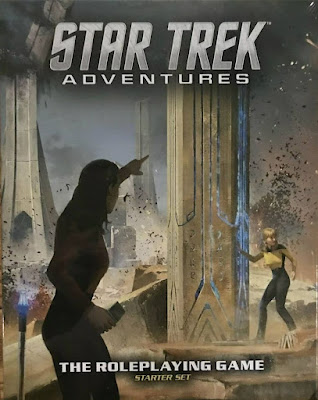
The Star Trek Adventures Starter Set


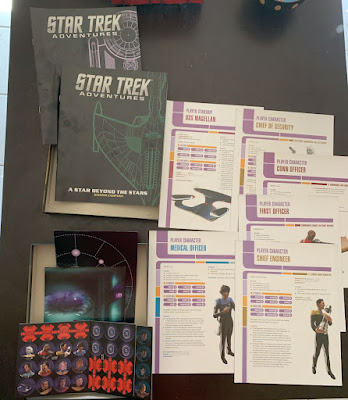
I got this a while back and I felt like I really should post about it. While I have some quibbles with the rules themselves this is a really good starter set. It contains the expected basics for something like this: intro rules, intro adventure, pregen characters, a ship sheet, some map sheets, tokens, and dice.


The most recent starter box type products I have used are the Starter Kits for the various Star Wars games from FFG/whoever is doing it now. Those have similar contents - clearly an influence here and I have had good experiences running the Rebel set and the Jedi set for my players. I thought this would be an easy way to start my crew with the new STA game if the opportunity arises and I was pleasantly surprised as I read through this one.

First up the rules booklet is more thorough than I would have expected. It gives a solid presentation of the main rules, covers combat in a separate section, and the starship rules are in a separate section as well. You could certainly run the game with what is presented here. The only major mechanical element missing is character advancement - not really unexpected in a starter set.

The pregens are fine and representative of what you would find in a typical federation bridge crew. The ship is a Galaxy class so it should be familiar and fans will have a feel for what it can do under normal circumstances. 

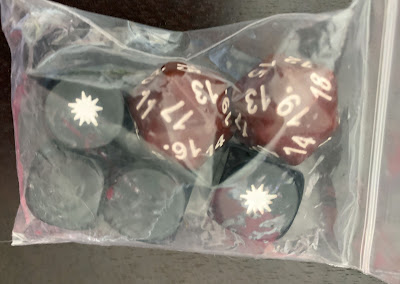
The dice in this set are the same ones they sell separately.

The adventure is surprisingly good. There are three parts here and the first starts off fairly mundane - scan stuff. Beam over and check systems on another ship. Some basic combat. But that's alright here as this is very much a "learning the system" situation. It made me think about some of the old D&D Basic Sets in that way, although it is assumed a GM is running the game - it is not programmed self-instruction. This section is still decent as it introduces a mystery involving an old antagonist - one that is not over-used.

The second section involves further exploration of the mystery and brings in some familiar races. This time it expands to planetary exploration and action. 

The third section has a ton of potential as it brings in some major lore nuggets, space combat, and puts the PC's into position to make some major choices that could have a significant impact on the setting - much more so than a typical starter adventure.  This is not low-level characters in a starter dungeon type material - it's big time Trek and actually made we want to run this to see what my crew would do.


So yes, if you are considering checking out the game this is an excellent starting point and even if you already have the big core book a) the adventure is good and b) the small rulebook would be a handy player reference at the table. You could easily run this with a newly generated crew instead of the pregens and with experienced players that's probably the best option as we all know no one likes pre-gens. At 20-25$ most places it's a great way to start your campaign.


Friday, December 21, 2018

Greatest Hits #21 - Trek Tuesday - Decipher Trek

The most recent Trek RPG - until recently


Getting back to the big glossy editions of Trek RPG's, it's time to talk about the Decipher years. The genesis of this one is a little strange. Last Unicorn had been publishing their edition of the game for a couple of years when in 2000 the announcement came out that they had been purchased by WOTC. Within a few months WOTC/LUG lost the Trek license, supposedly because there was a clause against the same company having both the Star Trek and Star Wars licenses which WOTC now had.

Regardless of the details a new Trek game appeared in 2002 (roughly a one-year gap) from Decipher of all companies. Decipher had been known only for card games up to this point, so it was a surprise. Considering they already had the Trek license for card games, it did make some sense. One interesting thing was that quite a bit of the design team from Last Unicorn made the jump to the new edition - take a look at the credit pages below:

Last Unicorn credits page
Decipher credits page
There is a lot of overlap there. So you might think "lots of continuity there" right? Well, not so much. Despite having invented a whole new system and written multiple books on Trek just within the last 5 years, the design appears to have looked more at a different system that was popular at the time.

The stats shift to six familiar-looking basic attributes plus some others. Task resolution also looks familiar (and I don;t mean Traveller) being 2d6 + modifiers (lots and lots of modifiers) to beat a target number set by the difficulty of the task. It's shifted down about 5 points from the d20 difficulty numbers but it looks very familiar. This was during the height of the d20 boom and the system for stats, skills, and task resolution is very similar to d20.

Characters have a Species which modifies attributes and grants some special abilities. They also choose a Profession which designates some skills as professional skills and grants some special abilities. There are also Elite Professions which can be taken after meeting certain criteria.

Action Rounds are 6 seconds long and characters can take movement actions, combat actions, free actions, and full-round actions - not really trying to hide it at this point were they?

There is a some chrome here. There are Traits which are like Advantages/Disadvantages, there is a hero point mechanic and a reputation mechanic, combat uses a damage track as well as simple hit point type damage to introduce some damage effects,  and of course there is star ship combat as well.


So it's very much a d20-styled Trek game. You might think that would have taken off bigtime in that particular time. Well it didn't. They produced very nice full-color hardback books, six of them and a narrator's screen from 2002-2003 and then it got quiet. Considering the ready availability of these books in bargain bins and overstock deals circa 2005 I think it's safe to say this did not do well. It's not hard to see why:

  • First, despite having the same design team this is a very different game, mechanically, and having spent significant money to acquire the previous rules, there was not a huge incentive to turn around and spend money all over again a few years later.
  • Second, I don't think fans of LUG Trek felt that the system had run its course and so there was no great outcry for a revision or new mechanics and Decipher's version didn't cover any new ground that the prior version had not.
  • Thirdly, while it was like d20 it was not actually d20. This closed it off from the exploding ecosystem of d20 games that were cross-compatible to a degree, and from gamers who were extremely d20-focused.
  • Finally, there is timing - when this was released Voyager had just ended, Enterprise had just started, and Nemesis released and was not particularly well received. Trek was petering out in a lot of ways. I suspect that among casual players and fans there was not a lot of interest in starting up a new game and the die-hard fans already had FASA or LUG Trek (or one of the many, many homebrews) and were not terribly interested in something new. Contrast this with Star Wars which was in the middle of the new trilogy after a long gap and was all over the place.
Looking back I think if the design team had taken this as a chance to refine the ICON system, or if they had gone full-on d20 system, then it probably would have sold better as at least there would have been some built-in audience for the new game. Given the timing of its release I'm not sure it would have mattered but I can't help but think it would have helped in some way.


Personally I've never run a game of it. I tried - twice. We never got past character generation in either one. I tried selling it to my group once many years ago and it never took off. I tried it a bit later online and that never got off the ground either. I don't blame the system for those but that is the extent of my experience with it. Hey, I tried ...

If I was going to start up a campaign now I suspect Decipher's game would be several notches down the list even though I have the complete pile of stuff. It's fine and has plenty of material in the books to support a campaign, but so do most other Trek RPG's (official and unofficial). I see stuff in the other versions that I like better. I don't see much support for it online and I suspect it's just not as popular even now as the other options.

That's about all I have to say on Decipher Trek. Next week we will see what else is out there.

Thursday, December 20, 2018

Greatest Hits #20 - Trek Tuesday - Where No Man Has Gone Before

Another fun trek game - and it's free!


In contrast to the big glossy production I revisited last week, there are other approaches that are worthy as well. Where No Man Has Gone Before looks to me to be an ICONS type take on a Trek RPG - not in mechanics but in staying light and loose. Here's the introductory quote from the game:


This is a game about a five year mission, a world where
special effects never progressed beyond painted
Styrofoam blocks and cheap double-exposures. The 70's
were still The Future and Klingons had smooth
foreheads. The idea of a Star Trek movie was a
laughable proposition and nobody thought twice about
planets full of Nazis and space hippies.

I'm thinking you either read that and think it sounds cool or you laugh and close the browser.

Assuming you're still reading the game can be found here. It uses the Microlite d20 system so it is broadly compatible with d20 stuff that is already out there. Significant differences:

  • You only have 4 stats: Strength, Dex, Int, and Charisma
  • There are only 3 classes: Blue Shirt, Red Shirt, and Yellow Shirt Classes are mainly a silo for Talents. There is a set of general Talents and then a list for each class. 
  • There are only 6 skills: Communication, Engineering, Knowledge, Medicine, Physical, and Subterfuge. Each character is trained in one skill.
  • Task resolution is the same as any d20 game - stat bonus + skill bonus + 1d20 vs. a DC
The Talents are great and capture the spirit of the original show perfectly and are thematically appropriate to each class. There are chapters for personal combat and starship combat that look like they would work well. There is an equipment chapter as well. Some stock NPC's and aliens, common ship designs, and lots and lots of random charts to help a DM run things on the fly. 

Notable fun-ness: The "God" section in the Enemies and Allies chapter: 
  • God, Almighty
  • God, Irritant
  • God, Metal
  • God, Petty
Plus a list of godly powers.

There is also an appendix on figuring the ratings for your series which can lead to unexpected complications like the dreaded "Monkey Sidekick". 

All of this is packed into just 45 pages! It's certainly enough to run a few one-off sessions and likely enough to run a mini-campaign. I think the limited list of enemies and ships might become restrictive over a long campaign but there is an expansion, "Controlled Implosion" which adds more goodness - and more random charts - in another 18 pages. There are also paper mini's (shown above), multiple character sheets, and a lifepath generator. It's an amazing little package.

All in all it's a very different approach to Trek than the Last Unicorn version. Where LUG Trek takes it straight and serious this is completely tongue in cheek but does have some ways to reward good setting-appropriate roleplay with Action Points and the expansion has more advice on running it straight as well. If you're at all interested it is definitely worth a look.

Wednesday, December 19, 2018

Greatest Hits #19 - Trek Tuesday: The Last Unicorn Star Trek RPG


I used to own this book, in fact I bought it the month it came out back in 1998. My main impression was visual - this was the first full-color, full-of-photos RPG book that I had seen and it blew me away when I flipped through it in the store. Plus, it was Trek! We hadn't had an in-print Star Trek game in about 10 years when the FASA RPG petered out with the Next Generation Officer's Guide. Now there was a new Trek game, from a company I'd never heard of, using a system I had never seen before - and it looked amazing!


To continue with the visuals I had a lot of experience with FASA products, from Trek and Traveller in the early days on into Battletech and Shadowrun where they entered their "art is everything" phase, and even they did not publish full-color rulebooks. Even their Trek game was not overstuffed with photos - the main rulebook was, but the supporting material mostly used line art. TSR had gone sort-of full color with the 1995 AD&D 2E revisions (the black cover PHB-DMG-MM) but even then it was mostly black text on white pages with some red headers and some art here and there. This new Trek book was way past that, with full color photos from the show all over the place and LCARS borders in different colors. The closest comparison I can make is with Underground and it's use of color to mark different sections and full color art throughout the main rulebook, but even it didn't have photos to draw on like this. LUG's Trek stood above all others in look and presentation.

The next impression was (not coincidentally) the price - it was $35! This was by far the most I had ever paid for a single rulebook and it was a shock, but the presentation - and the subject matter of course - won me over and I picked it up as soon as I could. Remember the D&D 3E books that came out in 2000 were $19.95 full-color hardbacks, and later jumped up but only to $30. This was a couple of years before that. Even sticker shock and general stinginess can be overcome with the right content and presentation.
I think I may still like it better than the new one ...


Mechanics-wise I was somewhat disappointed. My standard of comparison was FASA's Trek game and it was a percentile roll game with a large skill list, an action point personal combat system, a fairly detailed ship combat system, a Traveller-esque character generation system, and in general a lot of simulationist crunch, to use the popular phrasing. I played it for years and I loved it. LUG's Trek worked on a 1-5 scale for stats & skills which seemed incredibly narrow and limiting at the time. It also had a much shorter skill list which also seemed limiting. On the plus side it did keep a sort of lifepath/background generation system and it added in Hero/GURPS style advantages and disadvantages which could add some flavor to a character beyond their stats, skills, and service record.

I also was not impressed with the die mechanics. That 1-5 stat is how many dice you roll for a skill check, then you take the highest die and add it to your skill rating (also 1-5) and that's your total. So the entire range of possibilities is defined by a d6+5. That certainly makes every point count but that is a huge amount of variability. One die in the pool is the drama die and on a 6 you get to add another die to the total, on a 1 there are increased consequences for failure. The recommended difficulty numbers are 4 (Routine) - 7 (Moderate) -10 (Challenging) - 13 (Difficult). Those seemed really high considering you're going to average around a 4 + skill level).

Starships were also less detailed and starship combat was far less gripping than FASA's game.

I was disappointed enough with the whole thing that I only tried to run it a few times and only played it a few times before the book hit the shelf. So much potential wasted. I eventually sold it or traded it for something else.


Recently though I've been digging into Trek after a long phase of not really caring so much. I stll have my FASA Trek stuff and a complete set of the later Decipher Trek RPG but I wanted to take a second look at LUG.  I picked up a copy of the book again (less sticker shock this time) and at first glance it's still very pretty.

Rules-wise I like it better than I did then, probably because I've played a lot more rules-light games and get this idea more now than I did then. It definitely leans towards the rules-light end of the spectrum, though it gets oddly detailed in some areas like starships, which ironically enough now seem almost too detailed to me in relation to the rest of the game system.

The game also is clearly and proudly in the narrative structure camp of gaming. Adventures are built around scenes and acts and there are really no random encounters and that kind of thing found in the book. That's fine, I can work with that when I know it up front. There are still some elements of a "Trek Universe Simulator" there but it's mostly a "Trek Series Simulator" rather than a physics engine like the FASA game was.


I am still not sure about the main resolution mechanic - relying on a handful of d6's still seems very swingy. I play enough 40K to know how unpredictable a few of them can be (saving throws for a terminator squad come to mind). I think to make this game work I would have to be very very strict about limiting tests to "only when there is truly a chance of failure" which is something I am not always good at doing. It would also need to follow the narrative convention of "one stealth check gets you from the shuttlecraft landing site to the hidden klingon base" rather than the more traditional "one stealth check per 100 feet" approach used in most of the games I have played. I'd be willing to give it a try, but it's definitely something I would have to watch.

So, yes - I like the game better now than I did and I might be up for giving it a try sometime. Only one of the Apprentices is really interested in Star Trek so I'd have to talk one of my other friends into it and that's going to be a tough sell. It's definitely going on the list as a secondary/try-out game though.


Tuesday, December 18, 2018

Greatest Hits #18 - A Reminder to All Captains - Count Those Drones!

Pretty sure we've played since this fight but it definitely left me scarred for a while

So we played a little Federation Commander over the weekend ...

Contact!

I took the CC Yorktown and the old CL Arizona out on a "keeping the cats out of the yard" mission against Apprentice Blaster's Kzinti BC and CM.

End of Turn 1
My idea was to have the CL stay in close and play wingman to help keep the drone wave off of the CC. Things went well until Turn 2.

Middle of Turn 2
Each of my ships had launched a drone on Turn 1. The Kzinti launched on Turn 1 and early on Turn 2. As we closed in we lit each each other up with phaser, photon, and disruptor fire. After some close-in maneuvering, I realized all four Kzinti drones were going to hit the CC on the same impulse. I managed to turn off so that two were hitting the #2 shield and two were hitting #3. "It's only four drones, I can handle that". This was a tremendous error and shows just how rusty I was.

So the drones hit, I line them up for defensive fire and say "OK, four drones - " and Blaster says, no, that's four drones. "What, I have four drones out there-" No, there are eight drones he says. "OK, eight drones-" no, eight drones on this shield, eight drones on that shield he says. "Wait, those are four drones PER COUNTER?!" - yes, he says, "I wondered why you weren't shooting at them before."

AAAAAAAAAAAAAAAAAAARRRRRRRRRRGGGGGGGGGGGGHHHHHHHHHH!

Apparently at some point a few weeks ago I told Blaster to use one counter for all the drones he launched the same turn at the same target. He remembered this, I did not. I was so wrapped up in my own thoughts I didn't notice that his pair of ships with 8 launchers had only lunched 4 drones over 2 turns - at least going by the number of counters on the board. The outcome was pretty bad. I did manage to stop 7 of the 16 drones. I stopped two more with tractor beams though, and when I lost the tractors those two hit the ship as well. Been a long time since that's happened to me.


At the end of Turn 2 the CC is in pretty bad shape but still has some teeth. It's not going to outrun anyone but with a fresh shield towards the enemy and some charged phasers I should be able to stop drones long enough to get some more shots off.

(I did manage to rip up the Kzinti Battlecruiser before this happened - overloaded photons are still nasty up close (even with only 2 left) - but not as badly as the CC was hit)

Turn 3 was pretty much the game. We were still in close but I was reloading photons and the Kzin had disruptors and drones ready to go. The poor Yorktown did manage to turn a new shield but did not have enough phasers to stop the incoming drones. After a final volley of phaser fire the CC went down hard.


On Turn 4 the CL disengaged with no internal damage other than armor, ending the encounter.

Notes:
It's been a long time since I marked off that many boxes on a Fed CC and an even longer time since I've actually had one blown out from under me. It was largely stupidity on my part with the whole counter-counting thing. All I can say is I won't forget that anytime soon.

One tricky thing with drones vs. old-school SFB thinking is that given the turn structure a drone can move 3 hexes before you will ever have a chance to fire at the thing. This makes the job of an "escort" quite a bit tougher as once the drones close to zero range only the target can shoot at them. That 0-3 hex range is where phaser-3's are most effective, and it can be tricky to make that work, especially on slow moving ships. I'll be puzzling that out more, especially since Blaster seems pretty attached to his missile boat Kzinti ships.

A dislike: Federation drone racks in Fed Commander are terrible. Most ships only carry one, and it's the hybrid-loadout type, i.e. the G-racks from SFB. Now in SFB they are fine  - against the Klingons I could load up with all anti-drones, giving me an 8-shot defensive system. On the Romulan border I could load all drones, giving me an extra offensive system. In Fed Commander the Feds go halfway - 2 drones, 4 ADDs. Against drone-heavy opponents I can burn through the ADD ammo in half a turn and against non-drone opponents I only have two shots and then have to reload. It's inadequate either way. Beyond that, with only one drone on the ship, any halfway decent penetrating volley will kill it anyway. I've played a few battles with them recently and I'm not loving them at all.

Not my lights, but a nice set.

One big like: The Federation Old Light Cruiser - It's not terribly expensive, it has a lot of power, a solid phaser suite, and it can take at least one good volley from any direction thanks to the armor. I've always had a soft spot for these ships and so far they've worked pretty well. Sure, I expect to lose both torpedoes and the drone rack on any significant amount of internal damage but with 8 phasers and 30 power I should have enough energy left to move and take some shots afterward.

Friday, December 7, 2018

Greatest Hits #7 - The Star Trek Model of Campaign Design

Another one of my favorites ...


1) The World is Not Known: In contrast to the Rangers or Star Wars, exploration is the focus and that means the setting is a major player in the campaign. Compared to the Rangers campaign where the setting is really just wallpaper behind the big action, in this style of game everything from geography to races and civilizations to even the weather can play a big role in the campaign and any of those could be the focus of a session. Compared to Star Wars the physical layout of the setting and the cultures are largely unknown, and while both can feature interaction and combat, this concept adds in the whole getting-to-know-them stage. In short: In Power Rangers you don't need a map, In Star Wars you just look up the map, in Trek the campaign is about the people who make the map!

2) Travel will be common and interesting. The PR game characters might never leave their hometown. In Star Wars travel is common and mundane but not typically a focus other than as a rest period between adventures. For this style of game travel is how the campaign advances. It may well involve a craft of some kind.  This could easily be ship based, even a flying ship or an airship if you're going in that direction fantasy-wise. A literal interpretation of the source material could lead to teleportation circles and flying carpets as supplementary travel options.

3) Character Diversity: This one is not as essential as the first two but in keeping with the source of the inspiration the concept can easily handle a wide range of character types, classes and races. It also makes some sense to start above 1st level if you're so inclined. Think those flying races are overpowered for a traditional campaign? Not so here. Always wanted to play a locathah or merman or sea-elf? This might be the place to do it. Reluctant to include the Drow character in your usual game? This is where you can "Worf" in your Drizzt wanna-bes. Steal justifications and explanations from the source without remorse.

4) Steady State: Unlike PR there is not necessarily a strong character progression here, making it more suitable for non-level-based games. That said it works fine with a level progression, and an expedition into distant planes of weirdness can be a good explanation for why your former frontier farmboy becomes a demigod. Unlike Star Wars there is not typically a huge amount of social change going on, and adding that in can distract from the exploration theme and change the campaign, moving it towards a Star Wars style game. In general the home social situation stays the same, and the characters may or may not progress a great deal, but the discoveries made by the players can certainly stir things up back home.

5) Open Ended: Also unlike PR and SW there is no requirement that characters defeat a world-threatening evil or change the state of the world. Individual characters may come and go but the exploration can continue for years. It might be different quests, different missions, or one really long Odyssey, but there is no inherent limit on it.


I did something like this with a Rifts campaign years ago described in this post. Here's how it breaks down as far as the elements in this post:
  1. In this version the only information available were a few scattered reports from other travelers and some pre-apocalyptic maps.
  2. Travel took place via a giant robot with room on board for everyone. They stomped across the post-apocalyptic US and had to deal with various challenges
  3. It was Rifts, so character diversity is a given. Wizard? Check. Ninja? Check. Cyborg? check? Dragon hatchling? Check? Power armor guy? check. Not a problem.
  4. They started at first and made it up to about 6th by the end. They were not in regular contact with the home base so it didn't really figure in the campaign. The world itself was not in the middle of a war or an invasion, just the usual Rifts stuff
  5. Some characters died, some dropped out, others dropped in, and at least one underwent a racial transformation. There's plenty of room for change, even with a seemingly limited crew.


So running this in Trek or Traveller is easy enough, and I've given a Rifts example above, how about D&D? It's not difficult as it's a fairly traditional sandbox/hexcrawl game at heart. I think I will save that for a separate post - check back tomorrow.

Thursday, December 7, 2017

What is Genesys?


So there's a new RPG hitting stores this week - Genesys.


No, not that one.


Not that one either - well, maybe her ...


Yeah. Wait - back to the game.


From the site:

The Genesys Roleplaying System allows you to create your own setting to roleplay in. Whether you're playing as a posse of outlaws in a weird west tale or an unlikely group of heroes fighting against the tyranny of a mad dictator in the far future, Genesys gives you all the tools to need to create your own personal playground.

So it's a "generic" RPG like Hero or GURPS or - maybe more widely known these days - Savage Worlds.


It uses special dice. It's from FFG and it's the "generic" version of their Star Wars system. Larger article here.

Of course it can't use the same !#@$@$ symbols as those dice:


They are similar, but still if you were playing in both games it might take a bit to switch "fonts" between the two.

Now I've run some sessions of their Star Wars for different people with different characters and I do like it as a different approach than d6 Star Wars or d20 Star Wars. If you don't like the Star Wars universe but are looking for a system that's "different" for another genre like fantasy or some other kind of cinematic adventure then this is worth a look.

  • Old schoolers may not like this system as much as you have a lot less natural control over things. Every roll of the dice can introduce unplanned complications both good and bad. You may have a fairly detailed plan for sneaking into the enemy base and then someone rolls really well or really badly and now you've stumbled across some hidden guards or broken some equipment or some other unexpected event that can throw things off. 
  • Those who like detailed tactical movement and combat may or may not like it. There is no grid and so no counting squares or hexes. There are quite a few options in combat but they are driven by what comes up on those dice. So if you like having a character "build" with hard set capabilities you may need to make some adjustments to expectations as many of your options will add a die to a roll or allow you to spend specific die results to trigger a new result. There are some of the traditional RPG "number bump" type options but less than you might expect. Combat is full of interesting choices but it's less crunchy and less predictable than in a level based game.
  • If you like "experiencing the story" as the big attraction of your game then you will likely love this system. The dice will send things in different directions and many character abilities key off of manipulating or responding to those dice. Interpreting the results is the heart of the game so if you are good at and enjoy coming up with interpretations on the fly then you will have a blast. 

Beyond the book itself you are going to need a few sets of the dice - I'd say 2 at a minimum. We have 4 sets on the table when we play here and we've never had to scramble/argue/fight for more with 3-5 players so I'd say that's plenty.


All that said I'm not in a huge rush to pick this up because I'm not sure what I would do with it. I think it's great for a pulp game and possibly a superhero game. Really any cinematic genre could be done well here. World War II commando missions, a good Western, 1800's world explorers/extraordinary gentlemen - I can see a lot of potential there.

At the risk of committing heresy, I think it could be great for a Star Trek game. There are a lot of character options for non-combat abilities from diplomacy to carousing to fixing things like a chief engineer. The dice results actually feel like some of those out-of-nowhere technobabble explanations or amazing stunts that resolve so many episodes. Being Star Wars it already has vehicle and ship combat rules and rules for psionic type powers for your Vulcans and Betazeds. Talking about it now this is probably the one option I really need to investigate and this new version might make it easier by removing the Star Wars elements for me.

So it's an interesting new option for doing your own thing with an RPG. It's a robust, interesting system that's no longer tied to a specific setting. If you're looking for something different, well, trust me it's very different, especially if you're used to d20 as your main game system.