Showing posts with label Champions. Show all posts

Thursday, August 13, 2026

Savage Worlds vs. Mutants & Masterminds and the Importance of Dice


I know, but we'll get to it I promise ...

Let's talk about two systems for a minute. I'm prepping to run a Savage Worlds game and I just finished running a short M&M campaign in May. At one point I figured I would still be running M&M for most of this year but given a break point and an off-ramp my players chose to change to a different system. Why might that be?

In general, M&M is a more abstract system than many but Savage Worlds uses a lot of similar concepts so it may be the most similar game to M&M mechanics-wise on the market. Comparison points:

  • M&M stats are a bonus to a d20 roll, SW stats are the type of die you roll
  • M&M skills are a bonus to a d20 roll, SW skills are the type of die you roll
  • M&M has Advantages and Complications that help customize your character. SW has Edges & Hindrances that do the same thing.
  • M&M Powers are abstract effects-based abilities personalized by Descriptors - it's not just "ranged damage" it's a "fire blast". Savage Worlds has Powers as well and they are generic effects-based abilities personalized by "Trappings" in the same way.
  • In both games Powers can be modified by various bonus effects or reduced effects that can increase or decrease the points cost (talking super powers here for Savage Worlds).
  • In M&M points are spent to purchase stats, skills, advantages, and powers. SW has separate pools for each but points are spent on stats, skills, and powers and taking hindrances allow one to add edges. 
As you can see they work in very similar ways. M&M in general can be more complicated and more detailed - SW is more broad strokes - but they are not that far apart in approach. 


Then we get to combat. With M&M one rolls a d20 +/- relevant modifiers to equal or beat a target's defenses. In SW one rolls the relevant skill die (typically Shooting or Fighting). In melee the roll has to equal or beat a target's Parry defense. For ranged attacks one has to beat a fixed number (4) modified by range, speed, light conditions, size, and other possible modifiers or abilities. They are similar but SW treats ranged combat differently from melee to a degree though it ends up being a roughly similar process.

The effects of that hit though ... that's where our paths diverge.
  • M&M hits mean the target rolls to resist the incoming damage. That damage is a static number based on the power or weapon used - this is the target number for the defender. The defender rolls a d20 modified by the relevant defense and the degree of success or failure determines how hard they were hit. It is possible, though unlikely, to take out another powerful opponent in one shot if they roll badly enough  and they are hit hard enough. 
  • Savage Worlds hits have the attacker roll dice based on the power or weapon used. The total of those dice is then compared to the target's Toughness (plus any armor) and meeting or exceeding that Toughness will impose a Shaken or Wounded status on the target. It is possible, though not likely, to take out a powerful opponent in one shot with any attack or weapon in the game because damage uses exploding dice. Your pistol does 2d6? Roll a "6" and keep on rolling a "6" and you can inflict 5/10/20 wounds in a system where most things will not exceed a 3 wound capacity.

I think this is a basic, visceral difference and one that is not readily apparent just reading the games. Having run and played a lot of RPG sessions over the last 40+ years I can tell you players like rolling big numbers!  Having run a long Deadlands campaign in Savage Worlds in the last few years I can tell you players get very excited when that one damage die just keeps exploding. It's a triumphal moment that everyone can see and it's hard to replicate when your damage system depends on someone rolling low to fail rather than rolling high to succeed and I think that's where M&M loses some people. 

 It's not just in comparison to Savage Worlds. Most RPGs these days have some kind of stat & skill system and have players roll to hit in combat and then roll for damage - and higher is better. This is from D&D (going all the way back) to related offshoots from Runequest to Pathfinder to other approaches like Traveller, Champions/Hero System, GURPS, and various Star Wars games. Even Powered by the Apocalypse games tend to use a fixed damage system where a bigger Harm number hurts more. There are RPG's where both attack and defender roll - one to hit and one to dodge or deflect a hit - with opposed rolls, but the attacker, if successful, tends to be the one rolling for damage. 


M&M is one of the few RPGs where damage is a) the result of a defense roll and b) directly determined by the result of that defense roll and with experience in both approaches over the last few decades I would say it is just less satisfying to most players. With M&M you know that your possible results are 1-20 plus your Power level. A critical hit can make it worse for the target, and of course you can build up that effect level in as many ways as possible before you strike, but it's still the other guy rolling vs. a target number. It's a big deviation from the way RPGs in general work and I think it mutes the excitement people have in M&M combat scenes.


A more specific example:
  • Strong Guy in M&M has a +8 Fighting and a +12 Strength. Enemy Robot has Toughness 10 so if hit it rolls a d20 + 10 to beat a 27 target number in M&M 3E. Most likely he will take a bruise and maybe a stun. Maybe some Knockback too. A 27+ means it takes nothing but a 7 or less means it is out of the fight, with various damage conditions popping up in between.

    Odds here are not too hard to figure if it matters to you. A critical hit will shift things up a bit but the basics there are a 35% chance to knock out the robot and about a 20% chance to do nothing. 
  • In Savage Worlds Enemy Robot might have Toughness 15 while Strong Guy punches for 3d10. a 14 or less total means Guy does nothing, a 15 shakes the 'Bot, a 19 = shaken + a wound, 23 ups it to 2 wounds, and a 27 ups it to 3 wounds and most likely out. 

    Odds are trickier to figure in Savage Worlds as a few 6's in there can jump the damage up a lot and a raise on the to-hit roll adds another d6 into the pool for damage so it can snowball quickly. That said multiple dice also makes it a bell curve so it tends to stay in the middle range

  • Then just for fun let's do it in Champions: Strong Guy has a 60 Strength so punches for 12d6 damage - that means you get to roll a fistful of dice and add them up looking for the total (for Stun Damage) and for specific numbers (for Body Damage) figure out some knockback (and see if that did any more damage) then compare those numbers to Robot's Physical Defense and start marking off Stun and Body if you exceeded it. Then you also compare it to it's Con score and see if you Stunned them. It's great! With tons of dice flying around the table and multiple calculations on each roll it feels like every swing that connects is impactful to say the least. Is it faster? No. But sometimes speed is overrated.  

    See?!

Now I love M&M and this is in no way a call for a hit point system to be added to M&M. Savage Worlds , though, does show that a non-hit point system can still embrace a "roll your damage dice" approach . I suspect that if there were ever a radical shake-up with M&M that this would be a good area to consider for a change. I don't know exactly how it would work* and it would take a big rethinking of how defenses work in the game. With 2nd - 3rd - 4th editions really being refinements of a solid framework I would not expect to see anything like this soon - but it's something to think about. 


*First rough idea: Attacker rolls to hit like now and if they do hit then we flip the Toughness roll around from how it works today: attacker rolls Effect level + d20 vs. a target of the opponent's Toughness + something. Yeah, it looks a lot like Savage Worlds, I know - but I know that works and it keeps things fairly similar to the current M&M approach. The main problem is that it means everyone is "rolling a d20 for damage" all the time and I'm not sure that changes it up enough to get people excited. The real jump would be rolling a fistful of dice based on power level of the attack but that's a whole other level of change. 

Monday, July 28, 2025

Supers on the Brain


All the M&M 4E talk sent me down a rabbit hole last week. Besides starting a re-read of the 3E rulebook and looking back through all of my other M&M books I started feeling the urge to check in on Champions, started poking around online and I ended up picking up the Hero Designer software and the Old School Enemies book that just came out which collects all of the entries from original Champions and Enemies I, II, & III and stats them up for 6th edition. This is just the kind of thing that lights the fires for sketching out a new campaign. I'm feeling pretty fired up about it right now. My players mostly haven't touched Champions since 4th edition so now I get to figure out whether it's smarter to go with 5E which is very close to 4th, or just go with the latest and greatest and use 6th.

For a short version of where Hero System/Champions stands there are roughly 4 generations ...

  • Champions 1st-2nd-3rd pretty much were just building on the same framework and tweaking one design. This was before the concept of "Hero" as a system, not a set of similar but different games, had arisen. It's more loose, there are some holes and weird rules interactions here and there but it is totally playable as many of us ran many games back then.
  • Champions 4th came out in 89 and was the big blue unifying rulebook that took many of us through the 90's. I suspect that popularity-wise this was the high water mark for the game as I knew multiple groups playing it then and there was a ton of support for it. One version even came with a character generator on a floppy to expedite character creation. I would run this today if someone wanted to. This is also where the game became part of the "Hero System" and the rules got unified. Some people did not like the changes here and stuck with the older editions and whatever house rules they had created - the first schism.
  • Champions 5th and 5th Edition Revised (2002 & 2007) was a big black book that was very similar to 4th but with a lot of things more defined and more definitive language in general. It was less "fun" in some ways as a read and while it's a tighter ruleset it comes at a cost that was too much for some and this is a second break point among fans. This version was very well supported though - lots of cool and interesting books. The revised rulebook mainly added in examples - lots of examples.
  • Champions 6th edition (2010) finally grew too large to be contained and was split into two books. I'd say this one has the biggest breaks from the past as it drops all figured characteristics - a signature feature of Champions in my opinion - the comeliness stat, certain powers - at least as separate powers, and just rearranges a lot of classic Champions features. Now I don't hate it but if you had been playing for 20+ years when this one came out it brought a lot of changes that not everyone was asking for - the third break among fans. 

So nowadays if anyone talks about a Hero or Champions game one of the first questions has to be "which edition?" and then the real conversation starts. Hero Designer thoughtfully includes both 5E and 6E so there is support for the two latest versions. If it did 4th I'd probably jump back there out of sheer nostalgia. Since I don't have a working floppy drive any more it's probably smarter to go with 5th or 6th so I can use the current application.

That leaves coming up with the actual campaign outline, regardless of mechanics. I think a short campaign is better to start but Champions takes enough initial investment that a one-shot would be kind of pointless so I'm thinking something with 3-6 sessions of "go" in it. Start small and expand as we go. I have a vision of a campaign with short bursts in the 40's, 60's, & 80's timejumping forward to each in turn to set up some history for the current day where the longer campaign would sit. It's probably too ambitious but I'm noodling on it for now. If I'm finally going to commit to a long term superhero game, why not make it something ambitious?

Even came with documentation right there in the book

This is also ignoring the imminent arrival of the M&M 4E playtest rules this weekend which will probably fire up this cycle all over again.

I just need more time! 

More to come. 


Thursday, March 9, 2023

Aaron Allston's Strike Force


This is an updated version of the original Strike Force from 1988 and is the product of a Kickstarter drive in 2016. I made a post about the original over ten years ago and thought very highly of it. With a newer version out there I figured it was high time I looked it over too.

Some straight-up comparisons:

  • The original was a 96 page softcover while this one is a 256 page hardcover. Both are available in PDF.
  • The original was black and white while the newer book has some use of color in layout and illustrations. It's not a Mutants and Masterminds book but it's not B&W either.  
  • The Strike Force campaign kept running so while the original covers the first 6-7 years of the campaign this one includes information on what happened after that from AA's own notes.
So right there if you're interested in how an original superhero campaign progressed, well, there's a lot to explore. For one there was an alien invasion and then a third world war which had the heroes helping to rebuild the war  - here was a man who was not afraid to shake things up! I've preached for a long time that you have to be willing to let your PC's leave a mark on the world and here is a strong example of where that can go. Throughout this campaign there is dimension-hopping, space exploration, alien invasions, alternate earths causing trouble ... a bunch of comic book tropes used and explored and making permanent impacts on the world. This new edition covers another two decades of play so it is definitely worth a look for that. 

"Bolo"

There is a big section on the heroes and villains of the campaign. It took up roughly 50 pages in the original and it's around 100 in this one. In many ways this is the least valuable chapter in the book for me as the value in this book is less about Hero System stats and more about how the campaign as a whole worked over time. That said this also includes bios for most of the characters and those can help one make sense of the interplay between characters and the changes over time. For example, one of the early Dr. Doom-ish villains slowly moves away from world domination and by the end is more of a scientific benefactor aiding the heroes and the world in general - not something we see in a lot of superhero stories where some things need to be constant but totally applicable to an ongoing RPG campaign. For the major heroes it shows their Champions character sheet at the beginning of the campaign and then their updated sheet at the end of the campaign which could be interesting for Champions players and GMs.

Other interesting campaign material includes the expected timeline, discussion of major events, how magic works, how technology fits in and has changed over time, secret lands, major organizations, some secret societies, other dimensions, other earths, and alien races and empires. This all fleshes out the big picture side of the campaign with about 50 pages of totally steal-able ideas. The breakdown of magic in particular is a great example of laying the ground work for things by setting some boundaries and some common language while still staying fairly flexible. 

Kestrel

The last big chunk of the book is how Aaron set up a campaign, how he kept it going and kept people happy, and his advice on solving problems that can arise in a campaign. This is where much of the blue-booking discussion and the player archetypes discussion happen which are two of the things Strike Force is most known for. As an example of the contributions of others involved Steve Kenson gives some excellent advice on blue-booking in the age of smart phones and tablets. There is a lot of good, useful information here and the best thing about it is that it comes from actual play experience - not theory!

The only disappointment here is that a) it is a summary in many places of the campaign, not an actual-play recounting of the games and b) many known superheroes and things from other IP universes - like Battlestar Galactica - were used in the campaign, especially early on, and those have to be renamed when mentioned here so it's not always totally clear who was interacting with who (the real who) at times. The good thing is that the raw package of Aaron's notes is available apparently though I have not gone that far myself yet.

So yes, I would recommend this 100% if you've never read the original. While some of these concepts have leaked into RPG guidance in general it's still great to see them all in one place and there are undoubtedly at least a few concepts you will want to take home.

If you have the original it's a little more complicated. Did you like that book? If you didn't like it then this may not change your opinion. If you did, well, this book is a lot of what was in there, plus more. I have the original and I still bought it in hard copy and I have no regrets.

Skyrocket

I see a lot of "GM Advice" products out there now, since PDFs and DTRPG have made it where anyone can run 15 sessions of D&D 5E and call themselves an Expert Gamemaster. This is the opposite of those products - decades of running games distilled into one book. At this point in my gaming career I don't rate most of the advice I see out there as I've been playing longer than many of the advice-givers have been alive. I need a track record to pay any attention to this kind of thing. Take it from me, this guy had one hell of a track record.

If you're actually running a game, or planning to, and would like to see how someone else actually ran a game, this is probably the best written example there is.

Some links:
(these are not affiliate links, I don't do that. They are just here for informational purposes)
There are supposed to be character files for Icons and Savage Worlds as well but I am not sure where to find those.


Thursday, February 23, 2023

Superhero RPG Roundup Part 2 - The Multiverse of Superhero RPGs


Given the opportunity to start a new superhero campaign I dove into the deep end and ran through a bunch of games I own and checked into a few I did not. Part 1 of this covered the Marvel Superhero options as I do love the old warhorse and there are a lot of options out there built around that chassis. 

Beyond that though there are many other games in this genre. I hit most of the big ones in my exploration so I thought I would share some thoughts on each in this post.


  • First up, Mutants and Masterminds: In my mind this is the current standard for superhero RPGs and has been for more than a decade. Third edition is thorough and expansive game system with a unified mechanic that is fairly simple to run in play, options for point-build and random character generation, and supplement books to assist with deeper options in almost any area you can think of - powers, gadgets, locations, running a super team, cosmic campaigns, supernatural campaigns, adventures ... pretty much any area of running a game has extra material available if you want it. It's a great game and one I have run multiple times previously.

    For this campaign it was a strong contender but I decided to try something new. I will run this again, maybe later this year, but for now I chose "new" over familiar.
  • Second, Champions - my first superhero RPG and one that still lives in my head whenever we get to discussing them even 40 years later. It works and works well if you want to have all the details. People fuss about math in this game but once you build your character the math is mostly "do I have enough dice to throw for this attack?" rather than anything particularly complicated. I love it and I have players with some experience with it and the current Champions Complete is the best version of it to be released in years.

    Despite this we will only be playing this game once a month and introducing some new players to Hero system when playing on that schedule is just not the best idea in my opinion. I'd love to run it and I will make an effort to do so but it's not the best choice for this campaign

  • Next up - ICONS - lord knows I have talked about ICONS enough on this blog over the years. It's a great game with a ton of support that plays fast and is very good at letting your players focus on what they are doing in the game rather than how the rules work. Bits of MSH, bits of FATE, elements of M&M ... all combine to make for a really good game that can handle a wide range.

    For this campaign I was very tempted to use ICONS but in the end as mentioned above I decided to try something new. ICONS will be back in the rotation at some point as I have a couple of players that have never tried it but for this one I decided to go in a different direction.


  • Savage Worlds - I am running a Deadlands game now and there is a shiny new Super Powers Companion that just came out so it would make some sense to run a Savage Supers campaign now. The new book is solid  - these things have really evolved since they were basically the powers chapter of Necessary Evil with some additional material added in. They have gotten further and further away from the standard SW approach of "powers cost ongoing power points" which is fine for wizards and mad scientists but does not work well for superheroes with permanent abilities so it's a welcome change - it's basically a point buy system for powers now. It is not as comprehensive as some of the other games but a lot of that is because it's a supplement to a game system and not a self-contained game in itself. I'll have a separate review of this one soon.

    As much as it would make sense to use this option - especially since I was considering a WW2 supers game and I have the Weird War 2 book as well making this really easy to run - I ended up deciding to hold off. My main concern is running two games in Savage Worlds in parallel at different power levels and possibly making one feel "less" than the other. There's also the danger of making them feel too "samey" using the same rules for two different games. I will need something to run after Deadlands and I'd say Savage Supers would be a good fit when that day comes so that's probably where it will come into play.


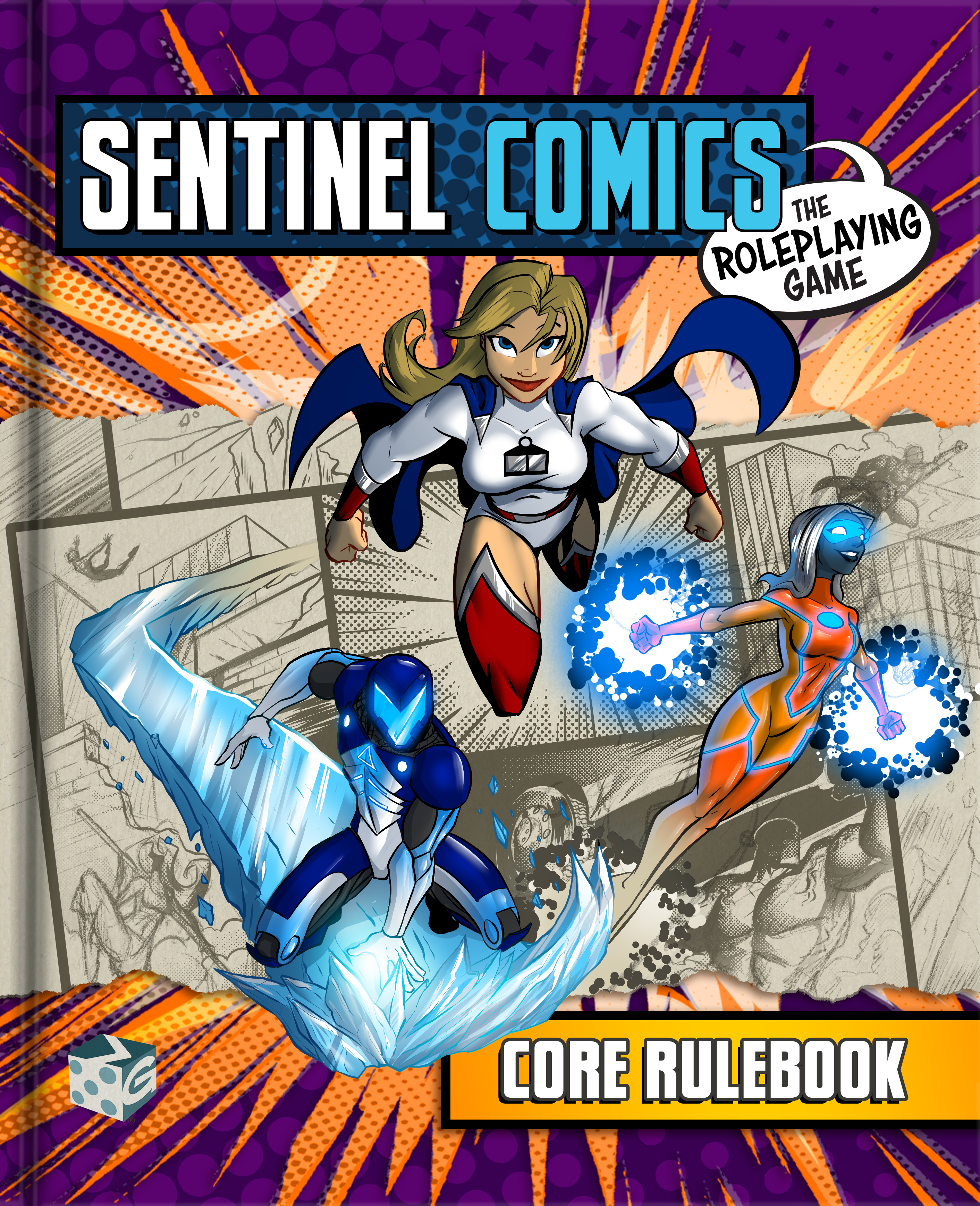
  • Finally I looked at the Sentinel Comics RPG. I had run one of the starter kit adventures a few years ago and it was cool though some of the concepts were tricky coming in cold. I did the Kickstarter and had the rulebook and the GM kit but had not really dived in with an eye towards running it until now. There's a lot of Marvel Heroic (Cortex) in there but it's not just a clone.

    For example you're only going to be rolling 3 dice in your pool - a power, a quality, and your status dice which is a new concept that sort of replaces the solo/buddy/team element in MHR.  This status is determined by a Green/Yellow/Red system which has two tracks. One is your health - as your character takes damage they begin "Green" then move into Yellow at a certain point and then finally into Red as they take more and more damage. There is also the Scene Tracker which replaces the Doom Pool from MHR with a fixed countdown by round that moves through a G/Y/R sequence to show things escalating automatically - no die manipulation necessary. So your status die is determined by the current "color" (some may progress upward d6-d8-d10, some downward, and some may be steady) and also some of your powers are gated by this as well - the biggest bangs are only available when things turn red, for example. 

    This is a great concept that really anchors certain tropes into the mechanics. There are a lot of changes like this where things that were somewhat abstract in MHR become more defined and set and I would say more intuitively playable. I'll do a longer review later but there is so much clever stuff in here that I had to give it a go so it will be our system for this next campaign.

So, more to come on all of this. More in-depth reviews of some of these books and some session summaries as well. So far 2023 is a pretty good year here. 

Monday, December 14, 2020

Champions Complete


So ... it's been a while, but I have hopes of actually getting something going before the end of this wonderful year. Deprivation followed by a bit of hope  can send you to strange places so I found myself finally picking up a copy of Champions Complete!

First up it's funny how so much of this is still locked into my brain. I started playing Champions - 2nd edition, officially - about 1983 and the core of this 6th edition of the game is incredibly similar. Most of the changes are in details and clarifications, not in the way the game works. 

This book is a reworking of the 6th edition Hero System rules and the 6th edition Champions sourcebook to get back to giving players a one-stop source for "Hey let's play Champions" that does not require two big hardback rulebooks and another big sourcebook just to play the damn game. You know - like it was up through 4th edition. It's 240 pages long, softcover, black and white inside, and is listed at $30 though it can usually be found for less than that online at least. 

Side note: I bought this and the D&D 5th edition Eberron book on the same day from the same place and both of them were $22. The 5E book is hardcover, full-color throughout, and 1/3 longer. It's a clear demonstration of the power of the print run and scaling advantages. 


Hero 6th edition came out ... ten years ago. Sheesh. I stopped at 5th because I was still catching up with 5th edition and it's lengthy line of books when 6th was announced and I was also keeping up with 4th edition D&D and it's impressive run of books as well. Considering we never played Hero 5th, not even once, it made little sense at the time to me to start picking up a new version. Plus somewhere along the way I realized I would probably just use 4th and my damn-near-complete set of books for it if we got a serious Champions itch going. So I'm seeing some of the 6E changes up close for the first time. Thoughts below:

If you've played and remember the core of what Hero System is like from an earlier edition you will find it's very similar. The stats are very similar though the point costs are different as this edition has completely removed the whole derived stats concept. So if you want to make a character who is great at sleight of hand but terrible at dodging and shooting things you don't have to do anything complicated - you buy up Dex and do nothing for OCV or DCV. most still have a base value, pretty much what the old versions used if you had the human average of 10 in your core stats, but your character's Con, Body, Stun, PD, and ED are completely unrelated to each other mechanically. Dex is still an important stat but it's no longer the god stat that it was as it's unrelated to your CV's and your Spd. Overall I'm fine with this change as while it seemed intuitive back when it was new it does make some assumptions about characters and as time has gone on and more complicated concepts have emerged it's totally fine to de-couple these things. 

System-wise you still build a character out of points with a base allotment and then an expected amount from "Complications" - the new name for Disadvantages. It's a little more clear as a name for what it covers and I'm fine with that change too. There are actually fewer discrete complications than I recall because most of them are folded into Physical (which we always had), Psychological (which seems even broader than before), or Social (seems new to me but makes a ton of sense as a category) complications, plus the old standbys like DNPCs and Hunteds. 

You still have skills and they still work the same way with a 3d6 roll-under approach. A typical roll is still an 11-, with a familiarity being a fixed 8-, and a nice sidebar on what the various other levels mean and how you might rank up compared to the world at large. Levels are still a thing too and combat levels have been thoroughly fleshed out to where I think you can aim to achieve pretty specific things via levels alone. 

Powers and  power modifiers take up a big chunk of the book (as they should) and I don't see any problems here either. Some things have been combined or refined or clarified and I can see where they have tweaked some areas I remember being tricky or unclear. I have not really spent much time trying to recreate any old characters -yet- but I didn't see anything ridiculously different. Well, "Energy Blast" is now "Blast" - I mean it makes sense and that might have changed in 5th but it's been "Energy Blast" since I was about 13 so it stood out to me.

In fact, each of the "bigger" to my mind, or maybe "more complicated" powers has a very cool discussion of how it works and interactions with other parts of the game. Things like telekinesis and teleportation and even stretching are covered like this. A lot of powers that at one point in the game were described mechanically and left a lot of implications and loopholes for enterprising players to explore are much less so now with some discussion of modifiers included right there in the listing for the power itself. The improvements in this section are some of my favorite parts of the book. 


One other major flaw with Hero for me in recent years is the lack of a Fate/Force/Hero point/Bennie mechanic like most other RPG's have now and have had for decades in some cases. At the least they are a way for players to smooth out the extreme whims of the dice gods and in many cases they allow for some scene editing that makes a ton of sense in a comic book game. Champions hasn't had that ... but it does now: Page 130 of this book - "Heroic Action Points". It's not as completely fleshed out as Savage Worlds' Bennies or Mutants & Masterminds Hero Points as they are  straight-up 1 to 1 dice modifiers but it is a start and I could work with it from there. 

Final notes:

  • Yes, the vehicle construction and combat rules are included
  • Yes there are base-building rules included as well
  • Yes there are rules for heroic or agent level play with normal characteristic maxima, hit locations, bleeding, and all of those optional combat rule changes you sometimes see with that style of play.
  • There are some excellent, excellent examples of actual well-known comic book hero powers: power rings (built as a multipower and not a VPP - I was shocked), claws, invulnerable shields, web shooters, utility belts - solid solid solid.
  • The sourcebook section is a good start - types of characters, types of campaigns, villain motivations, and more. There are tons of additional material of this type in the Champions line alone, much less the universe of superhero RPG's but it is not wasted space here. 

In case it wasn't clear I am really impressed with this book. It is truly a one-volume rulebook for playing and running Champions. They actually did it! For context, the "normal" 6th edition rules were split into two separate books that are almost 800 pages long combined. The Champions book which is mainly sourcebook type material and not a duplication of the core rulebook material and adds another 300 pages. So, on some level here we have a 240 page book that accomplishes what you might have taken 1100 pages previously! The Hero bloat, especially with 5th and then 6th, was real. It's nice to see the realization of that and that action was taken for those of us who would like it to stay a game, not a lifestyle choice. 


Wednesday, December 5, 2018

Greatest Hits #5 - Notes from a Campaign that Failed

You won't win them all - why not pass along some notes from a failure too ...


Whatever tone you set and whatever level of campaign buy-in you are comfortable with, it's also important to make sure that's where the other participants are too.

In the early 90's, Champions was our Superhero game of choice. By 1994 I was ready to start a new campaign and over several weeks wrote up the background for "Miami 2000" which was set in Miami... in 2000... which seemed like a good idea at the time. I did a lot of research on the real-world Miami, gathered maps and travel guides, then imposed a few changes on the city to make it more of a near-future superhero setting. Characters were discussed and created - a mentalist, an energy projector, a brick, and others were all written up and reviewed.  and we were ready for my semi-serious Bronze Age campaign.


First session opens up as PC's discuss their characters and we have a bank robbery - heroes respond. Within one round "The Rose" has used her Thorn Blast at full strength on the escaping villain "Pulsar" which is enough to kill him outright, and he tumbles out of the sky over the bank and crunches onto the street. This triggers her code against killing and she shuts down. The other heroes flee the scene, grabbing her on the way, looking suspiciously like THEY had committed the robbery. I decided to go with that and give them some trouble with the police. They went underground like the X-Men and it looked like we were set for a slightly darker game than I had planned but I was ready for it. Then the mentalist adopted the name "Professor Y" and things disintegrated. 


Now The Tick was on TV and setting our circle of friends on fire at the time and I blame this completely for the ruining of that campaign. Once the dam cracked it was all over - it's Professor Y and the Y Men ("Y? I'm glad you asked!") running all over Miami talking in funny voices, coming up with newer dumber costumes and flipping the bird to anyone who has serious questions for them. Ugh.


I tried to get on board by introducing The Hedgehog (also known as Weapon P), Hogan to his friends (because if adamantium spikes coming out of your hands is cool, adamantium spikes coming out all over your body is clearly even better). He's the leader of a crazed band of underground rebels who all think they're mutants (even though most of them are not) who hide out in an abandoned amusement park and hear about/start/make up crazy stuff all the time which Hogan takes very seriously and asks the PC's to handle but it was too far gone by then. We played for less than 3 months total and then I had Godzilla step on them all, ending the campaign.


Clearly there were some different expectations here. I was thinking bronze age to gritty supers and so were the players when we talked about it. Then The Tick came out and completely changed the environment. I tried to roll with it but the campaign was just not built to run that way and I fought it indirectly. I should have just started over from scratch and ignored what I had written up before but I could not do it. We could have had a lot of fun with it but I was not really in the mood to break my vision and just ended the campaign rather than try and adapt. Sometimes that's just the way it has to be. 

So I would say my lesson learned here was to make sure everyone has approximately the same view of how the campaign is going to run and try to keep the focus there. If there a planned "premiere" session then send out some teaser emails to reinforce the sense of the game and maintain the momentum and interest. Also make sure there is some level of buy-in for the characters - pick a name, pick a home area, pick an organization to be a part of, something to ground them in the game and keep them there. Also:
  1. Never let characters with an overpowered killing attack take "Code Against Killing"
  2. Always set your games in coastal cities as Godzilla lives in the ocean. 

Thursday, December 1, 2016

Superhero Settings and Me


I've been digging through the superhero RPG shelves quite a bit the last couple of weeks and I spent some time thinking about settings - specifically campaign settings for superhero games.

In the ancient times of the early 80's there was Champions. Lots of Champions - and occasional episodes of Villains and Vigilantes. We didn't really have a specified setting - we just ran some games and assumed everybody's characters were available and local to "super city USA". There were suggestions in various books about setting it in your home town but I never cared for that idea. Partly because it seems limiting to me to set it in a real world city as-is. Partly because DFW isn't on a coast so you lose all of those ocean hooks from sinking ships to invasions from Atlantis to random sea monster attacks. Champions had an implied setting with organizations like VIPER and various heroes and villains but never went into detail on cities and nations.  We treated it kind of like we treated most of our D&D games - assumed/implied setting without getting too detailed on the larger picture.

Mid 80's we got a Marvel game and a DC game. We played them in-universe. Why wouldn't you?

In the 90's Champions finally put out a dedicated setting book with "Champions Universe". It was kind of cool but it was also a jumbled conglomeration of notes about characters, organizations, and world information that was way more than any of us were looking for at the time. I also wonder how much of it came from someone's campaign as opposed to being written up specifically for this book. I never worried about ti too much as anything other than a back up reference in case I needed to throw in a random organization for something.


My Champions games in the 90's ended up set in what I called "Miami 2000". It's a little dated now, but I love Florida as a superhero setting: Ocean access, home of the space program, the Everglades, the occasional hurricane threat, plus proximity to Communist Cuba, the historical pirate waters of the Caribbean, and the Bermuda Triangle. This is all great stuff for running a superhero campaign and it's all built right in. I have lived in Florida multiple times and also watched a lot of Miami Vice, so it was easy for me to envision the whole thing in my head. It represented a softening of my attitude towards real-world cities but only to a degree as my version of Miami roughly ten years in the then-future was altered in many ways. I started with a simple fold-up map of the city circa 1990 and had so many notes and changes by the end I'm not sure anyone could have deciphered it but me. A lot of it never saw table-time as I didn't run nearly as much as I had hoped but it was there, waiting. I still have most of the notes but I lost the main map somewhere along the way. I'm sure at some point Miami will return in one of my games - it's too good to ignore.

The biggest change of the 2000's has been my own personal drift from Champions to Mutants and Masterminds as my supers game of choice. M&M comes with Freedom City as its own setting and it's a great one. A nod to all kinds of comics, particularly the silver age, it's the reason M&M exists as Steve Kenson actually wrote it first for a different game. When that game folded part of the deal to publish the setting was to come up with a new system for superhero play - a d20 game.  As much as I like Freedom City and M&M I have probably run fewer than 25 sessions of the game. Most of those were scattered one-offs with the occasional two-parter or three-session run here and there. So we've never really spent time digging in to the setting, making it our own. I'm hoping that will change soon.


The second biggest emergence of the last ten years for me is ICONS. Lighter than M&M it's a great game, a nod to Marvel Super Heroes, and it's amazingly playable. For a more casual style of play it's just the best thing I have found. There are a ton of PDF adventures out there for it along with hero and villain supplements if you want them. Spurred by the revelation that was this game I started coming up with a new setting for my own games and ended up with "Atomic City". It's somewhat detailed in some areas and very loose in others, mainly because it's developing as we play rather than via me writing up 1000 pages of history. Sketch out the big picture, worry about the details when they come up. I went west coast instead of east this time but it's still a coastal American city with a growing population of super-types. I was happy enough with it that I've used it for some  M&M games too.


Finally we also had a new round of Marvel and DC games. I've written quite a bit about the Marvel Heroic game here and it ended up being a third style of game (with Champs and M&M being more detailed and ICONS being more fast and loose), one that I liked way more than I expected. Of course we've played it in the Marvel Universe and enjoyed it every single time. DC was the initial release of M&M third edition and I didn't really care about playing it as "DC" until last year when Apprentice Red asked about doing that. I still wanted room to do our own thing within that universe so I used Emerald City, the M&M 3E west coast counterpart to Freedom City, with some tweaks to add it to the DC universe. After all, it's not like the "X City" naming convention is unknown in DC anyway. This turned out to be easier than I thought and I was pretty happy with it during our brief run.


Emerald City makes even more DC sense now since there is a set of adventures for M&M tied to EC that begin with a "precipitating event"  which grants a bunch of people superpowers. It looks a lot like the beginning of the CW's The Flash with the particle accelerator explosion and plays into a nice campaign from there. I plan to emphasize this even more the next time we play.


So M&M and ICONS have taken over as our main games and I have tied them to particular settings. Marvel and DC are occasional side trips and I expect to continue with their own built-in settings whenever they come up. I still like Champions and I do want to give it a chance with my current group of friends and Apprentices but it will probably be sometime next year. I'm not sure what I would do there - go with Millenium City from 5th edition and the MMO? Resurrect Miami 2000? Roll it in to Atomic City since I use a lot of Champions villains there anyway? Not sure - we will cross that bridge when we get there.


The dream setup: A regular M&M campaign with a group based in Freedom City, another group running in Emerald City, and an occasional Cosmic game with members of both groups taking part. Additionally a M&M game running in Atomic City in its own universe with its own mix of players and the occasional crossover with the Freedomverse campaign. ICONS would still be "The Animated Series" for Atomic City run as one-off adventures when the option presented itself. Marvel and DC sprinkled in as completely separate games here and there. At some point: an ultimate finale crossover event where everyone picks their favorite character between all of the games, adjusted to make sure we have each one represented as a one-time, translated into one system, and run through a weekend-long epic adventure.

Could it happen? Sure. Will it happen? Probably not, as I'm not sure how I would find the time to run all of these games often enough to call them a "campaign". Maybe of one of the Apprentices started up his own game ... Anyway there's the backstory and the dream. More to come - a lot more - the rest of this month.

Wednesday, August 6, 2014

RPGaDAY - Day 6 - Favorite RPG that you never get to play

A few weeks ago I might have said "Savage Worlds" but I'm fixing that particular problem so I'll say it's this:

The Original
I've owned this game since 1982, picked up every version except the latest, have a ton of supplements for it, and haven't run or played it in at least ten years. Why?

  • It's a fairly complex game that rewards "system mastery" but not many people want to take the time to "master" it nowadays.
  • Combat is complicated, though I don;t think it's much more complicated than most 3E/4E/Pathfinder D&D games and like those it smooths out a bunch with experience
  • Champions books were everywhere in the 90's during 4th edition. Most RPG'ers knew about Champions/Hero System. Then the company that published it hit some hard times and it took a few years to get the game back on track with a new publisher. I think this put it behind the curve of the 3E boom when a lot of people came to/came back to RPG's circa 2000 and it never really caught up in "mindshare". Now it's on a 6th edition and it still almost non-existent in game stores as the company again has had some rough times the last few years. 
  • It covers a lot of genres but it was always best known for Superheroes, and in the last 10-15 years a bunch of superhero RPG's have come along, from Mutants and Masterminds to ICONS. Not all of them have survived, but going from 3 or so popular superhero games to half a dozen or more really segmented up what was already a niche genre.

The Peak
It's big advantage though is that it models anything you can dream up with a system that is pretty crunchy and uses a point system that has 30+ years of actual play behind it so when they say "balance" it's not just a bullet on a list of design goals. It's also pretty fun to play (and run) based on my more-distant-than-I-would-like memories. There is also quite a bit of supporting material developed over the years and even more from hardcore fans on the internet.

The Current
(and wow that is not my favorite cover)
I really need to find a way to work this game in to the rotation.

Thursday, April 3, 2014

Super Options


Feeling super-creative (HA!) this week ... besides the Trek thing coming together I've also been digging through some superhero stuff.

ICONS: Working up a "trilogy" of single-session adventures we could play to get back in that groove prior to the new edition coming out. Team-Up's "universe" play has me thinking about using it, regardless of rule system.

M&M: Looking back through my Freedom City notes and my Atomic City notes and considering how to start one of those up again. 

Champions: I've talked about it an awful lot for not running it this decade. One of the Apprentices is looking over the 4th Ed Book this week and I'm looking at an adventure and at my old "Miami 2000" notes and thinking about "Miami 2020" as a new campaign option.

Marvel Super Heroes: There's a trilogy of old MSH adventures involving time travel that I'd like to run, and I'd rather run them in the original system than spend time translating them. It's probably lower on the priority list than some of these but when we start talking you never know how things will go. Plus I suspect Apprentice Who will be a lot more interested in this than in learning Champions right now.

Marvel Heroic: The Apprentices have asked a couple of times about finishing our "Modern Marvel" campaign from last year. I have notes. I should really do something with this.

DC Heroes: I don't have any specific adventure idea, I'd just like to let the kids try it out so they see how it works and can decide for themselves whether it's any fun. Looking at the list above though, it's probably not going to happen soon. They'd probably like running heroes they know the best, so I may need to cook something up for that to ever happen.


We're supposed to play Pathfinder this weekend, and trying to work in a Trek game AND a Supers game alongside that in 2+ days and still do anything else (like getting outside) is a tall order. We're having tons of fun and actually gaining levels at a nice clip in that game so I'm not changing that up. I feel like I could run any of these games and run the occasional ICONS adventure too. It's mainly a matter of trying them out, shaking off some rust, and picking one to run for a while. Ah well, it's a good problem to have.

Wednesday, March 26, 2014

There IS a Hero System Combat Manager!


On a prior zero-prep post I made this comment:

"If there was program like Combat Manager for Hero System, I would run a lot more Champions than I do."

Well, it turns out they have one now. The Hero store has it here. It is linked to Hero Designer, but if I decide to dive back in to Hero in a significant way I would want that anyway. 

There is a video of it in use here. It's interesting. The interface is pretty plain, but it looks like it works well enough.

Now it works with 5th or 6th edition, as does Designer. I own 5th but have never really done much with it and skipped 6th entirely. I was thinking 4th would be my preferred flavor of Champions if I started something with it but the availability of these does make that call a little tougher.  I'll have to ponder this one for a while.

Tuesday, October 22, 2013

Old School Champions Returns! - Adventurers Club #7


Not their strongest cover

We're back with AC #7 from the summer of 1986! Oddly enough #6 was winter of 1984 so there's a bit of a gap in there - even longer than the gap in my posts on these magazines! I let this go for a while because I hit a gap in my collection but I do like digging back into the older era of Champions. Besides, there have been some good comments in the past and there's not a ton of stuff online about them so let's fire them back up again.

Some RPG context for 1986: Champions is a big deal but Marvel Super Heroes came out in 1984 and DC Heroes came out in 1985 and are also big players. V&V is still seeing new adventures. TMNT and Heroes Unlimited are around and locally at least TMNT was briefly popular. In other games, AD&D is in the 1st edition but post-Unearthed Arcana phase, Runequest 3rd Edition is another big player, Traveller is still in its original edition, Twilight 2000 is still a newish thing. Mechwarrior, Traveller 2300, and Ghostbusters are all either out or coming out this same year.

Remember these? Whoa ... three ... pages of written material each month. That sounds like a tremendous beating to run if he ever had more than 3 players.
(Googled - nothing about it online that I can find)

Up Front: We get some discussion of the reasons behind the delays which is pretty frank: lack of funding and resources. Compare this with the obfuscation and carefully worded press releases we see so much of today even from smaller companies and it's pretty refreshing. This leads into the announcement of the partnership with Iron Crown, which means we're going to get content wasted on devoted to Middle Earth Role Playing as well. Oh boy.

Letters: One notable item we get some complaining about "lack of quality control" noting that there have been 3 revisions of the Champions book, 2 of Champions II, and that Champions III was full of typos and missing tables, all in a period of 3.5 years. Yes kids, this stuff went on well before the internet. In some ways it is better nowadays but I still see stuff like this even in modern products. I suspect the ease of electronic publishing is a double-edged sword. There's also a letter discussing heroes and killing citing Wolverine as one example with the response citing Captain America as a counter-example - again, it was going on before the Great Internet Debates.

Also notable: No trash-talking Foxbat letters this month. Perhaps we are now too big for those. There's a lot less silliness in general in this issue, from the ads to the articles to this. I kind of miss it.

That is an awesome back cover. I really like it.
The Meat:

  • There's a nice article on Presence that uses Captain America as a pretty strong example and adds some new wrinkles for using PRE in positive ways. One example is to buff allies against an enemy's presence attack. It's good stuff.
  • Errata for Lands of Mystery - I wonder if this is online anywhere? google - look, it's on Aaron Allston's page!
  • A couple of WW2 Axis-themed villains for Champions, Packmaster and Aslan - more on them later
  • Gadgets: The Phase Door for Champions and the Mercy Gun for Justice Inc.
  • Mr. Allston has a really nice little article on making Justice Inc. adventures more cinematic
  • There's an article for Danger International on acquiring equipment in the field. This seems to be the least-loved child of this era as even in the magazine there is limited support
  • Grand Tactical Champions - this is a rules-tinkering article by George MacDonald that I don't recall seeing in later rules updates. It attempts to make it easier to run bigger scale combats by modifying the normal Hero system using everything from scale changes to grouping NPC's into combined units to simplifying the damage into more of a scale of damage steps that is a little like M&M's damage system!
  • No reviews this issue!
Ah, old school maps

The big item this issue is "Raid on Blackgulch" - a Champions adventure by Andrew Robinson. Blackgulch is a chemical weapons testing and storage facility for the U.S. Army. The primary villain of the adventure, Phosgene, is a victim of an army weapons experiment. I think you can see where this is going. Aided by fellow villains Mercuria and Dr. Magnus (stats are provided for all three) he intends to steal the chemical weapons and use them against the army as his revenge. As noted in the adventure, this isn't a mystery to be solved. Instead "it's a chance for mayhem in an unpredictable environment."


This is a solid setup: there are hooks, background on the facility and program, maps of the facility, and a run-through of the villain's plan. The detailed map is keyed like a dungeon with notes on the purpose of each room, contents, stats for doors and walls, and any other defenses present.

Phosgene!

The distinguishing characteristic of this facility is the chemical contents of some of the rooms and labs. There is a simple random system for determining the type of chemical that is "discovered" - likely through weapons fire - and how strong it is, how it affects characters, and the likelihood and size of possible explosions and fires if these things are violently impacted. This also includes things like nerve agents, welding torches, and fire extinguishers. If you have a character with a vulnerability or susceptibility to chemicals they are going to hate you for running this. Heh. The approach is similar to the Food Fight introductory scenario for Shadowrun, only more dangerous.

"Well surely my cautious and well-prepared players will take every step not to accidentally release some nerve gas or set themselves on fire. What could possibly go wrong?" Well Phosgene has an interesting power:


Yep, if he takes any body from fire then he explodes for 20d6. Note the vulnerability right next to it too. Now it looks like it only happens once per day but that's a pretty severe explosion and in the wrong room calculating the secondary explosions that result from this could take a lot of time, to the point I think I'd just go with "the Brick gets to make a Con check everyone else is unconscious" approach and go from there.

Dr. Magnus is an armored magnetic controller, ensuring someone can throw some of those metal containers (or fire extinguishers) at your heroes - or fling your battlesuit guy into them.

Mercuria is a fairly tough energy projector (35 Con!) who also happens to have a 6d6 NND explosion - that should be fun in close quarters.

Anyway, there's the rundown for Issue 7!