Thursday, June 14, 2012
The Apprentices, Pirates, and ... Pathfinder ?!
Where to start ... the Apprentices have been asking about Warhammer Fantasy Roleplay over the last two weeks because they really liked it after trying it out for a bit. However, I've run into a problem in that ever since 3rd Edition came out (a very different game, sort of a mix of board, card, and RPG by Fantasy Flight Games) I've had a hard time finding copies of the core rulebook for the second edition game. Well, difficulty finding it at prices I'm willing to pay, since I need two of them at least. I pick up at least one spare copy of the main book for most games I plan to run but I never got one for WFRP 2E - I'm wishing I had now. Regardless, right now it's an impediment to play. I'm also not sure I want to dig in to that game with them because it tends to have a very different atmosphere and different themes than a typical D&D campaign. It's pretty gritty, you tend to deal with a lot of ugliness, characters die easily, and I'm not sure it's the best way for the teens & tweens to spend their limited RPG time over the summer.
So I started looking for alternatives. They've asked about playing a pirate game for about a year now driven mainly by the Pirates of the Caribbean movies and the Savage Worlds powered Pirates of the Spanish Main. I'd really rather run 50 Fathoms for them which is just as piratey with more fantastic elements added in. I do like the system. The "plot-point" books are really handy for the DM to run as they have an overarching adventure running through them but they also have a ton of side adventures and random generators in the book along with a complete sandbox world to roam around in. So it's a full-on campaign in one book. The only downside here is that we would have to set aside another game as we have a lot of irons in the fire and not as much time as I would like.
Additionally they expect to have a recurring D&D game and we do have our 4E ToEE game going, but the combat time is a problem on weeknights, making it harder to fit in. They aren't as keen on Basic as they once were, and the Next playtest left them unexcited. So we're looking for a good D&D option here that we can play on a weeknight.
I've also been hearing almost universally good things about the Pathfinder Beginner Box. It has a lot of nifty components and is playable up to 5th level. I was looking for a way to introduce them to 3rd Edition last year and gave up in frustration at the prices for 3.5 PHB's and the lack of a good character generator as they do like their computer-made character sheets - they've been spoiled by 4E. Hero Lab just happens to have a free downloadable character generator for the Beginner Box - how convenient! A reasonably-priced currently supported version of third edition D&D that has a free chargen program - that's pretty much what I was looking for! Then I saw the latest Adventure Path:
It's Pathfinder Pirates, with the PC's starting off as press-ganged crew members on one pirate ship and then rising up through the ranks (and the levels) to do all sorts of cool things. That pretty much sold it for me.
So tonight I am surprising them after dinner by breaking open a brand-new box set and playing through the initial adventure to get them familiar with the system. We will likely use some of the supplemental adventures from the Paizo site as well and build up a small crew of low-level characters in the small town of Sandpoint. Once we've run through that I will offer them the pirate campaign option and that will likely be one of the main games for July.
What if they don't like the system? What if I don't like the system? Well, then it gets converted to 4th Edition (though I'm already doing a lot of converting) or maybe Savage Worlds (or maybe I chuck it and go ahead and do 50 Fathoms anyway), but my intention is to proceed as planned and see if we can run through the entire campaign by the end of the year. If that works out, well, the town of Sandpoint in the beginner box is the starting point for the Rise of the Runelords adventure path which is getting a shiny new anniversary edition in the near future. If it works out REALLY well, then maybe I won't have to run that one - maybe I'll get to play it.
Labels:
Campaign Concepts,
DnD,
Kids,
Pathfinder,
Pirates,
Warhammer
Wednesday, June 13, 2012
Wednesday Quick (Critical) Hit: A Podcast
Just a short one today - there is a very good 4th Edition D&D podcast that I want to share.
Link:http://majorspoilers.com/category/critical-hit/
It focuses on actual play but there are some side episodes that discuss some mechanics and some of the metagame choices made by the DM and the players. Some of the things I like:
- The DM is very patient and is clearly having a good time
- The players come together in the first few episodes as their characters join the adventure and they get along very well
- It's not a polished example of play - they forget things pretty regularly and admit that freely, so it sounds like a real group actually playing and not a script-reading.
- It's newbie-friendly - things are explained as they come up, whether it's mechanics, D&D-isms, or story elements of the campaign.
- The episodes tend to be around an hour long, up to about an hour and a half and that's exactly what I want from a podcast. I don't get the 3-4 hour marathon shows that some podcasts release on a weekly to biweekly basis. Pace yourselves, do some editing, cut one sessions into multiple shows - just don't drop 200+minutes of unbroken running show on us constantly. Critical Hit has a very good sense of when to break up a session
Tuesday, June 12, 2012
A Few More Observations on Next
One of the interesting things in RPG's outside of playing them is the turning of the wheel in how abilities, classes, skill systems, task resolution, and all of the different parts that go into a game change over time and sometimes end up curving back almost to an earlier point in RPG development. For example, so many of the things we were eager to shed about early D&D (like level limits) are now viewed as essential parts of those games by many in the OSR. Outside of the OSR I'm not sure if some of these things are retro or just cyclical but there's a big "changeback" coming in Next.
In Next we witness the re-ascension of the Ability Score - something once so atrophied that M&M 3 dropped it entirely (making the bonus the "score" that goes on the character sheet) is now the primary method of task resolution in D&D Next. Conversely Character Level, which had become a dominant mechanical feature by 4th Edition seems to be declining in prominence with Next.
In Basic and AD&D we used ability scores for quite a few areas where the game was not specific. Between things like the old Bend Bars/Lift Gates percentages and Saves vs. Poison there weren't a ton of physical activities that demanded it but it did come up sometimes. Early on I know we used 3d6 vs. the score but this was quickly deemed to be pointless as there were so many 18's floating around in those days. We jumped to the d20 pretty quickly and stayed there into AD&D 2nd edition, which pretty much formalized that system with non-weapon proficiencies mostly being a similar approach - roll against the relevant attribute.
Once Third Edition unified the bonuses and everything was modifier + a d20 vs. a DC some started to question whether we needed ability scores any more. With 4th Edition it evolved into modifier + level (or half level) + a d20 vs. a DC. and then especially with point builds for all characters it all seemed to point to the original ability scores disappearing. It escalated in 4th to the point that "Level" was the single most important number on the character sheet - even ability scores (and thus modifiers) went up as the level increased. In contrast, an AD&D fighter with 18/00 Strength had a pretty strong signature feature regardless of level.
Next appears to be de-emphasizing level in a big way and in a strong contrast to 4th Edition. Assuming that skill levels do not increase significantly with level (something we have not yet seen) and that ability scores do not rise significantly with level then it's definitely a flattening of the power curve. A 1st level character with an 18 score and the relevant skill could be just as capable (and possibly more capable) as a 6th level character with a 12 in the same score and the skill - this would not be the case in 4th. Also, Abilities are now used defensively as well as the game drops the triad of Fortitude/Reflex/Will and just uses abilities as saves against specific effects - Constitution for poison, Dexterity for lightning bolts, etc.
It seems like a pretty obvious path in some ways, but they could have gone the other way and dropped the 3-18 ability score altogether as some other d20 games have done. I never thought it was likely - one of D&D's stronger tropes is the 18 ability score - but I don't think any of us saw some of 4th Edition's mechanical changes coming either.
So I'm not sure where it will end up but Next is clearly heading down a different path than 3rd & 4th. Right now (despite my several posts) the detailed mechanics of this one aren't my primary interest as much as the willingness to embrace the past that I'm picking up in WOTC's communications. I'm interested enough to ride along and see what happens next.
It seems like a pretty obvious path in some ways, but they could have gone the other way and dropped the 3-18 ability score altogether as some other d20 games have done. I never thought it was likely - one of D&D's stronger tropes is the 18 ability score - but I don't think any of us saw some of 4th Edition's mechanical changes coming either.
So I'm not sure where it will end up but Next is clearly heading down a different path than 3rd & 4th. Right now (despite my several posts) the detailed mechanics of this one aren't my primary interest as much as the willingness to embrace the past that I'm picking up in WOTC's communications. I'm interested enough to ride along and see what happens next.
Monday, June 11, 2012
Monday Quick-Hit
There's a new article on monster design for Next here. It looks to me like they're moving in the right direction. I do agree with some of the commenters though as the first thing I thought of was "how do I know that it's a 5th level type opponent?" - I am assuming these kinds of things will be worked out as we all go forward.
Thursday, June 7, 2012
Some Thoughts on G-Core
I've been slowly consuming various Supers RPG systems over the last year and I kept running across this one on RPGNow. I poked around the internet a little bit and couldn't really find much about it that wasn't posted by the author. Finally, with the publication of G-Core deluxe at the still-bargain price of $3.50 I decided to give it a look.
First off, in anything I have seen for and about this game the author's enthusiasm for this game is loud and clear and that's one of the reasons I wanted to look at it. This comes across as someone's labor of love and I want to give credit for that up front, because I'm going to say some things that aren't all that complimentary about it for a lot of this post and I want to be clear that I get this part of it.
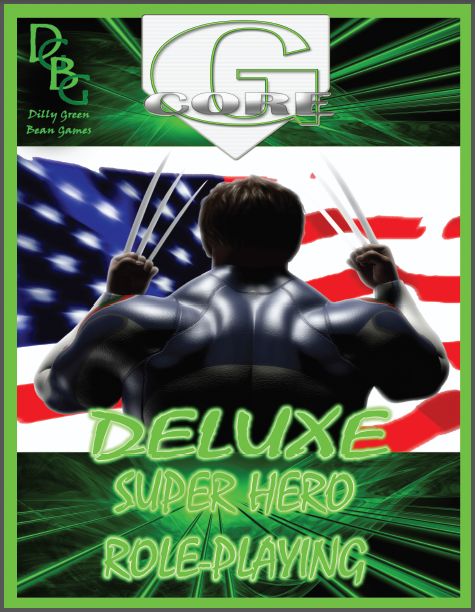
The thing that hit me right in the face as soon as I opened the file is the look of the thing. See that green border in the cover shot up there? There's a brighter shade of that in a thicker page border on every one of the document's 69 pages, including the blank character sheets at the end. That's a whole lot of highlighter green, probably more than I personally need. Also, the art is a combination of photoshopped movie stills and very shiny/creepy looking 3-D models. I don't usually care that much about the art in an RPG rule book but it's not good, and I've seen a lot of poorly-illustrated books over the last 30-something years. If I care enough to mention it, that should tell you something.
Organizationally there's an intro, an explanation of roleplaying, and then it jumps right into character creation with two pages of point allocation and a running example of building a character that is a little arcane when I don't know how the system works. Why would I put 10 points into this and 40 points into that when I don't know what it means? After this we jump right into Types, Origins, Flaws, etc and then finally on page 15 we get to the mechanics and how this stuff all works.
![]() |
| Some large boots to fill ... |
Abilities are rated on a 0-100 scale, and a typical task roll would be Ability + skill bonus (if any) + d100 roll (as noted above) vs. a difficulty ranging from 25 to 150 similar to d20 system difficulty classes. That works alright as a fusion of MSH and D20 mechanics, replicating the various colors from the chart (e.g. "you need a yellow Strength FEAT here to stop the bus before it goes over the side of the bridge) but it loses the easy adjustability of the column shifts as difficulty modifiers. If the speed and weight of the bus means that you need a yellow normally, then the column shifts would account for the fact that it's raining or you have one hand throttling a dinosaur or you're wearing high heels. It goes away with this mechanical system and nothing replaces it.
After this we get 20+ pages of powers. I think that's plenty to get started.
There is a Popularity system that is very much like the MSH Karma system.
Every table in the book is set up exactly like the tables in the MSH books - things like what each rank of an ability means along with a descriptive term - the one where Aunt May's Strength is "Feeble" and Hulk's is "Unearthly". It looks a lot like that without the neat little illustrations, the character names, and different descriptive terms. It's pretty familiar if you've read through the MSH books recently.
There are 5 pages of "Generics" or archetypal statblocks - this is a good thing and something I consider essential in a supers game if I'm supposed to run it. It's pretty solid too, covering everything from basic crooks to robots to giant octopi. It's a strong feature.
![]() |
| But is it Iron Kid friendly? |
- It's touted as a spiritual successor and very compatible with FASERIP - that's true. It even mentions loads of free FASERIP material available online, which is also true, including the original FASERIP rules! If I am that interested, I can just download those and use them in their original form. There's also the 4C version if you want the same mechanics with less Marvel sauce. So G-Core is an odd position of appealing to nostalgia on some level while the object of that nostalgia is freely available online - but G-Core will cost you a few bucks!
- It's touted as kid-friendly and in a "well it's not a 500-page hardback" sense that's true. However, the original MSH Basic Set pretty much nailed kid-friendly, probably more than any game published before or after. So I would say it's less kid-friendly than its parent game. Plus there is another game I consider kid-friendly that's in the same sandbox as this game - more on that in a minute.
- Compared to other Superhero games it lacks visual appeal - G-Core makes BASH look like a Games Workshop production.
- Compared to other superhero games it also lacks flavor. There's no universe, no context, no memorable characters or villains - this is strictly a set of mechanics.
- Compared to some other retro-inspired games it looks and reads like a far less professional effort - take a look at OSRIC, Labyrinth Lord, Mazes and Minotaurs, or Mutant Future and they have a certain look to them, even if they're mainly mimicking older rule book styles. Now consider that those are free and this game is not - that's a mark against G-Core.
- Finally, the elephant in this Tower: ICONS. Icons does everything this game aspires to do and does it in a way I like better. It looks better, it reads better, it has some interesting heroes and villains in the main book, it covers all the powers, it has both random and point-based character generation, and when it replaces the color chart it adds an interesting FATE-inspired system of mechanics in its place. ICONS is easily more kid-friendly, conversions are just as easy, and it plays just as fast. There is a cost difference, $3.50 vs $14.99, but there is a lot more ICONS-specific support and for my purposes it's just a better game, easily worth the $10 difference.
![]() |
| You probably thought I was going to put an ICONS cover here didn't you? |
So to wrap up: I don't think it's a bad game, I just don't see a good place for it with original MSH/4C filling the "nostalgia slot" and ICONS filling the "modern update of a classic" slot, and BASH filling in the "alternative lightweight system" slot (and with the non-ultimate version of that at $1.99). If G-Core was free I would probably have a somewhat different take on it as an interesting variation - once you decide to start charging money for it though, I feel like I should take a harder look. I admire the enthusiasm behind it, but that's not always enough. As I've mentioned in some other recent posts, what does G-Core do better than any of those other games? I don't have a good answer.
Wednesday, June 6, 2012
Character Builders
I'm seriously considering some character building software. The 4E offline builder opened the door, the ICONS Character Folio opened it a lot more (it's a lot of fun), and now I'm really sliding down the slope.
First, I'm thinking about HeroLab because it seems to be the standard and I could use it for Mutants and Masterminds right now. There are some things I want to convert from M&M 2E and software would make it much easier. The Apprentices impressive lack of ability to keep up with their character sheets for most games is also a consideration here. The character sheet output looks nice too. Beyond that it has sets for Savage Worlds, Shadowrun, and it interfaces with DDI. I might dig into the authoring tools as well and see if I couldn't learn something and tune it up for some other games.
Second, I'm thinking about signing on to DDI - despite my dislike of the subscription-based approach - for two reasons: The Monster Builder would save a lot of time on my conversion activities and I still like to have a printed monster sheet in front of me when I play. Additionally I think it's time to pull down all of the 4th Edition material while it's available and I'm running some campaigns. No, WOTC shouldn't pull it all off of the web just because a new edition is coming or after one launches - it's not like there's much expense in keeping it available - but it has happened before and there is some good stuff on there that I don't have. As much time as I spend running 4E games, I feel like it's worth ten bucks to try it out.
Finally I'd like to get Hero Designer just because I like to tinker with Champions characters and that's easier to do in software than on paper. Also it supports 5th and 6th edition and some 5E updates of some of the old 3E/4E characters would be a lot of fun and less time consuming with it. No I'm not running a Hero game (yet) so this would be a total indulgence on my part. I try to have a real use for the gaming stuff I buy, and I try to focus my money on games I am actually running, and this would not fall into that category. I'm still thinking about it. Mostly I'm thinking about which day this week to do it.
If any readers have any personal experience with any of these, I'd be interested in what you have to say. If I proceed with any of them I will share my experiences.
Tuesday, June 5, 2012
The Apprentices try D&D Next
So after a week of buildup we set up Saturday night to playtest D&D Next. I walked through some of the changes and they sorted out which characters they wanted to play. Only two of them were up for it so they took two characters each.
![]() |
| All Set! |
Blaster took the two dwarves, a fighter and a cleric, while Red took the elf wizard and the halfling thief. I had a very old copy of KOTB for the map and some flavor. I also had a brand new set of dice to ensure we were free of any lingering luck issues or edition issues.
![]() |
| Test game = Test mini's - Thank you Heroquest & Warhammer Quest |
The Apprentices wanted to start off moving through the forest between the keep and the caves as in our earlier Basic campaign it was full of spiders but it was a much shorter route. I explained that we weren't really worrying about the keep part or the traveling part tonight, we were going to jump right into the caves themselves - they were fine with that.
![]() |
| That's a Cave. Trust me. |
With the dwarves in front and the others in the back our heroes choose to enter the goblin cave (well remembered by the Apprentices from earlier times). Around the corner they encounter a band of six goblins. Neither side is surprised so combat begins.
The goblins have shortbows that actually do more damage than their maces (1d6+1 vs. 1d6) so rather than suicidally charging ahead they stand and shoot, hitting both dwarves.
The halfling returns fire and kills one of the goblins while the dwarves charge forward. The cleric takes one down with a swing of his hammer (ah, old-school goblin hit points!) but the fighter misses. The wizard magic missiles one gobbo but does not drop him.
In the second round the goblins step back and fire - 17/18/19/19 - two shots each into the cleric and the fighter! The cleric drops (and Blaster is stunned) and the fighter is seriously wounded, though in response he slays one of the goblins with his axe in a single blow. A second magic missile finishes off another goblin while the halfling moves into a better position.
Round three and the goblins back up again, put 1 more shaft into the dwarf fighter and he drops beside his clerical companion - at this point Blaster fails a morale check, declares "this game sucks" and sits in his chair fuming. Red's elf wizard steps up and lets loose with burning hands and fries both of the remaining original goblins plus two more that had just come up from the nearest room! Meanwhile two more goblins have advanced down the opposite passage and the halfling steps out of the shadows and absolutely eviscerates one of them. Apprentice Red, in stark contrast to Blaster, is having a pretty good time!
By the sixth round the fight is over and due to a quirk in the healing rules the party retreats back outside the cave ravine to a safer wooded area to rest and recover.
So that's it - about 30 minutes of discussion and rules talk, about 30 minutes of maps, minis, combat and complaining, and about 30 minutes of deciding what to do with the rest of our evening. We ended up making Warhammer Fantasy characters and playing through a short combat with them, and after getting to use the critical charts in that game the boys are all fired up and I may have inadvertently walked into yet another campaign. Apparently one of their friends has played it before and another may be interested so we will see where this unexpected development leads.
![]() |
| Plans B, C, and D |
So back to Next: What about it?
- I like the speed of play - it was a lot like our Basic campaign sessions. This is the one area where 4E still rubs me a little raw - there are no short fights.
- I like the general emphasis of the system - it is less rules-intensive than many previous version, but the unified mechanical approach makes for a smooth game in play too.
- I like the Race/Class/Background/Theme approach to defining a character - that should be pretty flexible by the time it's ready to publish.
- I like the way hiding and sneak attacking was handled - it's a lot easier to manage in play and makes 3E style sneak attacking / AD&D style backstabbing much simpler to pull off.
- I did not like the healing & resting rules. Even with a freak roll like I had the party normally should be able to recover but the cleric was the only one with healing capability and he was the first one to drop. A Short Rest takes 5 minutes and allows you to recover hit points from your "hit dice" (aka healing surges) but only if you have 1 hit point or more. After going below zero, you can stabilize, but you are still considered to be below zero hit points and so you can't benefit from a short rest, or even a long rest! After 2d6 hours you recover 1 hit point, and at that point you could rest and start recovering and healing people. It makes characters very dependent on outside aid to prime the pump, but able to handle healing themselves once someone gets them above zero. If we're looking for less clerical-dependency and for more self-sufficiency then I think this must-be-at-1-or-more rule needs to go away.
Now the night before I had run another session in our current 4E campaign so it was fresh in my mind for comparison. I am still very happy with 4th and will likely be running it when Next is eventually published and beyond, but I can see Next becoming a faster and lighter alternative, maybe for a weeknight game. I'd certainly take it over 3.5/Pathfinder if it keeps going in the right direction, and it may finally close the door on my occasional bursts of nostalgic fervor that demand everyone roll up an AD&D character on goldenrod paper and start beating up hill giants. I think it has a lot of retro-conversion potential.
The closest comparison I can think of is Mongoose Traveller to Classic Traveller. LBB Traveller was good but the rules were scattered around and didn't always work well in practice. The Mongoose version took 25 years of gameplay and design and adjusted the original in many small ways and gave it a unified mechanical system that made it much smoother in play and opened the door for an explosion of support and a near rebirth of the old game. That is how this feels - like Basic or maybe even AD&D polished up by the experience of 4th Edition and making some deliberate choices about playability vs. realism.
![]() |
| Like this, it feels a lot like the classic, but with some sensible improvements |
I will also say this - without the mixed business success of 4th edition, I don't think we would be seeing this. Despite the "back to the dungeon" slogan, 3rd edition was a huge mechanical change over 2nd edition. Emboldened by the success of this, 4th was an even bigger change and seems to have been a step too far, despite my love of it. Burned by that, WOTC seems to be looking backward for inspiration and not just for dungeoneering as with 3E. I think this one may out-retro Pathfinder, and still have cleaner math.
So that's our first run. If I can talk them into it we will be trying it again but it may not be for a week or more with all of the schedule madness right now. I may experiment with whipping up another dungeon for them to use for that - perhaps a certain tower needs another clearing-out after being catapulted into rubble by the townspeople...
Note: There's a good article on the new approach here. Again, older school in feel but newer school in mechanics.
Monday, June 4, 2012
The Obligatory DCC RPG Post
This one is getting a lot of attention in old school circles (and even on EN World) and I have not mentioned it here so I thought it was time.
I am a huge fan of Goodman Games - I used more of their modules during 3rd Edition than any other publisher's. I have 20-something of them still on the shelf. They were right up there with Necromancer in my view. So I have had nothing but good experiences with previous products.
I downloaded the beta for DCC and played around wit hit a little but I never ran it, nor am I all that excited about the new final version - let me explain why:
- Zero-Level Characters - this keeps getting mentioned as some kind of old-school thing - it isn't. The first published rules for it I can recall were in the Greyhawk Adventures hardback on the cusp of 2nd Edition AD&D, though I think there may have been an adventure that included the concept as well. Thing is, 1st level characters are already terribly fragile and have extremely limited capabilities. The idea of going backwards from there just holds no appeal to me at all as a DM or as a player. The vast majority of players in my past have shown zero interest - in fact many reject the concept outright - when offered the opportunity. How many sessions does any veteran player want to spend at 1st level? Zero-level beginnings only add to that time. As an option I can see some potential value to this but as the default approach to creating characters it falls flat for me as soon as I see it. It's been a long time since "having your characters die a lot is fun" made sense to me. Besides, I have Hackmaster for that already.
- Races as classes - at least this is old school, the problem is that it is "bad" old school. If old school is a "spirit of how you play - improvisation, rulings not rules, player skill" then why do people keep bringing back rules mechanics so many of us were eager to shake off? I don't know anyone who thinks Elf as a class is a better way to handle things in a class-based game than separating race from class. It's simpler, sure, by limiting player choices at character creation - the problem is that the player is going to live with that character through multiple levels of play (if things go well) but they're treated like it's a HeroQuest playing piece! As an introductory option for new players I'm fine with it, but that does not appear to be what this game is aimed at - it appears to be aimed at veteran gamers. So why choose this route over the more open approach?
- Spellcasting - rolling for spell success has nothing to do with old school D&D. The difference in the approach to spellcasting was listed as one of the big dislikes for many players against 4th Edition D&D. Roll-to-succeed has been in a lot of other games for a long time - Fantasy Hero, GURPS, and Warhammer for example - but not D&D. As far as the claim to Appendix N emulation how many times does Gandalf fail to cast a spell? Elric? The Lankhmar Duo? I just don't see it happening. The whole section reads like the Warhammer casting rules, complete with multiple tables of increasingly bad effects on a botched roll. I don;t really see the connection.
- The extra dice - No, I don't care for the extra dice. I can maybe see some logical need for fill ing the d14/d16/d18 gap but I've never felt a need for it in a set of rules or in gameplay, and certainly I've never needed a d30 for anything. If the game is going to require unique dice then it should come in a box and include them.
![]() |
| I don't think it requires this one officially |
Despite the dislikes expressed above this game falls into the category (and many games do at this point) for me of "I'd give it a try if someone else was running it, but I'll never run it myself". As is often the case I suspect that with a good DM and some good players it would be worth overlooking the mechanical dislikes to have some fun with a good group, but it would not be my first choice.
For me (and for other people too) the biggest limitation on our gaming isn't money or lack of good games, it's time - time to actually play something from the big pile of games that we already have. Old games have an advantage in that we typically already know the rules and have a pile of material to work with and these two factors make it easy to focus on actually jumping into a game. Examples here include Basic D&D and Hero System (for those of us who stuck with it for a long time). Newer games have some advantages in that they are typically designed to be easier to learn and play (less fiddily mechanics) and are also often designed to a goal of getting more done in a session and less to a goal of realistic simulation. Examples here include Savage Worlds and even D&D 4th Edition. So the less complicated rules system and the smoother play make up for the lack of familiarity. A game like DCC falls into neither category - it's like an old school game but enough of the mechanics are different that my familiarity means nothing (unlike say, Labyrinth Lord). It's also a new game but it's not really built like one, so the mechanical aspects skip newer design features like unified mechanics in favor of discrete subsystems that may add flavor but also and complexity and page-flipping.
While not specific to DCC I admit, I have developed a strong preference for games that place an emphasis on making it easier for the DM to run a game as that's really the core of what we do - to play the game, someone has to run a game. Systems that cater to that make me happy. Savage Worlds does that by keeping combat action-packed yet largely free of record keeping. D&D 4E does that with no-lookup monster statblocks, solid math, and a level-tag on everything to make on-the-fly eyeball-judging easy . Icons does that by taking a broader approach to superpowers and advantages and disadvantages and relying more on judging than detailed mechanics. M&M does it by providing tons of plots, archetypes, and the power level system to keep it all indexed for on-the-fly-eyeball judging.
![]() |
| I have this already |
Specific to DCC I have also developed a preference for games where payers have interesting choices to make right from the start and I don't see it as much here. Most of the characters from my D&D campaigns over the last 12 years could not be recreated in DCC. No Dwarf clerics, no Elf rangers, no Halfling wizards, no 1st level human Paladins, no Drow Vampires (sorry that's very much a 4th edition thing - ignore that) and that tells me my players aren't terribly interested in the heavily restricted character options available here. They certainly aren't interested in spending more time at the lowest levels of a D&D type game. They aren't going to go buy more special dice just for this game. So I won't be running it.
Then there's the final question - I have 5 or 6 or 7 versions of D&D around the house. I have Fantasy Hero, GURPS, and Warhammer. I have Rolemaster. I have Reign. I have MERP. I have Pendragon. I have old and new Runequest. I have Savage Worlds. What does this game do better than those games? Why should I spend money to acquire it and time to read and digest it and plan a campaign for it? How is it going to push any of them out of the starting line up and take their roster spot? I just don't see enough there to incite me to make that jump, and I see a lot of reasons not to. I'm not telling anyone not to go play it - this is strictly my take on things - but going back to what I said above I have a fixed amount of time available to play RPG's. My players generally do favor Fantasy over all others, but they need a reason to switch, and as the DM I need a reason to push for a switch. As it stands now DCC doesn't give me enough of a reason to do that. Don't feel bad DCC - Pathfinder didn't give me enough either, and I like those guys too, so you're in good company.
Subscribe to:
Comments (Atom)