Thursday, August 3, 2023

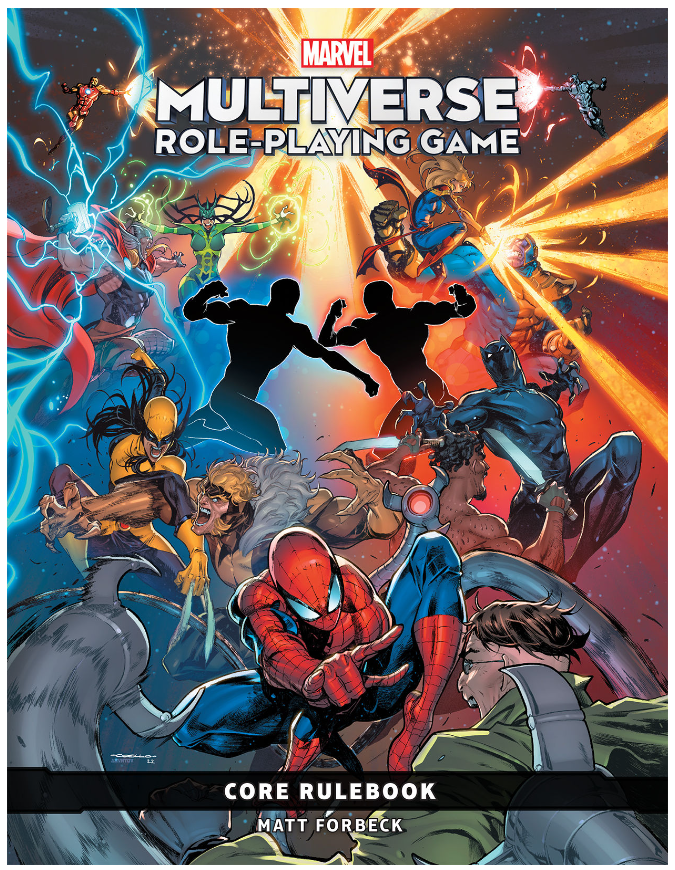
Marvel Multiverse RPG - First Look


Quick take: this is a vastly improved system compared to the initial playtest rules. I talked about them here and then a later take on the playtest updates here. I did not like that initial version at all but had more interest in the final playtest rules. This new version is improved in every way over those and I like it enough I will be trying it out with the crew this weekend. 

Of course they're going to want to sell you some dice!

Basics

  • It's still 3d6 with one designated as the Marvel die where a "1" counts as a "6". Add these together, add a stat modifier, then compare to a target number where meeting or exceeding = success and rolling under = failure. So it's similar to most d20 systems but with a bell curve and a wild die mechanic. 
  • A 6 on the Marvel die and succeeding means you have a "Fantastic Success" which gives a bonus effect depending on what you're doing. Some of these are defined but there is a lot of flexibility here. A failure when you do this is a "Fantastic Failure" and means something good still happens - this is similar to netting out with only advantages in FFG Star Wars. It's not a success but it's still beneficial somehow. 
  • Rolling all sixes is an "Ultimate Fantastic Success" and is an auto-success which ignores any Trouble (see below)  and is pretty much the best possible outcome you could have.
  • Some powers, traits, and situations, grant "Edge" which is reroll one die from your roll and take the best result - so it never hurts you. 
  • "Trouble" is triggered in similar ways and means you must reroll the highest die and take the worst of the two. Trouble and Edge can stack up individually and they do cancel each other out if both would apply. 
  • They dropped the "Botch" concept from the early version so they figured out that you don't really need a critical failure mechanic, especially in a superhero game. That said the concept is out there if anyone wants to add it back in. 
Characters

  • A character is built around the 6 core stats: Melee, Agility, Resilience, Vigilance, Ego, Logic. Yes it spells Marvel. Yes they mention it. Your score in these stats is your modifier like Mutants & Masterminds. Human average for all of these is zero and derived stats typically have a minimum of 10.
    • Melee drives HTH attacks
    • Agility drives ranged attacks
    • Resilience x30 is your Health - hit points by another name.
    • Vigilance x30 is your Focus - this is another damage tracking stat but it's not Stun as in Champions or Shadowrun. It's more for emotional or possibly fatigue type effects. This is where psychic damage hits. Reaching zero here gives a character Trouble on all rolls. I think there are some interesting implications in this.
    • Ego in D&D terms is sort of Wisdom + Charisma and it drives magical attacks and rolls
    • Logic covers the obvious and also drives mental powers. The example given in the book is that Reed Richards and Professor X both have high Logic scores.
    • I think the usage of these are fairly obvious but I do like seeing Vigilance in the mix there. Perception type skills are used a lot in in RPGs in my experience so why not make them a core stat?

    • There is also "Karma" which starts off equal to Rank and allows one to heal and activate Edge and Trouble once per point and then refreshes with a good night's sleep.
    • Beyond the stats a character is defined by Powers, Traits, and Tags
      • Powers are covered in about 14 pages and I am sure we will see more in future books
      • Traits are like advantages in other games. They add flavor and typically give a small bonus like Edge on certain checks
      • Tags are more like disadvantages in other games - think secret identity, dependent NPCs, code of honor, etc. - and give no mechanical benefit but can be touched on for Karma
    • They did, thankfully do away with the archetypes and the 25 ranks that were in the original version. I really don't think many people are asking for classes and levels in a superhero game these days and they figured that out during the playtest. 
    • Rank is still a thing though. There are six ranks that are really a power tier kind of system. Rank 1 is "normals" even with some training, Rank 2 covers neighborhood protectors as they say - like Daredevil & Elektra. Jump to Rank 4 and that's where most of your Avengers and X-Men fall like Spider-Man, Cap, Iron Man, Black Panther, Colossus, Wolverine, etc. Rank 5 covers your heavier hitters like Thor and then Rank 6 is Cosmic level - Captain Marvel and the Silver Surfer types.

      This does have a mechanical impact on the game as your Rank is a multiplier to damage. So if someone throws a punch it is the result of the Marvel die (so 1-6) x the characters rank  and then we add the Melee stat modifier (the stat is the modifier like Mutants & Masterminds, average human is "0"). 

      Example: War Machine has a Melee stat of 2 and is a Rank 4 hero so a punch will do 1d6 x4 + 2. There may be some additional power or circumstance that could impact this but that's the base. Also, a Fantastic success  in melee means double damage so that could change things dramatically.

      If you're wondering how this stacks up to his defenses ...

      War Machine has "Sturdy 2" which reduces the multiplier of incoming attacks and has 90 Health so an average punch to himself would do 3.5 x2, so 7, +2, so 9. So he could take 10 average punches from himself.

      But if, say, Thor whacks him with Mjolnir, well ... now we're looking at a d6x10 (which we reduce by 2 for the armor) so 3.5x8 = 24, then we add 12 for the stat ... so BAM! 36 points in one average hit! On the third one of those Rhodey is down and out!
    How many spider-characters will be in this book? 10? 20? 100?

    Combat

    • This game does use rounds of 5 seconds where each combatant gets a move action, a standard action, and a reaction once per round. 
    • Initiative is a standard 3d6 test - highest goes first.
    • Distances are measured on a grid of 5' squares. This is the weirdest thing left in this game to me - an obvious D&Dism that is just silly in a game where people fly and teleport and run around the world in ten seconds. It's not really an obstacle to anything, just a weirdly specific baseline to have.
    • In addition to Health and Focus damage there are various conditions like Blinded, Stunned, etc. I think the game covers the full range of things one would expect. 
    • The topper: Knockback ...


      It's a good start ...

    That example just cracks me up and this whole section shows me that someone gets it on the writing team.

    Initial Concerns

    • Well, there is no skill system. Your stats combined with Traits pretty much describe your day to day life.
      • You're not going to make a "Stealth" roll - you're most likely going to make an Agility check with an Edge from your "Sneaky" trait if you have one.
      • Defensive use of stats, like say the guard you are trying to sneak past, is the modifier + 10. So this sneak check would be Agilty + bonuses vs. the guard's vigilance defense which would be Vigilance + 10. 
      • Not much modifies these rolls - having a trait gives you an Edge or gives the opponent Trouble, depending on who is doing what. It's playable but it's not exactly intuitive coming from many other RPGs. 
    • There are no vehicles listed in the core book. I have a process for throwing a car at someone and a process for punching someone through the side of a battleship but I don't have stats to use either of those things in the game. That feels like a miss.
    • Task numbers are good but there is one concept that leaked in that is a personal beef:
      • There are 7 levels of difficulty from Trivial at -6 to Challenging at 0 to Absurd at +6, with steps of +/-2 in between. This is fine and expected.
      • Then there is a separate chart for "Challenging TN by Rank" which presents the base target number for "Challenging" tasks as 10 + Rank. I really really dislike this approach as a task, in my mind, should be rated in its absolute difficulty - If climbing the side of a skyscraper is a "Difficult" rated task then it should be, say, a TN14. It shouldn't be a TN12 for a Rank 1 character and a TN 16 for a Rank 4 character. Rank 4 types are inherently more capable so yes, they will typically have an easier time completing the same task than a Rank 1! Changing the base number equalizes the difficulty between the two which defeats much of the reason for designating Rank in the first place.
      • This feels especially off when they note that many teams have members of different Ranks like the Avengers where Hawkeye is Rank 2, Black Widow is Rank 3, Captain America is Rank 4, and Thor is Rank 5. 
      • I'm going to try it as written first but I will be keeping an eye on it.
    It's not just a pun - pretty sure he will be in my game this weekend!

    Things Done Well
    • The rules are presented in the right order: Basic task resolution mechanics, then how to read a character sheet, then combat, then how to create a character, then the reference sections. Excellent! Don't jump into telling me how to build a character before I have any idea how the system works!
    • The layout, language, and examples all seem right. It's a good-looking book.
    • It does contain a full character creation system so one can make an original character right from the start.
    • There are about 130 pages of character profiles and they take one page each so that means we start off with about 130 Marvel characters to use. Now some of these are things like "Hand Ninjas" or "Vampires" but the vast majority are named Marvel characters which is exactly the kind of thing a game like this needs. Well done!
    So there's my initial rundown of the book. I'm going to get my hands dirty with it this weekend I will post about that next week!

    Monday, July 31, 2023

    Campaign Planning 2023


    I say 2023 because I am betting this will start later this year though you never know with schedules and complications and I'm not going to rush the Deadlands game to a conclusion. It's good to have a plan though. 

    Fair warning: this will pretty much be me thinking out loud about various options, many of which I have outlined before, sometimes years ago on this very blog.  Hopefully it all makes some kind of sense.

    I have been running Deadlands "The Flood" since September of 2021with 25 sessions completed. That sounds light to me but there was a 3-month gap at the end of 21 and start of 22 then a 6-month gap last spring/summer as I went house-hunting and then moved into a new place. So when we get going we are pretty consistent but we do have gaps here and there. It has been the main game for the last three years so Savage Worlds has been our main system.

    This year I have also run some FFG Star Wars as a side campaign and ran a Sentinels of the Multiverse kick-off session that has thus far only been that one session. 

    When we finish the Deadlands game that's probably enough Deadlands for me for a while though I do have plenty of material to run more. After running a particular setting for an extended period I like to  switch to something else even if I know I'll be coming back to it later. It helps me to change perspectives and assumptions.

    System-wise I do like Savage Worlds and I have since it was first released but I'll probably change that out too. System mastery is nice but there are a lot of cool games out there and I'd like to spend time with all of them so rotation is important.

    That said let's talk about Savage Worlds options: it's probably Rifts. I'd love to run Weird War II, and for some reason Slipstream has been calling out to me lately, but if I turn right back around into this system it will probably be for Rifts. Even now, 30+ years later that game calls to people with all of the character options and setting weirdness and I should probably take another run at it. I have plenty of ideas and there is more than enough setting material new and old for a nice long run. I had a thought recently about converting some adventures from other games that I like to see how it might go - from D&D to Traveller to Twilight 2000. It's definitely a candidate. 


    Another candidate would be some kind of old school D&D type game. The Black Hack looks like fun, with Labyrinth Lord or OSE as more traditional options. I might run this as a traditional Town + Wilderness + Dungeons/MegaDungeon setup. I haven't run a fantasy game aside from a one-off last year in a long time and this might scratch that itch. The other thing here is that I don't see this being as much of a long-term campaign as some of the others. Make characters, get our hands dirty running through a few levels, and then consider rotating out. There tends to be less system overhead with games like this so in my experience you get more done per session than some games. I'd play this pretty loosely and let the players choose their path of course, as sandboxy as they want, and try to have a suitable stopping point in mind. 


    A smaller contender for a fantasy game would be a Warhammer Fantasy Roleplay campaign. This would probably be 2nd edition as I have all of the books and between published adventures and stuff I sketched out years ago I could run for quite a while. It's a fun system and it's not like I don't have the miniatures ... it's just a matter of getting people to try it. 


    The other fantasy contender would be a 5E game that would take the classic path of Temple of Elemental Evil-Against the Giants-Drow Series with a finale at Queen of the Demonweb pits. There are good 5E conversions of most of these so the technical side is easy enough. I've wanted to run these for years and this would be that effort. looking at the long term there are several built in stopping points too - maybe if we completed ToEE my guys might have had enough 5E for a while so we rotate to something else and then come back to it down the road to play through the Giants series. I know I tend to burn out on 5E so if it takes a year I may well be ready to do something else myself. There are enough monster books out now for it that I can probably make them interesting at least and If I do run 5E again this is the most likely path.


    Getting away from fantasy campaigns the dream would be to finally have a superhero game as the main campaign for the first time with this crew. I like Sentinels after trying it out and there are a lot of other good supers rules but for a longer-term campaign I would go with Mutants & Masterminds. Tons of support both books and online , tons of characters and villains both, locations ... it has everything I would need. I'd probably go with my own setting rather than Freedom City but I might still include a lot of FC elements. This is the dream but I have to make sure my crew wants to commit to it before I start going nuts.


    Star Wars will always be an option and I've run enough now that I feel like it's a real campaign but I kind of like it better as the side/backup option. Everyone's familiarity with the setting and the visuals makes it very easy to drop in and out without missing a beat and I'd like to keep it going in that role. So I'm not ready to move it into the main spot right now.

    Other Space type games would be some version of Traveller or Stars Without Number. I'd love to run a post-apoc game like Gamma World or Mutant Crawl Classics but I think Rifts would take precedence. Maybe Hell on Earth makes it in next time as a compromise. Star Trek would be a blast but will probably never make "main game" status. 

    So there are my thoughts on the Next thing. More to come.

    Friday, July 28, 2023

    Catch-Up Time


    Tres Gatos

    Had a lot going on around here lately so posts have been sparse. I took some time to go and get married so that did have an impact but things are settling down now. It's also Con Prep Month so a bunch of my players are tied up with that so the regular RPG action dries up until August. But things are not -completely- idle.

    With the slowdown RPG action turns from "running" to "reading" and after working through MB and The Black Hack I am working on Hellfrost for Savage Worlds, the Trinity Core rules & Aeon (again), and Traveller Mongoose 2.0 Core 2022 Updated Edition etc. etc. with Sine Nomine's Wolves of God and Godbound on deck. Trying to cut down the stack but it's been a slow go with everything else going on and trying to read some non-game books too.

    RPG-wise I am also contemplating what to do after Deadlands wraps up. It's a few months off at least but I like to have some options ready to go. More on that later.

    Fred on the Fence

    With 10th edition 40K in that weird quiet time between the initial launch and the release of the first codex I've managed to work in at least one game and pick up some new units, new terrain, some of the index datacards (mostly for codexes we know are a long way off), and to manage some painting here and there. 

    The weather is not cooperative here right now as it's too humid in the mornings and too hot in the afternoons to spray anything and considering that affects both the first step and the last step in my process I am developing a logjam of almost-finished stuff and built-and-ready-to-start stuff. My Necrons especially are suffering here and I am feeling it because they are very close to "complete" as an army - well as "complete" as an actively-played army can be anyway.

    The plan was to finish the robots up and then dive into the Tyranids but it's not moving very quickly. In between the pile of Crimson Fists that are ready for paint and the Berzerkers in the same state to mostly finish out my World Eaters are getting some though no enough attention. Then there are the shelves full of Black Templars and Imperial Guard that are sitting there waiting for a turn as well. I might have overdone that whole "getting ready for 10th" thing. At least those two are playable armies I was just adding to, not starting from scratch.

    Ranger and Sam the newest cat

    Computer-wise it's been intermittent City of Heroes, some World of Warships, and starting out Baldur's Gate 3.

    So it's an active summer if not especially game-intensive - a bit of a break between a busy spring and a hopefully busy fall.  

    (Slow gametime-wise so why not some animal pictures? Enjoy.)

    Thursday, June 22, 2023

    The Black Hack


    Looking at another OSR type game that's not just an edit of an old rulebook this week leads me to the Black Hack. I was only peripherally aware of this one until last year when I finally picked up a copy of the rulebook and dove in. I am mainly looking at 2.0 here as I assume that is the author's "best" version to date.

    The Basics

    We have the usual six stats, the four basic classes, an option for backgrounds but no real race options outside of that background piece.

    Normal "test" are made by rolling a d20 trying to roll under the relevant attribute which is very common in OSR-type games . Instead of the traditional list of modifiers for things, though, TBH introduces Advantage & Disadvantage from 5E D&D - that's a good thing. 

    In another deviation the game steps away from the traditional dungeon grid of 5' or 10' squares and brings in a range band system similar to say FFG Star Wars among many others.

    Combat is also notably different in that PC's make an attribute test to hit an opponent and they also make a similar roll to defend when attacked. This is not an opposed roll situation - rolls are strictly made by players.

    Also armor absorbs damage in this system but not in a typical way. The wearer chooses when to use their armor which then absorbs all of the damage from that blow but the catch is that it can only do this a limited number of times from twice for leather armor to four times with plate. This is a version of the "shields shall be splintered"  rule that's been kicking around for quite a while now. One bonus is that there are built-in rules on how to repair one's armor right there in the same section so it's treated as "this is how armor works" and not as some special one-off event that will require a trip back to town. 

    Now right here we can see that despite the OSR label this game deviates from typical D&D conventions in many ways. A lot of more modern design concepts are showing up here and this spills over into other areas too, such as monster design. Each monster lists the attribute a PC must defend with but they may also have some special qualities too. Some examples:

    - Stubborn
    If hit by an Attack with an odd die roll, the Monster takes half damage.

    - Striker
    Targets must make two Defence Rolls that each only deal half of the Monster’s normal damage

    - Frenzied
    Every time the Monster misses, it gains an additional Attack in all subsequent Turns. All additional Attacks cease if it deals damage.

    Right there these simple modifiers make it easy to tweak the feel of combat against different creatures and liven it up from the simple swing/hit/miss/damage dynamic that can sometimes dry out basic D&D combat.  I like this a lot. Here's a specific example:

    Skittering strike - STR (1 Close) 6 dmg
    Swift! If the elf is hit by a melee Attack it may Move immediately

     Now we are starting to look more like 4th edition D&D's monster design and that is nothing but a positive in my opinion. Giving monsters (and player characters) things to do besides trade die rolls until someone's numbers run out makes for more interesting fights. 

    Spellcasting is simplified but still seems useful - it's memorize one per level up to the character's level. Casting it once is automatic and is then followed by a stat check to see if the caster retains it. After the second time this roll has disadvantage. A success here means the caster retains the spell while a failure means they have lost it until they re-memorize their spells for the next day. 

    Other Stuff

    There is the expected OSR obsession with random tables on full display here - a good-sized chunk of the back half of the book is random tables, maps that can be used alongside those or as random generators themselves (drop some dice on the picture to see what's here). There is good advice on running a game here as well. 

    I'm glossing over a lot of the details but all said this is a a comprehensive game covering all of the little stuff like light levels, diseases, poisons, magic items, etc. The difference here is that things that would get pages or a whole chapter in some modern games are covered here in a paragraph + a table or a half page. It is very flexible, giving the basics and assuming a DM will work from that and improvise as needed. Reading it, I don't see any major gaps but I will test that when I run my first session.

    One of my favorite monsters from this book the "Long Dead Future Man" which sounds like a name Hank Venture would come up with.

    Support

    The level of supplemental material this game has inspired is pretty remarkable. Just go to DTRPG and type in "Black Hack" and well over 1000 items come up - adventures, monster books, class books, race books ... it's impressive. Then add on all of the "inspired by" items like Mecha Hack and the game's impact/lineage/coaching tree is very strong. In short - the game is good and there's a ton of more good stuff for it and inspired by it.


    To close out I think this is the best of the OSR type games from the last 5 years. If you like B/X or BECMI type fantasy games but want to change up the system with some different concepts this is a great game to try and at the very least may inspire you to try tweaking a more traditional system in some interesting ways even if you don't go "full hack". I recommend it as strongly as any game I ever have on here.


    Tuesday, June 13, 2023

    Mork Borg


    So I finally took a look at the bright yellow hotness of the past year. Short take: it's a lot of style, some actual substance, and it's basically OSR Diablo.

    First off, the look: Yeah, it has a very distinctive style. It stands out on the shelf for sure. That said the differing fonts and colors and scattered layout make it a lot less efficient for looking things up and burns up a lot of space. It's supposed to be influenced by metal - doom metal/death metal - but I don't remember neon pink and bright yellow being players in those sub-genres - hair metal maybe but that's not really the theme they're going for here. 

    There are 10-12 pages of setting and it's very much a tone thing - a Realms-style detailed breakdown with maps is not what you're going to find here. I'm not going to get into the details here because a) it's an important part of the book's effort to set a certain tone and b) there's just not that much here. It presents a few paragraphs at most about a city or a region and maybe mentions what kind of insanity the ruler has ... it's a very loose kind of setting guide. 


    The end of this is where we find one of the more interesting things in this game: the "when the world ends" table. The DM decides how long they want their game to last and based on that they roll certain dice (ranging from d100 to a d2) every morning. On a 1 a "misery occurs" which is rolled on a random table on the facing page. There are 6 levels to it and each one can only happen once and then the 7th misery is the end of the world. Bang! End of game!

    Now this is cool on some level but the letdown here is that book sets this concept up but then fumbles at the goal line - what happens when the world ends? What do your player characters do? Is there a giant demonic beast to fight? Does the game shift over into some new kind of play? Do we at least roll on a random table for individual grisly ends?  Nope. As written it just ends. It's not even that it's hopeless it's just a non-event. The look and wording of the game is very Diablo-esque but those games typically end with some kind of big boss fight - here there is nothing. One of the points of a role playing game is doing stuff and there is nothing to do at this point - demonic rocks fall and everyone dies. Thanks for playing!


    Rules-wise it is again pretty loose. You can pick a class but the default is classless. There are 4 ability scores on the usual 3-18 range and they give modifiers to a d20 roll vs. a difficulty class similar to most modern d20 games. Race doesn't come up so presumable everyone is human or the world is so bleak it doesn't matter. There is a basic equipment list and armor is rated as a die roll to subtract from damage received. Magic comes from scrolls (which are permanent - not like D&D scrolls) and involve a roll so of course there are tables of bad things that can happen when you blow a roll. It's a fairly light set of rules but I can see a fair amount of page-flipping being needed during creation as things are mostly in one section but scattered around within it. 

    The book ends with a sample dungeon that is  fine in my opinion. It is the lair of a specific individual and his minions so it is not generic at all and the PCs are sent there on a rescue mission, not just to loot, so that's a nice start. It's maybe a session's worth of exploration and violence.

    Overall the game feels somewhere between tabletop Diablo with all of the doom and gloom and "Warhammer Fantasy Roleplay +1: Even Darker" with low-powered barely competent characters and a lot of mishap/injury opportunities like that game. I can see a touch of RuneQuest as well where the world is full of mysterious things and it can be very dangerous to go poking about. 


    My question after reading it is really how much time do I want to spend here? I just don't see the makings of a long term campaign here and the game doesn't really seem interested in a heroic fight against the darkness - it's more of a "keep your head down and try to get by until the lights mercifully go out" feel. I feel like it needs a table for why your character is being forced to go on these adventures in the first place because neither loot acquisition nor the zero-to-hero climb to power seem to be a part of this world. In the sample adventure you're offered a reprieve from execution if you can rescue a hostage from a dungeon - that's perfect for this world ... but then why go on with it afterwards? The whole setting is dark enough I'm just not sure what is supposed to motivate the PC's and to me that makes it mainly a one-off convention type game, not something you're going to run every week as an ongoing campaign. 

    Strong Veteran DM Take Here: The world should never because of a roll on a table. The world should end because of player actions. I realize that's a core conceit here but that doesn't make it right. That kind of event should come about because of your players.

    As far as an OSR type game this honestly feels nothing like the early days of Holmes Basic, AD&D, and Moldvay Basic. Not the tone, not the look, not the system, and not the adventures or setting. Early D&D was not especially dark and while your characters might be shanghaied into taking on a quest there was always a future to look towards: levelling up, finding gold or magic items, exploring the world, and just making some kind of progress in general. So if someone is looking for the feel of and old school game this is not that. Mechanically it has some of the loose feel of OD&D but even there the tone and approach is very different. 

    Comparisons:

    • If I am looking for something old school but more modern in design my personal choice would be  Labyrinth Lord or Old School Essentials. 
    • If I wanted something a little different then The Black Hack is out there for the taking. 
    • If I want a more distinctly different system with the old school tone then Dungeon Crawl Classics would be my choice. 
    • If I like some of the direction of Mork Borg but want a more defined setting and a little more "system" to go with it then WFRP is definitely in the sweet spot. 

    So to wrap up I don't hate Mork Borg and there are some interesting ideas here but if I ever run this game it will be a one-off to give it a spin but it will never be in the regular rotation - there are just too many other games that suit my and my players preferences better. That is the beauty of RPGS though - whatever your tastes you can probably find one that fits really well.


    Friday, June 2, 2023

    40K Friday - So Much 40K!


    Well it was a ridiculous May for this game and I expect June will be even more so. A faction focus almost every day! Much online discussion! Salt and tears! Then Thursday they go and nuke Horus Heresy models by Legend-izing them out of "competitive" play! I admit I've raised my eyebrows at some of the changes but in general I'm still excited about the update. The streamlining, the new data card approach, and getting it all out up front for free are very positive in my view. 

    Some of my enthusiasm may be coming from actually getting in some games again after a long gap. So far my Necrons are batting .500 against Blaster's Eldar which is fine but working through all the layers of running a 9th edition army is a lot of effort and there are a lot of opportunities to miss or forget things and I am even using the cards. I think the core of my dislike is the level of many of the strats - here's a set of 50 cards and 10 of them only apply to one specific unit in your army under specific conditions. "Only Canoptek units" - sure, maybe. "Only when a character dies near a Doomstalker which is not engaged in melee" - not so much. It's absurdly specific and that is the kind of thing that should be on the unit data sheet in some form, not on a card. Cutting out those kinds of stratagems can only help the game. Strats were a cool idea when they first appeared but they have mutated too far. Add on the dynastic protocols, character auras, the general rulebook strats, some of the more esoteric wargear ... it just piles up like the last few seconds of overwhelmed Tetris game.


    Getting all motivated meant sprucing up some armies and adding ... a few. That's been my month.

    • I decided that if the Crimson Fists are going to be my all-time Marine chapter then they should be far more up to date and the process I started here have only gotten worse continued. Progress was made so I added more to the pile and now have ... more progress I need to make. There has been a lot of filling in units I did not have - Intercessors, Incursors, Invictors, Aggressors, Inceptors, Suppressors, Repulsors ... heck I even picked up a unit of Reavers in the hopes they will be decent in this edition! Optimistic I said!
    • I have not gone nuts with then other loyalist marines. I set the Dark Angels aside for now, added one or two painted units to the Blood Angels when an opportunity presented itself, and reallocated some stuff to the Grey Knights I already had. I did recently decide to jazz up my Imperial Fists Deathwing army a bit since that should be even more playable now. Mainly some dreadnoughts, which had been painfully lacking since I first acquired the army. Of course they were Contemptors and a Leviathan so ...

    • Other Loyal Imperials: The Guard got a pretty massive upgrade as I decided it was time to make them more than just a tank army - A bunch of the new infantry, some Chimeras to move them in, some new Sentinels, Hellhounds, ordinance batteries, Basilisks, Wyverns, Ratlings, Ogryn, officers, even a Rogal Dorn - it was a major add-on as I finally decided I do love the guard. I am really looking forward to trying them out in 10th.
    • The other other Loyalists - I have been eyeballing a Custodes army for a long time and decided the time was now. They are kind of the opposite of the Imperial Guard so it will make for a nice change after playing one or the other. I did make this a "painted stuff only" force so I am not adding to the backlog. Given that they're a small elite army it's not too hard to put together a few thousand points and they tend to be painted similarly anyway so it really worked out. 
    • The other other other loyalist force I tuned up was my Imperial Knight group. With none of them painted the same way - because I wanted a gathering of individual knights, not a space marine chapter - it is ridiculously (some might say dangerously) easy to add one here and one there. I'm up to 7 of the big ones with 5 painted, one needing paint, and one needing to be built as Canis Rex. Then I have 6 of the small knights which I intend to paint up similarly to each of the larger knights (but not Rex) so the effectively each one has a squire. That's the plan anyway.

    • Of course once I started with the good knights I started noticing the bad knights. Not having any of them made it easy to see them as a gap and to justify getting some as the logical opponent to my loyalists ... and to try and convert some of my friends with "40K Battletech" as an option. So I bought a chaos knight army. In an interesting contrast to my good guys, this army is all painted to match. Well, except for the one big knight I added on which is close-ish, and the one I still need to build. The best thing is that it is all magentized! Given the largely fixed loadout of the chaos knights it's a handy thing to be able to switch form one type to another as needed. More to come on these for sure. 
    • I added a couple of items for the Iron Warriors but not all that much. I didn't want to create a backlog where one did not already exist.
    • The Death Guard did get some significant upgrades as mentioned in that earlier post and I am working on them in between Crimson Fists. Lots of Terminators and a lot of the newer style plague marines which I had avoided up until now. They will be ready soon enough. 
    • Finally I did pick up some Tyranid stuff - hey since the new boxed set is half  'nids I figured I might as well. Nothing too extreme here - some genestealers, some warriors, and a hive tyrant. I have some ideas on a color scheme but I figure I will build them all at once and see what direction I want to go with them.

    I added some terrain too hoping to spruce up the battlefields we fight on but the big focus was on the armies. It is admittedly a lot all at one time but the only really big backlog now is the Guard - no getting around that. It's going to be awhile before I can field everything I just added. That said, there's always a backlog of some kind and it's nice to have some major upgrades on the pile. 

    So yes, the hype worked on me and I'm looking forward to getting these things on the table with some new rules. Batreps to come!

    Friday, May 12, 2023

    40K Friday - Lots of Faction Previews


    Well we've had a couple of weeks of faction notes for 10th edition 40K and one thing that holds true with these kinds of things is that every faction looks at them and starts to talk about nerfs, negative changes, and how GW hates them. Every. Single. Time. 

    Link is here - scroll down if you're interested.

    I still remember last edition how people were complaining on the Dark City about how the new Dark Eldar codex was terrible and GW obviously hated them a few weeks after it released even as they were winning their first tournaments with what was widely considered to be a drastically overpowered codex. 

    Space marine players were fairly even-keeled about it this time but so far I've seen Necron players assuming the worst about Resurrection Protocols, Chaos Marine players griping about Dark Pact hurting their units, Guard players complaining about the Battle Cannon's AP reduction, Votann complaining about almost all of the changes to their army -despite going to Toughness 5 - and just a notable level of saltiness after each reveal. 

    I just don't feel this way. Sure, there are a lot of changes to these forces but it IS a new edition. That's what that means! Especially in a "full reset" edition like this! The general character of an army rarely changes outside of the first couple of editions where they appear - that's where the Votann are now so I am not shocked they are getting some adjustments, really more than most of the other armies we have seen. Without full context of the rules it's generally a bad idea to see changes as all negative but that doesn't stop people.  


    The only times I have really gotten annoyed with these kinds of changes are:

    1. 3rd edition gave space marine tactical squads both weapons if they took "more than 5" instead of needing the full 10. This gave rise to the 6-man las/plas squad as a standard. Then for 4th edition they changed it back and my Crimson Fists had to be rejiggered after I had built them around this concept.
    2. Various edition including 9th have messed with ork morale in some really bad ways. They hit a solid, playable standard with the Late 4th/but mostly 5th edition codex Mob Rule where leadership effectively was equal to the number of orks in the squad with mobs of up to 30 boyz. It was thematic as orks were basically unbreakable until most of them were gone at which time they got fairly easy to shatter. This last edition broke it once again to where most ork players were finding ways to use smaller mobz and much of the flavor was lost. Hopefully the new game will fix it. 


    Tuesday, April 25, 2023

    Magic Items in Deadlands - I Handed Out a Few


    Now magic items in RPGs are fairly common but not all games use them the same way. In D&D and similar games they are built into the game's assumptions - and the players' as well. If your character has few levels under their belt and you don't have a magic item of some kind ... well that's an unusual game in my experience. 

    Yes, Deadlands does have magic items. In general though they are not run-of-the-mill things one finds and then replaces as one "levels up". They tend to be fairly powerful for a character and retained regardless. Nor are they 100% beneficial as most of them have a "taint" which inflicts some negative effect on the character while they retain the item. There are roughly 3 tiers of unusual items in Deadlands:

    • The Steampunk level stuff that is somewhat mass-produced. These are things that can be found in the Smith & Robards catalog. These are not overtly magical but they are a bit more than conventional physics or engineering would allow which is typically explained by "ghost rock" - powered by, shavings of, steel forged using ... etc.  Many of the more complex devices have a malfunction effect to remind players of the risks of pushing the envelope.
    • Mad Science Devices can be created by a mad scientist is you have one in your party or know a really benevolent NPC. These can often do more - basically replicating a power - but tend to be limited to a fixed number of charges or a hard time limit. They are unique and cannot generally be sold or traded. They operate similarly to supervillain gadgets in a superhero campaign in that respect. 
    • Relics are the permanent big time magic items in the Deadlands setting. They generally are not "crafted" but are instead created in the heat of a catastrophic or tragic event. They are not really something one can buy or sell and there is no known list of common relics because they are not common!
    So now that we have that breakdown I can explain that although I have been playing around with Deadlands in various forms since the 90's when it came out I have never placed a relic in my games. There have been mad scientists whipping up flamethrowers and the like, and Smith & Robards has done some business, but I haven't dropped a single relic ever. It's a little strange for me and once I started thinking about it I wondered if I had developed a blind spot for them in this setting.


    The reason for this realization is that after 20 sessions of The Flood campaign we were finishing up the Shan Fan arc (if you've played it you'll know what that means) and there comes a point where the party helps to defend a secret society's vault of artifacts. The suggestion is to reward your players with some unusual items or a bunch of money for doing this. As I contemplated how this could go I realized my lack of prior relic drops. As I dug into them with the aim of making it like a traditional D&D treasure horde where you conveniently find a range of items tailored to the party or at least generally useful for a D&D party I realized this might not be the best approach. 

    No, there is no "random relic table" in Deadlands. Sure, I could make one, and as much fun as that might be it didn't really feel right either. 

    So I went full 4th edition D&D: I let my players tell me what they found in the vaults. 

    Each one got to pick one item from the relics list or from the S&R catalog, subject to GM veto if they got way too ridiculous. I told them to think about their character, both how they've played them up until now and also where they want to take them in the future, both mechanically and conceptually, as this could be a turning point in their life. They have insight into the big picture of Deadlands now and they just survived a war between triads - things might go in a different direction for them after this and finding some relic or infernal device could be a part of that change. 


    I trust my players and they did not disappoint. No one tried to break the game.
    • The very practically-minded bounty hunter took Owl-Eye Goggles - steampunk night vision goggles - they're not even a relic but they fit the character perfectly.
    • The mad scientist chose an Epitaph Camera, which is an in-universe thing that is used by the Tombstone Epitaph to publish pictures of unusual events and this totally fits with his interest in making moving pictures for education and entertainment purposes. This is also not a relic.
    • The huckster/hexslinger finally got a decent Book of Hoyle. She's been searching for one the entire game and finally got what I believe is about the third best type in the game, the 1801 version. This is a major way for this type of magic-tosser to learn new powers and her capabilities will expand quite a bit now. 
    • The martial artist had a really hard time deciding but ended up taking a lucky jackalope's foot. This basically just gives him 2 extra bennies per session (which can be super useful) a the risk of making critical failures a whole lot worse if (when) one happens. It is a relic but is pretty generally useful. Considering he is the stealth guy, the melee guy, and their liaison to the Chinese community I am sure he will find them useful. 
    • The gunslinger of course had to pick a gun - in this case the Guns of Jericho ... which are bad ... but also kind of awesome. It's a cursed Gatling rifle that stains the wielders hands black, make the user Greedy and Mean (these are Hindrances in-game), and on a critical failure the guns disappear and reappear somewhere else. Oh, and the evil hombre that created them is still out there looking for him and might show up if word gets out that someone is using his guns somewhere - what GM doesn't see the potential in THAT kind of setup!
    So I am very happy with this set of choices and for now I think my decision to let them pick instead of picking for them or going random was a good call. We are already into the next adventure which involves a haunted island that may have one of the marks they need to find so I will update as the game progresses.