No, not wizard, not mage, not sorcerer - Magic-User! Some things get so ingrained that even years later I still refer to Lady Blacksteel's 4E wizard as a magic-user sometimes.
I really liked magic-users in my early D&D years. Partly because they were cool in that they were by definition part of the "fantasy" as anyone could pick up a sword (whether in game or in reality) but only they got to throw magic spells. They also got to use a lot of the coolest magic items - Staff of the Magi anyone? They were also positioned (probably due to the Gandalf Effect) as the characters that knew the most about the world, the planes, monsters, and the nature of magic, at least until Sages came along in the DMG. Plus they were the kings of versatility in the campaign - need to get over a crevasse? Levitate or fly or teleport! Water ahead? Water walk or water breathing! Locked door? Knock spell! Fifty orcs in a room ahead? Fireball! They had a solution to most problems once they had a few levels under their belts and they had a lot of fun with side-searches for new spells and items.
I really only played one main M-U during 1st edition though I had an illusionist too. The M-U's sheet is below.
I took the name Felarof from those appendices at the back of Return of the King. If you're ever stuck for a name there's a ton of good stuff back there in the histories and family trees and such. I think his name is actually that of a horse, but I didn't care - I thought it sounded cool and like a wizard's name so I used it.
Felarof managed to survive from level 1 in those early days of AD&D and as you can see made it all the way to 15th. He's by far the highest level I've ever taken a magic-user (or wizard or mage or whatever) and he will probably stay that way for the foreseeable future. I got away from wizards in 2nd and 3rd edition focusing more on clerics and given my limited playing time nowadays I don't think I'll be running one up the levels anytime soon - not that I wouldn't like to.
In play was not usually associated with any particular spell although I did like the summoning spells. I do recall that once Evard's Black Tentacles came out in Dragon he had a new favorite 4th level spell and used it quite a bit. He eventually settled down between adventures and built a tower - a really big tower with a bunch of soldiers. He had a ridiculous list of magic items too.
Some of that is because our DM(s) allowed for recharging of rods, staves and wands and some of that is because he was stingy. He was very happy to walk around with a Staff of Power but there was no way in hell he was going to be burning any charges off of it unless he was taking hit point damage. Magic swords and armor are easy, they don't run out of charges, but all of the big M-U items were theoretically disposable, and I was not inclined to dispose of them, which is why I needed a golf bag for them by 14th level. I will also say that I typically made sure that I was the only M-U in the party so that all the "wizard loot" went to me. A little greed, sure, but working through the low levels as a magic-user tended to cultivate greed and paranoia and personal cowardice in those characters (musical tribute to this here) so at least he came by it honestly.
A lot of those early days adventures were homebrewed so he hasn't really been through a lot of published stuff. I know he started off in the Keep on the Borderlands, went through the Ghost Tower of Inverness at some point, and went Against the Giants for at least part of the hill and frost giant halls. I suspect at least some of our dungeon crawling was done via the random generator in the back of the DMG because big chunks of it didn't make a lot of sense but that might have been from playing with a group of other 12 year-olds too.
In 2nd edition I played a few low-level specialist wizards because it was new and cool. I have a soft spot for the Forgotten Realms Wild Mage from Tome of Magic because I played alongside one for years and thought it was a brilliant concept and a blast in the game. If I ever got sucked into a 2E game that's probably what I would play.
In 3E I ran more than I played though I did play at least one wizard at low levels. I experimented with feats and multiclassing to try and achieve a decent sword-wielding wizard but I was never all that happy with the results.
In 4E I have not played a wizard though Lady Blacksteel does and they are still pretty versatile and still good at blasting out a room full of monsters so some things haven't changed. They have added the Wild Mage back as a type of sorcerer - which fits - and that's another one on my short list of characters to try.
That's probably enough about magic-user's. I loved them early but got away from them for a while, but going back through all of this has me sort of fired up again. I'm going to have to find a way to get in more playing time.
Tomorrow: Well let's hope "N" doesn't stand for "Nothing"
Wednesday, April 13, 2011
Tuesday, April 12, 2011
L is for: Lexington
...U.S.S. Lexington to be more specific.
No not that one, though it's a story worth reading. CV-2 was a very cool ship.
No not that one either although CV-16 survived long enough to become a museum now in south Texas.
Ah, there we go - this is a gaming blog and not a naval history blog (though that's an area of interest for me) so we're going to talk about the fictional U.S.S. Lexington from Star Trek.
Star Trek the role-playing game came out in 1982 in a big boxed set with a thick (for the time) rulebook, counters, control sheets, and deck plans for Federation and Klingon cruisers. Fasa really did it right. For a Trek fan it was heaven. Keep in mind that this was 5 years before the whole Next Generation started up. We had the original series (viewed many many times), we had the animated series (viewed when possible), we had novels (very hit and miss) and we had two movies, the second of which was liked even by non-trek fans in many cases. That was it - no internet archives, no computer or video games. We had reference material like the Star Fleet Technical Manual and the episode guide books but we had to hunt that stuff down. The RPG drew from all of that and put it in one place and made a lot of us very happy.
I won't get into mechanical details but it was a good system, one I would be happy to play or run again today. Characters could be from a number of races and went through a career system much like Traveller's character generation system giving them a nice little history to go along with their stats. The game was set completely in the time of the original series and so action was a bigger part of things than in some later incarnations. My first character was a human science officer that lasted throughout my playing career with Fasa Trek and I still have his sheet.
Now that is not his name. I ran into a little problem here in that I used my actual name spelled backwards for his character name. This was a popular thing to do in the early 80's and I can probably blame Gary Gygax and his love for anagrams infecting my D&D games. I can also blame a friend who played Traveler who named his character "Repik" - his name backwards - and drew a bunch of pictures of his character doing cool things. So anyway his name is not Captain Wolfcastle but I used that in the Star Trek MMO so we will use it here.
Anyway Captain "Wolfcastle" had a long and glorious career. There were really three phases: the first few sessions before he was given command of a starship, then the majority of the game where he was in captain of the Lexington during the original series era, and then the movie era where the universe starts to change in many ways. His three greatest moments are recounted below:
![]() |
| 8 Inch guns on a carrier? Yes! Lex and the Saratoga were the only ones |
No not that one, though it's a story worth reading. CV-2 was a very cool ship.
![]() |
| Worth a trip if you get the chance |
No not that one either although CV-16 survived long enough to become a museum now in south Texas.
![]() |
| Remastered! |
Ah, there we go - this is a gaming blog and not a naval history blog (though that's an area of interest for me) so we're going to talk about the fictional U.S.S. Lexington from Star Trek.
![]() |
| The Trek MMO is, if nothing else, a beautiful game |
Star Trek the role-playing game came out in 1982 in a big boxed set with a thick (for the time) rulebook, counters, control sheets, and deck plans for Federation and Klingon cruisers. Fasa really did it right. For a Trek fan it was heaven. Keep in mind that this was 5 years before the whole Next Generation started up. We had the original series (viewed many many times), we had the animated series (viewed when possible), we had novels (very hit and miss) and we had two movies, the second of which was liked even by non-trek fans in many cases. That was it - no internet archives, no computer or video games. We had reference material like the Star Fleet Technical Manual and the episode guide books but we had to hunt that stuff down. The RPG drew from all of that and put it in one place and made a lot of us very happy.
I won't get into mechanical details but it was a good system, one I would be happy to play or run again today. Characters could be from a number of races and went through a career system much like Traveller's character generation system giving them a nice little history to go along with their stats. The game was set completely in the time of the original series and so action was a bigger part of things than in some later incarnations. My first character was a human science officer that lasted throughout my playing career with Fasa Trek and I still have his sheet.
Now that is not his name. I ran into a little problem here in that I used my actual name spelled backwards for his character name. This was a popular thing to do in the early 80's and I can probably blame Gary Gygax and his love for anagrams infecting my D&D games. I can also blame a friend who played Traveler who named his character "Repik" - his name backwards - and drew a bunch of pictures of his character doing cool things. So anyway his name is not Captain Wolfcastle but I used that in the Star Trek MMO so we will use it here.
Anyway Captain "Wolfcastle" had a long and glorious career. There were really three phases: the first few sessions before he was given command of a starship, then the majority of the game where he was in captain of the Lexington during the original series era, and then the movie era where the universe starts to change in many ways. His three greatest moments are recounted below:
- Early in his career (right after assuming command of the Lexington) he was captured and imprisoned along with his helmsman on a Klingon D-7. Using the "I'm sick jailer, help me" trick (which I thought was very clever at the time) he escaped and with the help of many, many liberated disrupter rifles he caused serious harm to the ship, allowing the Lex to locate it and capture it without a fight.
- During his time as captain, one of the most frustrating and memorable adventures was "Denial of Destiny" which was a published adventure for trek but it had the interesting conundrum where the star of an inhabited system is about to go nova. The UFP sends in a rag-tag fleet of anything that will fly to help evacuate but most of the population doesn't want to go - they intend to die with their planet if that's the way things go. It's about 100% talking and role-playing as there's no space combat and really no ground combat. There's no skill challenge to convince the billion inhabitants of the planet that they do need to leave (and it's not like you can carry them all anyway. You can convince certain groups within the population to leave so it's not a pure storytelling exercise but it is very open-ended as far as what the players want to do. I distinctly recall sending down survey teams to take recordings of all of their great works of art and literature to try and preserve as much as possible. One of the constraints is that much like earthquake prediction, nova prediction is imprecise so that you know that you have days, you just don't know how many. Plus you have to be able to beam your teams back up in a hurry when it does blow. I admit some of the details are fuzzy and my DM probably changed up some of the adventure - I've never read it - but it was a distinctly Star Trek adventure, one you probably wouldn't see in any other game. There's no way to "win" so it's a little Kobayashi Maru-ish in that sense - a really good experience after playing for a while.
- In contrast to the previous entry, much later in his career (several years of real time and game time) the Lex was used in some experimental weapons system upgrades* and sent to a secret research base to test them out. There was of course a Klingon spy on the base and a signal was sent and while setting up to test the sensors show a bunch of Klingon ships incoming. We had a survey ship that was going to be assisting with the testing, the lightly armed base, and the Lexington. I sent the survey ship to evacuate the base and went out to meet the Klingon fleet with the intention of delaying them. The Klingons demanded surrender, Captain Wolfcastle told them to stuff it, and the battle was on. There were 12 ships - a scout, a couple of escorts (K-23's, Heh), something like 4 D-7's, a pair of D-10's, some of those nasty frigates, L-9 Sabers I think. With the new tech I was feeling pretty good as I was doing things like targeting torpedo launchers and disruptors to pull their teeth so that they would drop out of the fight. The Lex was taking some damage but it was a fairly one-sided fight. Then the D-7 with the Romulan plasma weapon decloaked behind me (the first appearance of cloaked Klingons in our game - another experimental ship) and things got pretty dicey for a time. By the time it was over and another Federation squadron raced in to chase off the last few attackers, I had blown up something like 8 or 9 of them, but the LExington was down in the single digits on both warp engines, was completely out of superstructure, and was down to a couple of phasers for offense. It was epic, and some of the most fun we ever had playing with the ship combat system in that game. If it hadn't been for my Vulcan Chief Engineer (another PC) I never would have made it through that fight. My ace helmsman made a big difference too.
After that last fight the Lexington was a wreck and was put into drydock for a year for upgrading into an Enterprise class ship. This was a big deal as it marked our transition into the movie era and it made for a much more powerful ship at the time. Our adventures after this took on a somewhat more military tone as the Klingons demanded that Captain Wolfcastle be turned over for war crimes (several years before Trek VI!) for the "massacre" at the research station and tensions rose all along the borders. We took on several missions in smaller ships with the Gorn, helping them out against the Romulans** and some other aliens after spending some of our early adventures fighting against them. Once the Lexington was relaunched we made a bit of a grand tour stopping in to deal with Tholians, Orions (harassing the Gorn again) and the Romulans. We also made a hi-speed run into the Triangle to rescue a Federation ship and that was ... about it. We were playing less and the Klingon and Romulan boxed sets were out so we spent some time playing Klingons and generating our linefamilies and doing klingon-y things then it all kind of petered out.
One thing that made that campaign memorable is that it was run differently than any other game I have played. My captain was the central character in some ways, but it was really the ship that was the link. Other players made characters too like my engineer and my helmsman and my security chief and I even made up a Catian Communications officer as a secondary character. The DM would say hey let's play some Star Trek I have a cool idea and whoever could show up to play would play. He kept a copy of the character sheets so that if someone couldn't make it then Sirok the Chief Engineer was still present and as effective as he normally would be, even if he wasn't a featured character for that episode. It made for some awesome continuity. At one point my helmsman was up for a game where I couldn't make it and so he was promoted to command his own ship and branched off into his own story - and he rolled up a replacement helmsman of a different race so that he could still play with the main group! This wasn't some special visiting DM either - this was the same guy who ran most of my AD&D playing sessions and played in my Champions games. It was just the way that this particular game worked out.
Also unique among my playing experiences was that about half of these sessions were one on one - my DM ran them and I was the only player. That doesn't work well in D&D and many other RPG's without some serious bending to accommodate it but it worked in trek. One reason is that combat power resides more in the ship than in the character so that one player can still play in a combat encounter if he's running the ship. Another is that combat isn't really the center of the game. There are enough exploratory/diplomatic/mystery solving elements in most trek adventures that you can have a good time without a big mechanical impact. If it comes down to needing certain skills, well, if I'm the captain I can have Ensign Chang run an analysis and provide some information. Based on these experiences I think Star Trek is the perfect game to run with 1 or 2 players and I think more than 3 might be too much.
Digging a little deeper it looks like we played some Romulans too.
I think we only played two runs with these guys, an introduction and then a longer covert mission that we never finished. Ah well.
So that's probably enough about the Lexington and her crew. To me Star Trek RPG = Fasa Trek. There was the Last Unicorn version (OK but not my favorite), a Decipher version (better but still not quite like the old one) plus parallels like Prime Directive and various fan conversions for Savage Worlds and the best fan creation of all Where No Man Has Gone Before, which can be found here. One of the Apprentices has shown some interest in Trek so maybe sometime soon I'll get to run my own Next Generation adventures, even if I use an older system to create them.
*I had looked over the notes on the experimental stuff and thought it looked pretty overpowered in game terms but my DM just smiled. This was after Trek III so one of them involved running the phasers through a transwarp drive reactor (ala Trek I) which would increase the power and let them have a chance of bypassing the shields. There was also a fire control scanner upgrade which let me have some control over the damage location when I hit. Plus the photons were upgraded to 15-point photons from the original 10. It was a pretty serious set of stuff.
** We weren't afraid to drop some Star Fleet Battles stuff into our Trek universe if we thought it made for a better game. The Romulans and Gorns are bitter enemies in that game and there is a bunch more on Gorn society and history there too.
Monday, April 11, 2011
K is for: Karl Bloodaxe
I had played Warahammer Fantasy for several years before the Warhammer Fantasy RPG came out, and I was very excited when it did. It was a completely different look and feel from AD&D and it was very different mechanically as well. One of my friends decided to run it and so we all made up characters and he ran each of us through the starting adventure in the back of the book, "The Oldenhaller Contract" , in separate sessions with some slight variations to kick off our campaign. It was a blast and we played that campaign in between our regular AD&D runs and other games for around 3 years.
The first character I made for WFRP was a human outlaw I named Karl Bloodaxe. Race and career were your main choices when starting a character back then (and you were supposed to roll for both but out GM let us roll twice and choose what we wanted) and Outlaw looked like a pretty good one. There were also Advanced Careers which were a little like Prestige classes in 3E D&D only 14 years earlier. The Advanced career I chose was "Outlaw Chief" which as you can imagine built on the preceding career quite nicely. That's as far as he got though, we didn't play long enough to exhaust all of the advancement possibilities of that second career. I gave him a sort of barbarian look and attitude assuming that he had been raised in the wilder areas of the Empire and preferring to live out in those wilder areas most of the time. He was also based on this mini that I painted up specifically to be him.
It's one of the few times I have painted up a miniature wit h a specific character in mind. I've only used it a few times since, as it's pretty solidly linked to Karl in my mind. I'm pretty sure I had his character sheet up until at least a few years ago but I can't find it now. I suppose it makes sense that the metal miniature would outlast the paper character sheet but that hasn't always been the case with my characters.
Inspiration for a character can come from many places (as I'm trying to demonstrate in this month's posts) and more than one of mine have come from specific miniatures. Typically this happens after I've already painted it and it's resting in a case somewhere. When I start looking at the world and the rules for a new campaign sometimes I think "ooh, I could finally make THAT GUY" and attach a definite personality and skill set to a particular mini. In this case I had bought a pack of 3 barbarian miniatures from some company I don't remember thinking that I needed some mini's for D&D berserkers, which are a fairly common low-level opponent in Basic D&D. Before I did anything with them the whole WFRP campaign thing came up and I rolled up my outlaw and remembered the mini and suddenly a few lines of description and eventually a fair amount of background detail sprung into my head over the next few hours. I got out the brushes at the next opportunity and painted him up the way I saw him and it came out fairly well. That was about 24 years ago (it came out in 86 and I think we started up in 87 and while it's not my best paint job (that was still early in my painting career) it's held up despite handling, moves, and an apartment fire years ago. Looking at the miniature itself I have no idea why that particular miniature clicked for me as that particular character. It's not a particularly distinctive barbarian, though I do like the posing and the stance of him - he looks like he's wary, and about to really lay into someone. Most people that hear medieval outlaw would think of a more Robin Hood style figure but that never even occurred to me in this case. This particular combination of mechanics, look, and personality just clicked for me.
A few years later I made a version of him for a GURPS fantasy game set in a very warhammrish world (grimdark fantasy with early gunpowder weapons) and it was fun. I went more barbarian in that version but he still worked and some of the personality traits had some mechanical benefits as well. Alas I can't find that sheet either.
So for now I'm going to leave this as a sheet-less and stat-less entry. If I find it I will update this entry and I have an idea on how to update him later this month for another system which could be fun. I'm writing quite a check for myself with this end of month update thing for multiple entries but if I concentrate on one or two systems it should be do-able.
I will say that Warhammer Fantasy FRP is a good system with a great background and a very different feel than the traditional D&D type campaign. The 1st Edition came out in 1986 and was well supported for at least a few years, 2nd came out in 2004 and was very well supported during its 5-year run, then 3rd edition came out at the end of 2009 and is a completely different kind of game of which I have nothing to say as I have no experience with it. If I was recommending it to someone today I would say find the core rulebook for the 2nd edition and see if it's your thing. It's a rare example of what I consider a new edition where they did everything right - improving the mechanics without screwing up the flavor or feel of the game.
Tomorrow: Something completely different.
Sunday, April 10, 2011
J is for: Jeet Kundo
Inspiration for character creation can come from many different places. I've designed characters based on a concept (Dragon Man!) but I've also designed them based on an illustration and a miniature too. Some have been deliberate parodies. Some have been based on a particular mechanical idea within a system. Sometimes something as basic as a name can get you started.
I played some scattered games of d6 Star Wars over the years but I didn't really get into a sustained campaign until the d20 era. I was designing a long adventure for a campaign - described here - and I had a Jedi NPC that was going to be revealed as a darksider at the climax of the adventure. Now this character was the former padawan of a player character and he would be discovered on a planet appearing to be a normal Jedi refugee, so his name was going to be coming up a lot. I was stumped for one that sounded Star Warsy enough to fit well but didn't sound completely dumb. As I pondered it over a weekend I eventually arrived at Jeet Kundo as the name, which seemed to fit on several levels.
Now some of you have already gotten the joke here (link at the bottom for those of you who don't get it), but none of my players did and somehow the name does seem to fit the universe and a Jedi character, so it stayed. I proceeded to stat him up and this is what I ended up with:
The red is from his final combat against his old master at the climax of the mission. NPC's don't always get sheet protectors...
(Yes, he was an NPC but he was built as a PC so my rule for April still stands, sort of. Besides this was an easy way to work in some Star Wars characters. )
One tendency I have is that once I have a concept for a character I like to keep using it to create variations on the theme within a particular game or genre. Taking the same system for Star Wars names I soon created Tigh Quando, smuggler captain. This was a human smuggler who was mechanically adept and a fairly decent martial artist and so was not helpless when blasters were unavailable. Visually I saw him as looking something like John Milner from American Graffiti . Here's a very small picture of him along with the car from the movie:
My original idea was that he travelled with a yuzzem companion named Falfa (another American Graffiti nod) who was useful for lifting heavy things and for getting him out of fights when he got carried away. He also had a technical droid named Greaser. There was more background for them and their ship (painted with bright yellow stripes of course) but as you might guess if you've been reading the blog this month, this was a character for (let's all say it together) yet another campaign that never launched. Annoyingly I've only been in one game since then as a player and it was set in the prequel era so I never have gotten to play Tigh in an actual game. I also don't have his sheet anymore so I'll be starting from scratch mechanically.
The last character named in this fashion was another started and played once character named Jooj Itsoo, a Rodian scout aiming to become a bounty hunter down the road (as it's a prestige class in d20 RCR Star Wars). This was about the same time as Tigh's campaign was supposed to start playing so I wanted something a little different. I liked the idea of a Rodian's mouth making those "ooo" sounds in his name so I tended to overemphasize them when speaking in character. He was flying about the galaxy learning about different environments and creatures in preparation for his future career. He didn't really develop beyond that but I liked the name.
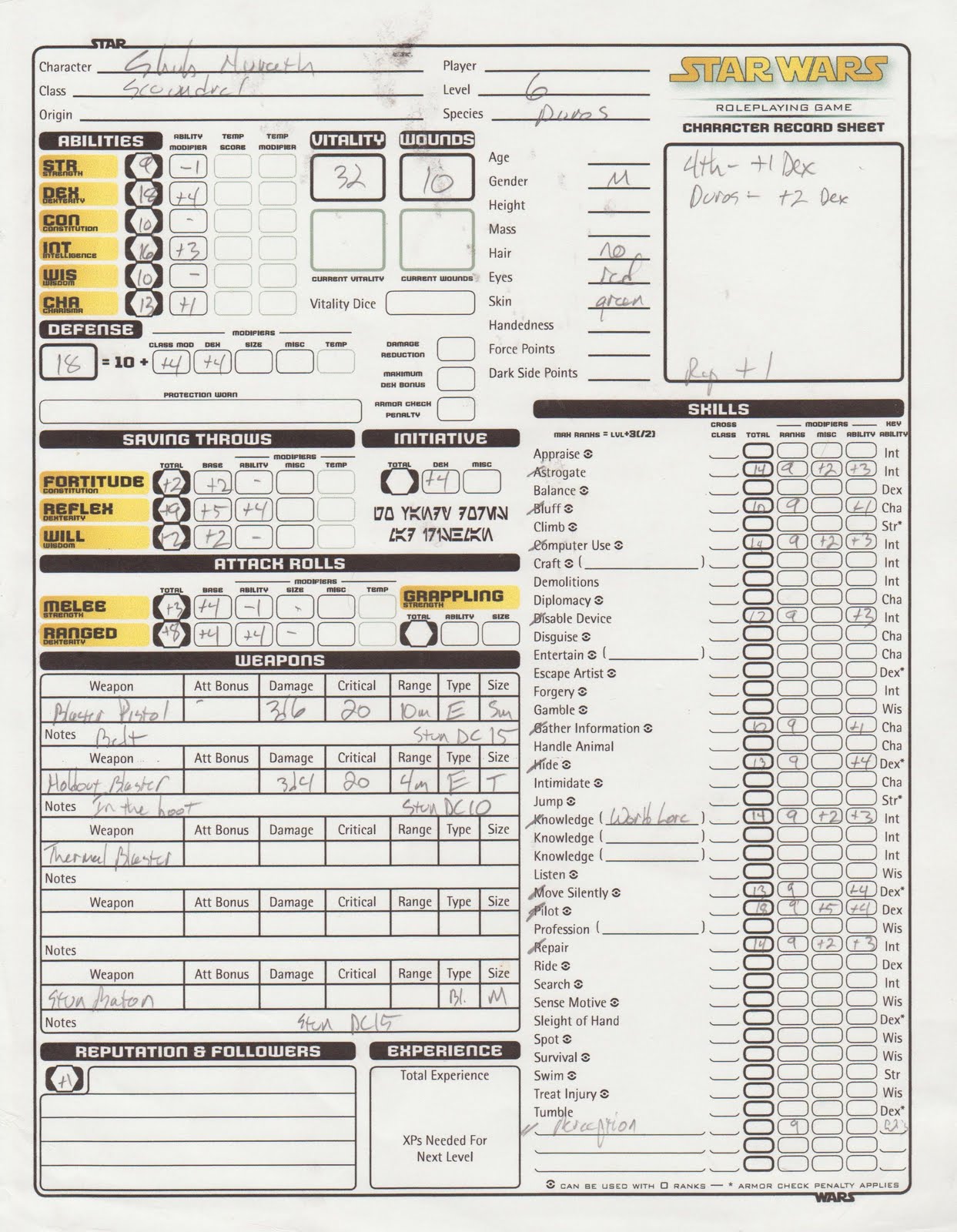
The only other Star Wars character I have played to any degree is Shub Nurath, below.
He's a Duros Scoundrel, mainly a pilot and fixer of things.
He's a decent shot and an experienced traveller of the galaxy. I played him as the "ready for anything" guy - 3 blasters on his person plus a grenade, plus a pistol and a grenade hidden in the party's astromech droid, plus tool kits in his pockets, plus any little gadget he could find a use for and a place to keep it. The goal was to never run out of options, and he was pretty good at it. I played him as a very happy person, always interested in something wherever he happened to be. This campaign didn't last long either, but it was fun for a time.
I haven't played a character in Saga edition yet. I've run it, but not played it. If I get a chance to play any edition in the near future then Tigh Quando will be resuming his career in short order, with Shub a close second choice. Jeet made a reappearance in my Saga Campaign as a Jedi master for one of my players' padawan Jedi characters. The cycle turns, and the old ideas just keep being reborn for some reason.
Origin of the name "Jeet Kundo" - take a look here. The rest should become clear after that.
I played some scattered games of d6 Star Wars over the years but I didn't really get into a sustained campaign until the d20 era. I was designing a long adventure for a campaign - described here - and I had a Jedi NPC that was going to be revealed as a darksider at the climax of the adventure. Now this character was the former padawan of a player character and he would be discovered on a planet appearing to be a normal Jedi refugee, so his name was going to be coming up a lot. I was stumped for one that sounded Star Warsy enough to fit well but didn't sound completely dumb. As I pondered it over a weekend I eventually arrived at Jeet Kundo as the name, which seemed to fit on several levels.
Now some of you have already gotten the joke here (link at the bottom for those of you who don't get it), but none of my players did and somehow the name does seem to fit the universe and a Jedi character, so it stayed. I proceeded to stat him up and this is what I ended up with:
The red is from his final combat against his old master at the climax of the mission. NPC's don't always get sheet protectors...
(Yes, he was an NPC but he was built as a PC so my rule for April still stands, sort of. Besides this was an easy way to work in some Star Wars characters. )
One tendency I have is that once I have a concept for a character I like to keep using it to create variations on the theme within a particular game or genre. Taking the same system for Star Wars names I soon created Tigh Quando, smuggler captain. This was a human smuggler who was mechanically adept and a fairly decent martial artist and so was not helpless when blasters were unavailable. Visually I saw him as looking something like John Milner from American Graffiti . Here's a very small picture of him along with the car from the movie:
My original idea was that he travelled with a yuzzem companion named Falfa (another American Graffiti nod) who was useful for lifting heavy things and for getting him out of fights when he got carried away. He also had a technical droid named Greaser. There was more background for them and their ship (painted with bright yellow stripes of course) but as you might guess if you've been reading the blog this month, this was a character for (let's all say it together) yet another campaign that never launched. Annoyingly I've only been in one game since then as a player and it was set in the prequel era so I never have gotten to play Tigh in an actual game. I also don't have his sheet anymore so I'll be starting from scratch mechanically.
The last character named in this fashion was another started and played once character named Jooj Itsoo, a Rodian scout aiming to become a bounty hunter down the road (as it's a prestige class in d20 RCR Star Wars). This was about the same time as Tigh's campaign was supposed to start playing so I wanted something a little different. I liked the idea of a Rodian's mouth making those "ooo" sounds in his name so I tended to overemphasize them when speaking in character. He was flying about the galaxy learning about different environments and creatures in preparation for his future career. He didn't really develop beyond that but I liked the name.
The only other Star Wars character I have played to any degree is Shub Nurath, below.
He's a decent shot and an experienced traveller of the galaxy. I played him as the "ready for anything" guy - 3 blasters on his person plus a grenade, plus a pistol and a grenade hidden in the party's astromech droid, plus tool kits in his pockets, plus any little gadget he could find a use for and a place to keep it. The goal was to never run out of options, and he was pretty good at it. I played him as a very happy person, always interested in something wherever he happened to be. This campaign didn't last long either, but it was fun for a time.
I haven't played a character in Saga edition yet. I've run it, but not played it. If I get a chance to play any edition in the near future then Tigh Quando will be resuming his career in short order, with Shub a close second choice. Jeet made a reappearance in my Saga Campaign as a Jedi master for one of my players' padawan Jedi characters. The cycle turns, and the old ideas just keep being reborn for some reason.
Origin of the name "Jeet Kundo" - take a look here. The rest should become clear after that.
Saturday, April 9, 2011
I is for: Ironhead
Iron Man is my favorite Marvel hero. As a kid I liked the usual Batman, Superman, etc., but once I discovered Iron Man he quickly shot to the top. I think part of it is that like Bruce Wayne he's a wealthy playboy type but unlike him he likes it! He's not a tortured soul warped by a childhood event - he enjoys being a superhero! I think that one change makes a big difference and I was happy when the movie captured this pretty well instead of trying to make him a dark avenger. I was also happy that they used the main story from Iron Man 200, one of my favorites. I do like the do-it-yourself superhero concept, and I like to play around with it when I make super-characters. One example of this is below.
The typical power armor guy is either a millionaire that builds his own, has someone build it for him, or is a guy who works for some government agency that provides the suit. What if none of those were true? What if there was a guy who wasn't a millionaire but was just a regular guy who slowly pieced together his own suit of hero-armor? He would probably be smarter than the average guy, at least when it came to electrical and mechanical stuff and have some creative sparks as well. Sounds like some of the guys who work on cars, especially custom show cars. So what would happen if a talented gearhead decided to take a stand for justice? Well you might get something like you see in the below picture:
That's "Detroit Fury" from the Paul the Samurai branch of the Tick comic family. I'd link to a site about him, but he seems to be internet-swamped by the arena league football team of the same name that played a whole 4 seasons -ah well.
Discussing car-based supers I feel like I should mention The Turtle from Wild Cards here too. Not exactly powered armor and not exactly a car guy but he was a regular guy in most ways and one of my favorite things about that series so I'm dropping him in here.
But what if the suit was not an actual car, but was just built by a guy who liked to work on cars? You might get something like this:
This is American Ironhead. He's an armored flying hero who can project electrical energy and who has all kinds of interesting gadgets at his disposal. He's not a billionaire playboy so his suit is not as sleek or graceful or high-tech as it could be, but it gets the job done.
The background concept is that Chip Barris runs a domestic car-repair and customization business in a not-so-great part of town. He finally got tired of the criminal element in the neighborhood and decided to do something about it. Not being trained in the martial arts, lacking any convenient mutant powers, finding no radiation to expose himself to, and as it tuns out also not the son of an ancient god, he turned to the one thing he did know - how to bend metal. Thinking of it as the ultimate customization project, he finished the Mark I and went into action against the local gangs.
Finding some success he continued his one-man war on crime and continued to refine and develop his armor as well. His identity remains a secret to all but his assistant manager Jose, who helps him work on the armor and covers for him when he has to head out during the hours the shop is open. Chip went with the all-American themed paint job because he prefers American cars to imports and this carried over into his superhero persona.
Chip has refined the armor into the Mark II with faster flight and a new targeting system and better sensors. There are definite limits to what he can accomplish considering his armor is being built and maintained in a garage by himself and one other person and uses a lot of car parts, but never underestimate the ingenuity of the American gearhead when it comes to solving a problem!
![]() |
| Oh NO! Ironhead is trapped in a cage of electricity! Will he survive? |
American Ironhead (Mark II) for ICONS:
Prowess: 4 (Good) While not a martial artist he has been in enough scraps at this point to hold his own against regular guys
Coordination: 5 (Excellent) He has pretty good dexterity
Strength: 6 (Remarkable) He tries to stay in shape and the suit helps out here as well, boosting his strength just a bit
Intellect: 6 (Remarkable) He's a smart guy and especially good with devices
Awareness: 4 (Good) He pays attention to what's going on around him
Willpower: 5 (Excellent) He's a pretty strong-willed guy but he doesn't have any special training or protection
Stamina: 11
Determination: 2
Origin: Gimmick (+2 to one mental stat - Intellect)
Specialties: Mechanics (Expert) +2, Electronics, Shock Punch
Powers:
Blast - 7 (Incredible) - Electrical Blast/Strike 7 - Shock Punch
Super-Senses - 5 (Excellent) - Radar, Infra-Red, Enhanced Vision +1, Enhanced Hearing +1, Extended Vision 1
Invulnerability - 5 (Excellent) - Armor Suit
Flight - 7 (Incredible) - Rocket Boots
Qualities:
"One of the guys" - Ironhead thinks of himself as a regular guy, not a super hero or someone with a special destiny. He listens to what regular people have to say, doesn't assume that he knows best just because he has a suit, tries to obey the law as much as anyone, watches TV and goes to work just like everyone else. The super-thing just stated as a kind of hobby, and even though it's grown beyond that it's how he still thinks of it.
Challenges:
"Non-Sponsored" - The Ironhead suit is built from steel and car parts and consumer electronics for the most part. Specific functions of the suit can and do break down at times and fixing damage sustained in a fight can take days. It's not made form some exotic self-repairing material either so the suit does show scars even after it has been repaired.
"Working Man" - Chip runs a shop that's open 5 days a week. he has clients and vendors to meet, payroll to make, and bodywork to do. This cuts into his time and availability to go adventuring. He also keeps his identity a secret.
Notes:
AI comes in at 58 points, still a little higher than recommended but not over the top. He has fairly broad abilities but since his strongest powers are 7's, he's going to face some challenges if he runs into seriously high-powered opponents. In Champions terms I would give him a multipower for various electrical attacks including a stun and an entangle and probably a small gadget pool for things he can whip up in the shop. For ICONS a lot of that is going to have to be stunts. Down the road he could add some life support (finally got some decent seals) and some additional area attacks or stuns as well. For some fun I could see a support van and maybe some kind of pit crew to help get him back into a fight faster if he gets hurt or damaged in some way. Just keep in mind that the idea here is that even though it's a power-suit he's not super-strong and not really super-tough - he's on the lower end of the power scale.
![]() |
| He's here for when these don't work |
Anyway that's American Ironhead. Too many street-level heroes boil down to martial-arts guy or guy with guns, and I wanted something different. Over time I could see him becoming powerful enough to move beyond street-level adventures but I see him as always being connected to the neighborhood and his business, making him more grounded in the "real world" than many supers are even when they start out.
Labels:
April 2011 A to Z Challenge,
City of Heroes,
Icons,
Supers
Friday, April 8, 2011
H is for Howling Griffons
In the early days of Warhammer 40,000 people made stuff up. This is a lot harder to do now in the game as so much has already been created that people tend to paint up armies and characters that have been defined by the writers at Games Workshop. I don't mind finding inspiration in other people's work or ideas but I don't like the slavish copying of characters and lore over and over and over again. So my armies in the Warhammer games tend to originate around the fringes of the background and stem from the early days of the game. This is particularly true of my Space Marines, who are painted in the colors of the Howling Griffons chapter. When I got into the game this is all of the material there was on the Howling Griffons:
That's it - no lore, no famous names, no homeworld descriptions or special powers or psychotic tendencies or any of that other stuff that comes in the modern codexes for special marine chapters like the Space Wolves or the Blood Angels - just a really cool paint job and a cool name.
Now early on my marines were fielded with whatever models I had available. Back then they came in a box of 30 plastic troopers for a decent price and could be supplemented by metal characters and specialist types and some tanks and APC's and light vehicles and special weapons. Those basic troopers are still the core of my force, almost 25 years later.
I added leader types very quickly
Next up were some Dreadnoughts, basically walking tanks crewed by badly wounded marines who are placed inside pretty much permanently. One of them was subsequently modified during a later version of the game to include a bigger gun, which is a custom-crafted thing that I'm still pretty happy with.
Marines have access to super-heavy suits of power armor known as terminator armor. The usefulness of them fluctuates with each new version of the rules but I loved them early on and have used them ever since.
The landspeeder is a light scouting/gunship type vehicle. This is one of the original types - the newer ones look much much sleeker and higher tech but I like my ancient artifact.
Later versions of the game added a variety of tanks for the marines and these are two of the nastiest. When people fear the big nasty gun on one of your tanks it's best to take two of them - it's the only way to be sure.
For some time this was just a random collection of similarly painted troops and stuff. What really brings a force together and starts to generate stories is when you decide on a theme for an army. Once that happens then characters start to emerge and make regular appearances and after a series of battles Force Commander Vorzan finally gets to face off against the Ork Warlord Thrashmangala, Scourge of the Seven Worlds, and either dies gloriously or brings down the beast with the crushing grip of his power fist. Of course he also might die rather ingloriously in one round without inflicting a single hit but that generates some stories too. Playing with a regular opponent or group of opponents and using some persistent characters, the battles soon become a mini-campaign of their own and start to sound much like an RPG campaign with stories of character confrontations, screwy die rolls, unusual abilities, and interesting gear. In fact it's akin to my favorite kind of RPG stories, the ones that arise and develop in play rather than being handed down from on high by the DM - there is no DM, so that cannot happen. It all comes about from players interacting, winning,losing, characters dying or being incredibly lucky or unlucky and it can make for a ton of fun even in between games.
Early on I decided that my marine force was based on a strike cruiser, a type of ship the space marines use for patrolling and rapid response. They aren't battleships but they are the ones out on the frontier watching for and responding to trouble. This gave me an excuse to fight any and all opponents and keep a coherent narrative for myself as they could all be encountered while patrolling a frontier, from Space Orks to rival marine chapters. Later the game added rules for Drop Pods which can let marines deploy directly onto a battlefield without marching overland from a shuttle landing first, which is very cool.
I should say that I actually have two different marine forces. This came about because frankly Howling Griffons are a lot of work to paint. That quartered color scheme tales a lot of extra work to keep clean on a miniature and it's all got to be done by hand one at a time. It was taking me forever to do and I wanted another marine force I could paint in a hurry (the traditional way to basecoat grunt marines in mono-colored power armor is to spray them, do the guns, the eyes, and maybe one other spot, and they're done) so I started working up another force as well. Now it became even more important to differentiate them from each other and so Captain Tiberius Kirk was born.
Marine Captain Tiberius commands the strike cruiser "Inceptum" which is on a 5-year patrol of the spinward frontier of their domain. He is assisted by his able command crew of Senior Librarian Sproch, Chief Techmarine Scottus, Senior Chaplain MacKoy, and his squad leaders Sullus, Chekorov, and Uhrus.
If trouble is discovered on a planet the typical response is that the terminator squad led by Tiberius teleports down while the jump squad deploys nearby and the rest of the troops including the dreadnoughts Captain Pike and Captain Garth make an orbital insertion via drop pod.
So yes I've ripped off one well-known sci-fi universe to use in another sci-fi universe but it's a lot of fun even if the other person doesn't get it. It gives me a good strong theme to use when planning my games and when adding to the force. As a ship-based mobile reaction force that deploys mainly by teleporter and drop pod it also contrasts nicely with my other marine force, which is an armored column of tanks and APC's, basically an all-vehicular force. Each has it's own personality and they play very differently from each other.
I haven't posted a lot about miniatures games on the blog mainly because I've been playing them less over the past year or so, but there are a lot of similarities to RPG's. This includes everything from creating characters and recounting stories to the relentless march of new editions and new books full of supplementary material. It's familiar territory to say the least.
Characters: Like Icons 40K rates things on a 1-10 scale but there tends to be more concentration at the low end than in Icons mainly due to the nature of the game, so this isn't necessarily good for a straight up conversion en masse, but what if a single space marine was sucked into the warp and deposited on earth:
An Imperial Space Marine for ICONS
Prowess: 6 (Remarkable) Marines are genetically enhanced, trained from recruitment, and do nothing but fight and meditate their whole lives. Leaders would be higher.
Coordination: 6 (Remarkable) Maximum human capability
Strength: 6 (Remarkable) Maximum human capability
Intellect: 4 (Good) They're smart but tend to react more from training and experience, plus their education on anything but war is limited
Awareness: 6 (Remarkable) Maximum human capability + years to decades of experience
Willpower: 7 (Incredible) Genetic enhancement + training + indoctrination + psycho conditioning means they are very difficult to control or corrupt. It's not impossible (see Traitor or Chaos Marines and the Horus Heresy) but it's difficult
Stamina: 13
Determination: 3
Origin: Transformed (+2 to one stat)
Specialties: Weapons (Guns), Weapons (Blades), Military
Powers:
Blast - 6 (Remarkable) - Bolt Gun - shoots physical ammunition
Life Support - 4 (Good) - Power Armor - No breathing, no pathogens, no toxins, immune to vacuum
Invulnerability - 6 (Remarkable) - Power Armor
Qualities:
"For the Emperor" - Space Marines are fanatically devoted to serving their emperor. Separated from the Imperium by time, a marine would attempt to get back and would also look for threats to the future emperor that he could deal with now.
Challenges:
"Space Marine" - Marines are typically called in as the next to last resort as they see all problems as military problems and are not concerned with collateral damage or casualties. They are a relatively fine instrument in the 41st millennium somewhat akin to 2nd millennium special forces, but they are not dissuaded from direct action by things like hostages.
Notes:
This example of a marine comes in at 54 points, not terribly overpowered compared to a random roll character. There are specialist marines that might have specialties in Electronics or Mechanics and leaders would have a higher level of Military and combat training. One time-lost marine could be fun in a superhero campaign but they might better serve as a plot hook if you have some players who are interested in the 40K universe. Perhaps some Supervillain has opened a gateway to M41 and is attempting to bring through some Tyranids for nefarious purposes. The marine will recognize these and can warn the heroes of the threat they represent. This could lead to an awesome fight against swarming hordes of bio-engineered alien monstrosities with an effort to close down the gateway before a bio-titan steps through, taking the threat to a whole new level.
Wrapping up, Space Marines are super-powered humans from the future in hi-tech power armor, making them a natural fit for a supers game, a fun diversion for a D&D game, and an interesting addition to a horror game. They might also be fun in a light or comedy game as ultimate straight men.
Final wild idea: Federation scientists, searching for a solution to the Borg problem, open a portal to somewhere else. This somewhere else happens to be the 40K universe.
Referee: Borg, tyranids, tyranids, borg. I want a good clean fight.
Also: Chaos possessed borg cubes. Discuss!
Anyway, that's enough about marines and 40K for now. Next up, a double character weekend!
Subscribe to:
Posts (Atom)